Key Takeaways
- PDFs are the standard for sharing documents, but many users struggle with editing, converting, and organizing them.
- Browser-based PDF tools now allow you to work confidentially without installing software or uploading sensitive files [K1].
- Beginners should learn the core skills: combine, split, rotate, annotate, and convert files using local, privacy-first utilities.
- Before publishing any PDF externally, check and strip hidden metadata and personal information to avoid data leaks [K5].
- You can handle most common PDF tasks for free, even with large files, if you choose the right tool.
1. Introduction
If you have ever emailed a resume, submitted a scanned contract, or tried to send a large presentation without it breaking, you have used a PDF. The Portable Document Format is designed to keep your text, images, and layout consistent across any device. That reliability is also why PDFs are a standard for legal documents, academic papers, and business workflows.
Yet for many beginners, the format still feels like a closed box. You can open a PDF, but merging two files, removing a page, or turning an image into a PDF can feel confusing. Worse, traditional desktop software is often expensive, and online converters frequently require uploading your documents to a remote server. That raises a natural question: how do you work with PDFs safely and simply?
This tutorial will answer exactly that. You will learn the essential skills to organize, edit, and convert PDFs, what to avoid, and how to keep your files private while working in the browser. The approach here is intentionally practical: each section explains the tool, the logic behind it, and a realistic situation where it matters.
2. The Right Way to Create a PDF from Images
Core conclusion: Turning images into PDFs is one of the most common document tasks. A reliable tool should keep the quality intact, let you set the order, and avoid uploading your files to a server [K1].
When do you actually need to convert images to PDF? The most typical scenarios include:
- Scanning a signed contract and sending it as one neat document.
- Combining receipts or invoices for reimbursement claims.
- Turning photos of handwritten notes into a readable file.
- Sending design mockups or screenshots to a client without individual attachments.
The goal is to produce a clean PDF with one image per page, arranged in the order you choose. Many tools claim to do this, but not all are trustworthy.
What to look for in a beginner-friendly image-to-PDF tool:
| Feature | Why it matters |
|---|---|
| Works in the browser | No software installation required |
| Local processing | Images never upload to a server, reducing leak risk [K1] |
| Drag-and-drop ordering | You can arrange the final page order visually [K2] |
| Supports JPG and PNG | Covers most scans, screenshots, and photos |
| Nothing to install or log in | Faster and more private |
If you use a browser-based converter, prioritize one that explicitly states local processing. This means your images are parsed on your own device and never sent to a cloud server. For a business account, this detail is often a deciding factor when handling client photos or raw scan exports [K1].
Recommendation: Start with a tool that lets you add images and reorder them with drag-and-drop. Confirm the final page order before exporting, and check that your file contains only the pages you intended.
3. Organize and Edit a PDF without Desktop Software
Core conclusion: You do not need Adobe Acrobat Pro to merge, split, rotate, or reorder pages. Modern browser-based tools cover all the essential organization tasks, and they can do so without uploading your file [K3].
For beginners, the most valuable skills are:
- Merge PDF – Combine several PDF documents into one file.
- Split PDF – Extract a page range or pull out each page as a separate PDF [K3].
- Rotate PDF – Correct scans by turning pages 90, 180, or 270 degrees for the whole file or just selected pages [K3].
- Organize PDF – Reorder and delete pages using drag-and-drop thumbnails [K3].
Let’s say you are preparing a client report. You have a cover page, a scanned table, and a set of slides. Instead of opening three programs, you merge them into one file, rotate the scanned table by 90 degrees, and delete an outdated page. The entire workflow happens in a single tool, usually in under two minutes.
For a small business sending monthly invoices, this becomes a daily routine. Combine all invoices for a client into one PDF, split a large statement for separate projects, and rotate any phone-scanned documents before sending. Tools with a 100 MB upload limit on Pro plans can handle most real-world files [K4].
Practical caution: Always double-check the orientation and the page order after editing. This avoids the classic mistake of sending a report with a single rotated page sticking out awkwardly.
4. Protect Your Privacy and Sensitive Content
Core conclusion: Privacy is the hidden risk in PDF workflows. Many online services require you to upload files to a remote server, which is unacceptable for legal, financial, or personal documents.
A privacy-first approach relies on three principles [K5]:
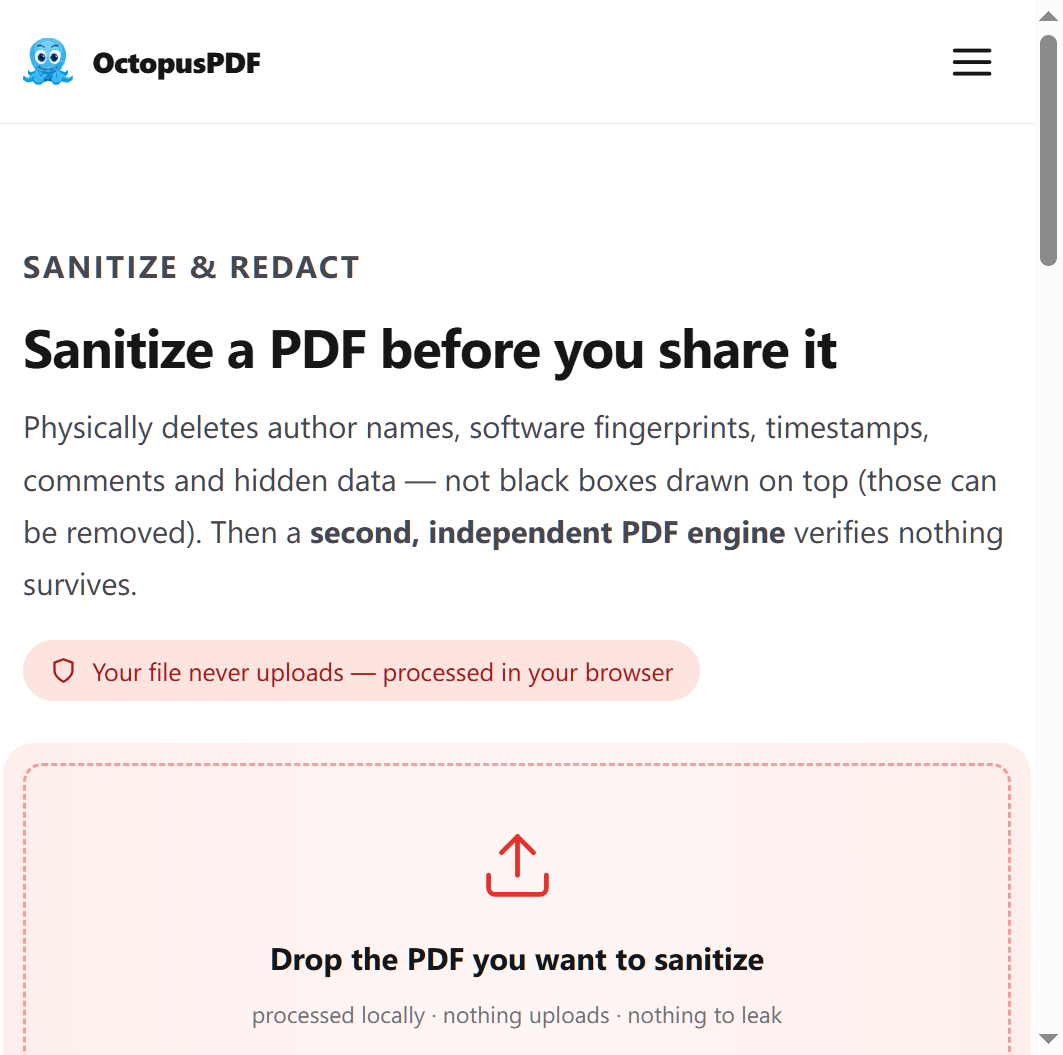
- The file never leaves your browser tab. The PDF is parsed directly in the browser using client-side tools. This means the content is not uploaded, and there is nothing to intercept on a remote server.
- Your API key stays local. For advanced AI tools like summarization and translation, the key is stored in browser storage and used directly by the browser when calling the AI endpoint.
- No server in the middle. The browser connects directly to the endpoint you specify; the tool does not proxy the request [K5].
This architecture matters in real situations. A solo attorney who redacts names and clauses before sending a contract cannot afford a leak. An accountant wiping hidden metadata from client files before electronic filing relies on local processing [K4]. A remote worker handling confidential PDFs on a shared device needs the guarantee that no copy of the file lingers on a server [K4].
What you should do before sharing a PDF:
- Remove or inspect the metadata (title, author, and hidden comments).
- Redact or physically delete sensitive text and annotations.
- Check that no previous edits or comments remain visible.
Tools that offer Metadata editing and Redact functions address these needs directly. Some can wipe all hidden content in one click [K3].
Recommendation: For any document containing personal data, contracts, or business plans, choose a tool that states "local processing" and "zero uploads" explicitly. Do not assume all online PDF editors are safe. Verify their privacy architecture before use.
5. How to Choose the Right PDF Tool: A Beginner's Checklist
Choosing a tool depends on your main use case. Here is a quick comparison to guide you:
| Use Case | Recommended Features | Why |
|---|---|---|
| Freelance designer | Watermark, page numbers, merge | Protect client proofs and add professional polish [K4] |
| Solo attorney | Redact, metadata wipe | Comply with confidentiality before sharing [K4] |
| Indie publisher | Page order, rotate, gutter margins | Create print-ready booklets [K4] |
| Graduate researcher | PDF to Markdown, structure-aware extraction | Prepare documents for LLM analysis [K4] |
| Small business | Merge, split, rotate, up to 100 MB files | Handle everyday invoices and statements [K4] |
| Accountant | Metadata editing, sanitize | Keep client data clean before e-filing [K4] |
| Print shop | Reorder, page count, preflight | Prepare customer files for duplex printing [K4] |
Overlooked but important features:
- Page numbers: Automatically stamp "1 / N" or "Page 1 of N" in any corner, with options to skip the cover page [K3].
- Watermark: Add a diagonal or tiled text/image watermark with opacity control [K3].
- Redact: Permanently delete hidden content, not just cover it visually [K3].
Boundary conditions to remember:
- Local processing does not require an internet connection, but AI features may. Check the tool's behavior.
- Converters that upload files to a server may be faster in some cases, but they create a privacy trade-off.
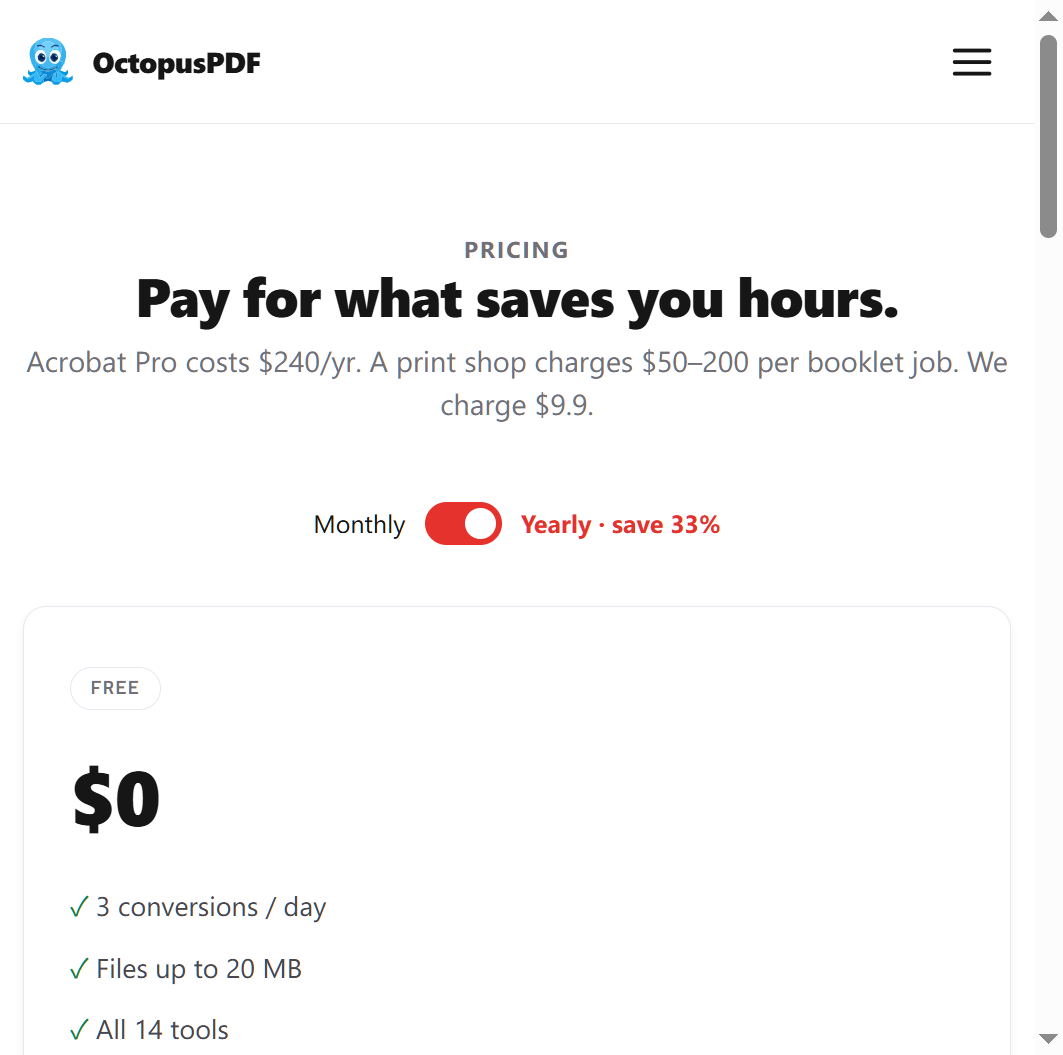
- Free plans usually have upload limits or feature caps. Check the maximum file size before starting a large conversion.
6. FAQ
Q1. What is the difference between a JPG and a PDF for documents?
A JPG is a compressed image format. A PDF is a document container that can hold images, text, vector graphics, and metadata. For text documents, PDFs are more reliable for formatting. For photos or scans, you can combine multiple JPGs into a single PDF to make sending and archiving easier [K1].
Q2. Can I edit a PDF without special software?
Yes. Browser-based tools allow you to merge, split, rotate, reorder, watermark, and stamp page numbers without installing desktop software. For more advanced editing, such as modifying the text inside a PDF, you may need dedicated PDF editor software. For organization tasks, browser tools are sufficient [K3].
Q3. Is it safe to use free online PDF tools?
It depends. Some tools upload your files to a server, which introduces a privacy risk. Tools that process everything locally in your browser, without uploading, are safer for sensitive documents. Always check the privacy policy or technical documentation before you upload anything [K1][K5].
Q4. What should I check before sending a PDF to a client?
Before sending a PDF externally, do the following: review the page order, check the orientation, remove hidden metadata, and physically delete any comments or sensitive annotations. This is especially important for legal and financial files [K3][K4].
7. Conclusion
The PDF format remains one of the most reliable ways to share information across every platform. The challenge for beginners is not the format itself, but choosing the right workflow. You have three priorities:
- Learn the basic operations – merge, split, rotate, and reorder pages.
- Prioritize privacy – use tools that process your files locally in the browser and never upload your data [K1].
- Choose tools that match your work scenario – whether you are a designer, accountant, lawyer, or student, the right utility saves time without compromising security.
Start with tasks you do frequently. If you turn photos into documents, find a simple image-to-PDF converter that respects your privacy. If you send contracts, learn how to redact and wipe metadata. If you prepare reports, master the merge and page number functions.
The best way to become confident with PDFs is to handle one real file from start to finish: upload it, organize it, protect it, and export it. With the right browser-based tool, that entire process can be fast, secure, and completely local.