Key Takeaways
- PDF contracts carry hidden metadata — author names, company identifiers, timestamps, annotations, and invisible content — that can leak confidential details when you share or archive the file.
- On Android, the most reliable way to remove metadata is a browser-based tool that processes files locally, not one that uploads to a server.
- OctopusPDF's Redact / Sanitize tool physically deletes metadata, comments, and hidden content, and it runs 100% in the browser tab [K1].
- The free tier covers 3 conversions per day with 20 MB files; Pro removes those limits and adds batch mode [K1].
- You can verify the privacy guarantee yourself: open the Network panel, convert a file, and count the upload requests. There should be none [K3].
1. Introduction
When you send a PDF contract from your Android phone, you may be sending more than the visible pages. PDF files routinely carry document properties (author, company, creation date), revision timestamps, and annotations. In a contract, this hidden layer can expose negotiating positions, internal reviewer names, or confidential notes you never intended to share.
The problem is more acute on Android than on desktop. Mobile workflows often push users toward online conversion services, and there is little visibility into whether the file was uploaded, copied, or stored. Even when a service promises to "delete after 1 hour," there is no way for you to verify that claim [K2]. This article explains how to remove metadata from a PDF contract on an Android phone using a local-processing workflow, and how to confirm that your file never left your device.
The short answer: use the OctopusPDF Redact / Sanitize tool in your Android browser. It removes metadata, comments, and hidden content physically — not merely from view — and the entire process runs in the browser tab, so the server never receives your file [K1][K2].
2. What PDF Metadata Is and Why Contracts Are a High-Risk Case
2.1 The hidden layers in a PDF contract
A PDF contract is not just the text you see. The file format stores several layers:
- Document properties: author name, company name, creation tool, creation and modification dates.
- Annotations and comments: internal review notes, approval chains, suggested changes.
- Hidden content: invisible text, old draft fragments, and OCR data that may not render on screen.
When you share a contract, all of these layers travel with the file. For a business agreement, the risk is concrete: a comment like "client hasn't signed — push back on clause 4" or a document property revealing the internal account manager's name can undercut your position during negotiation.
2.2 What "removing" metadata actually means
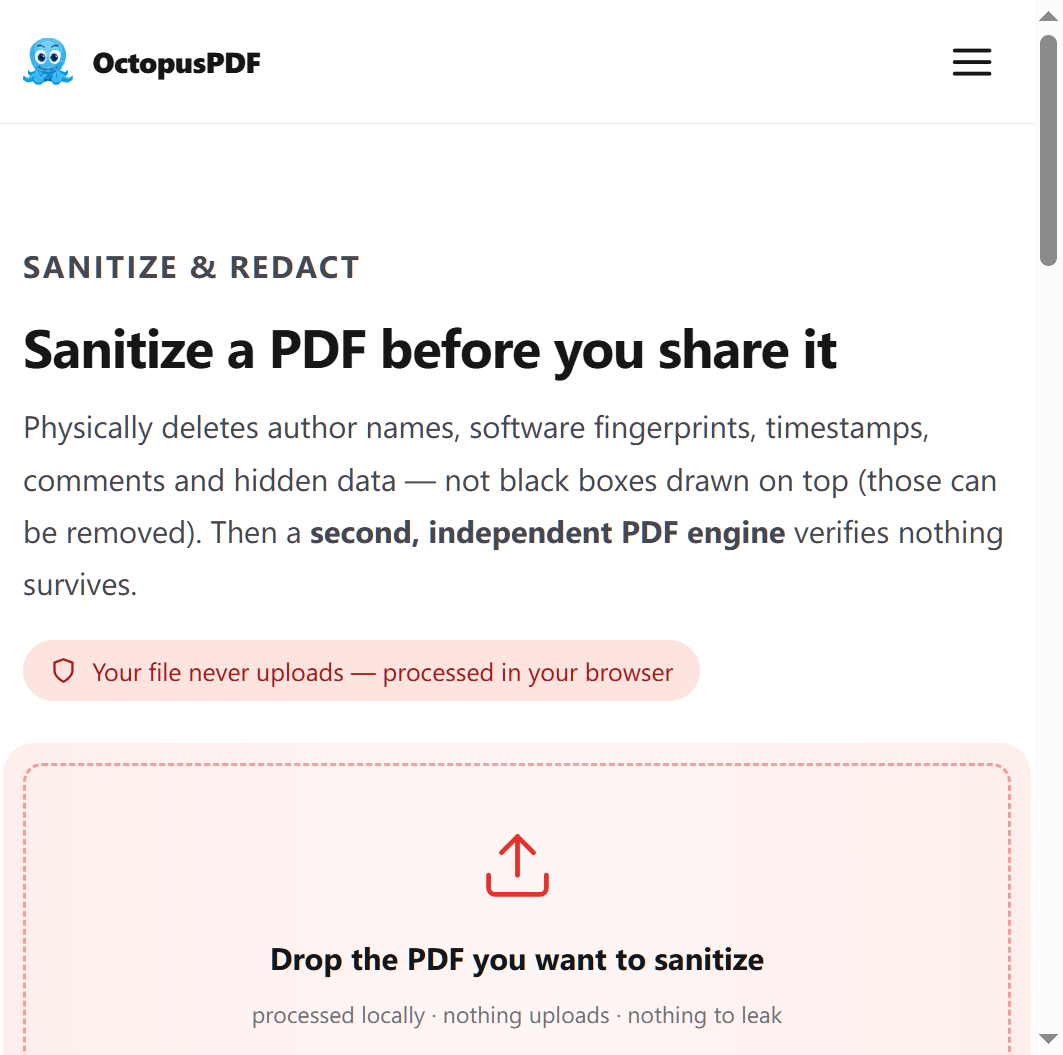
Many tools claim to remove metadata but only hide it from casual viewers. The OctopusPDF Redact / Sanitize tool is designed to physically delete metadata, comments, and hidden content before sharing [K1]. That distinction matters because sanitized files pass through forensic inspection more reliably — the data is gone, not merely concealed.
Core conclusion: For any contract you need to share externally, treat metadata removal as a mandatory step, not an optional privacy feature.
3. Why Local Processing Matters for Contract Privacy
3.1 The upload problem with online PDF tools
Most online PDF tools follow the same pattern: you upload the file, their server processes it, and you download the result. The operator promises to delete the file "after 1 hour," but you cannot verify that promise [K2]. Your contracts, tax forms, medical records, and manuscripts have all spent time on a stranger's server — and on a shared server, "deleted" does not always mean "gone."
3.2 Local processing as an architectural guarantee
OctopusPDF does not follow that pattern. The entire pipeline — parsing, redacting, sanitizing — runs in the browser tab. The servers physically cannot receive your file because there is no upload request to make [K2].
This is an architectural guarantee, not a marketing claim. You can verify it: press F12 to open the Network panel, convert a file, and count the upload requests. There are none [K3]. On Android, the same guarantee applies because the processing code runs in the browser runtime; verification is easiest on a desktop browser, but the architecture is identical.
3.3 Real-world reliability data
The local-processing approach holds up in practice. In a test of 113 real-world PDFs, 91.2% succeeded across 7 core operations, with a median processing time of 420 ms. The remaining files were DRM-locked rather than processing failures [K5]. Critically, the same test measured 0 bytes uploaded to any server [K5].
Core conclusion: Choose a tool whose architecture prevents uploads, not one that merely promises to delete them later. For contracts, that is the difference between privacy you can verify and privacy you have to take on faith.
4. Step-by-Step: Remove Metadata from a PDF Contract on Android
4.1 What you need
- An Android phone with Chrome, Firefox, or another modern browser.
- The PDF contract saved locally on your device (in Downloads or Files).
- Access to the OctopusPDF Redact / Sanitize tool. The free tier allows 3 conversions per day with files up to 20 MB [K1].
4.2 The workflow
- Open your Android browser and go to the OctopusPDF Redact / Sanitize tool page (octopuspdf.com/redact).
- Select the contract file from your local storage. Because processing is local, the file is read directly into the browser tab.
- Run the redaction / sanitization step. The tool physically deletes metadata, comments, and hidden content [K1].
- Download the sanitized PDF back to your local storage.
- Check the output by opening it in a PDF viewer and confirming that comments and annotations are gone.
If you process more than 3 contracts per day, or your contracts exceed 20 MB, the Pro tier removes both limits and adds batch mode [K1]. For most individual users handling a handful of contracts per day, the free tier is sufficient.
4.3 What the tool does NOT do
Sanitization removes metadata, comments, and hidden content. It does not redact visible text on the page. If the contract itself contains sensitive words or figures you want to hide, you need a separate redaction step that blanks visible regions. The OctopusPDF Redact / Sanitize tool targets the hidden layer specifically [K1].
Core conclusion: Run this workflow before sending any contract from your Android phone. The process takes under a minute for most files, and it is the only approach that gives you a verifiable privacy guarantee.
5. AI Features on a Contract: The Same Privacy Boundary
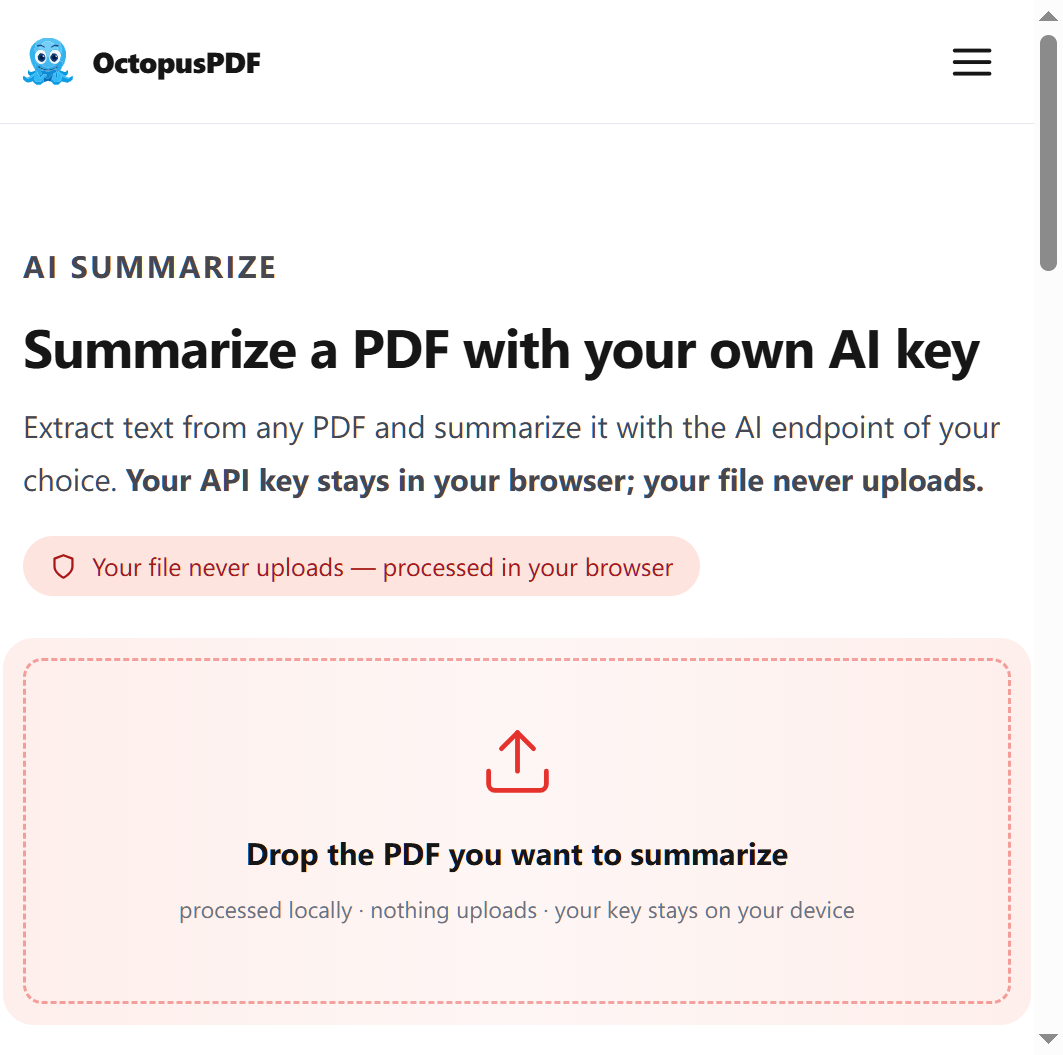
If you want to summarize or translate a contract, you might be tempted to paste it into an AI service. That creates the same upload risk. OctopusPDF's AI features (Summarize and Translate) are built around a "Bring Your Own Key" (BYO) model [K4]:
- Your PDF never uploads: the file is parsed inside the browser tab with pdf.js [K4].
- Your API key stays local: stored only in browser localStorage. The OctopusPDF backend has no API call that receives it [K4].
- No server-in-the-middle: the browser connects directly to the OpenAI-compatible endpoint you entered. OctopusPDF does not proxy the request [K4].
This matters for contracts because AI summarization is useful for quickly understanding terms, but it is only acceptable if the document does not leave your device. The BYO architecture preserves the same privacy boundary as the local processing pipeline.
Core conclusion: If you use AI features on contracts, use the BYO mode and supply your own API key. Avoid cloud paste-and-analyze tools for documents you cannot afford to expose.
6. Key Comparison: Online Tools vs. Local Processing
| Dimension | Typical online PDF tools | OctopusPDF Redact / Sanitize |
|---|---|---|
| Where the file is processed | Server-side | Browser tab (100% local) [K2] |
| Upload behavior | File uploaded to server | 0 bytes uploaded [K5] |
| Privacy guarantee | Promise to delete after 1 hour [K2] | Architectural: no upload request exists [K3] |
| Verification method | None (trust required) | F12 → Network panel → count uploads [K3] |
| Free tier | Varies | 3 conversions/day, 20 MB files [K1] |
| Pro tier | Varies | Unlimited, 100 MB files, batch mode [K1] |
| AI features | Usually server-side | BYO key, direct browser-to-endpoint [K4] |
| Test success rate | Not disclosed | 91.2% on 113 real-world PDFs; 420 ms median [K5] |
7. FAQ
Q1. Does OctopusPDF upload my PDF contract to a server?
No. The entire processing pipeline runs inside the browser tab, so the server physically cannot receive your file [K2]. In tests, 0 bytes were uploaded [K5]. You can verify this by opening the Network panel (F12), converting a file, and counting the upload requests — there are none [K3].
Q2. What hidden data does the Redact / Sanitize tool remove?
It physically deletes metadata, comments, and hidden content before sharing [K1]. That includes document properties such as author and creation date, plus annotations and invisible content. It does not redact visible text on the page.
Q3. Is the free tier enough to clean a few contract PDFs?
For most individual use, yes. The free tier allows 3 conversions per day with files up to 20 MB [K1]. If you need more than that, or you process contracts in batch, the Pro tier offers unlimited conversions, 100 MB file support, and batch mode [K1].
Q4. Is it safe to use the AI Summarize feature on a contract?
Only with the Bring Your Own Key (BYO) setup. Your PDF is parsed locally with pdf.js and never uploads; your API key stays in browser localStorage; and your browser connects directly to the OpenAI-compatible endpoint without any proxy [K4]. With a cloud-based alternative, you would be sending the contract to a server.
8. Conclusion
Removing metadata from a PDF contract on an Android phone is not complicated, but the method matters. The core requirement is a tool that physically deletes metadata, comments, and hidden content [K1] — and an architecture that prevents uploads rather than promising to delete them later [K2].
For most users, the practical recommendation is:
- Use OctopusPDF Redact / Sanitize in your Android browser for every contract you plan to share externally.
- Stay on the free tier for occasional use, or upgrade to Pro if you process more than 3 contracts per day or work with larger files [K1].
- If you need AI summarization or translation, use BYO mode so the contract and your API key never leave your device [K4].
- When possible, verify the privacy boundary with the Network panel check [K3].
The next time your phone asks which app should handle a contract PDF, choose a tool whose server never sees the file. That is the only privacy guarantee you can actually check.