Five Local AI Tools That Make PDF Summarization Cloud-Free
Key Takeaways
- Privacy by design: Local and browser-based PDF summarization tools eliminate the risk of uploading sensitive documents to third-party servers.
- BYO Key model: Tools like OctopusPDF let you use your own OpenAI-compatible API key, meaning the file and the key never leave your device [K1][K3].
- Zero-upload architecture: Modern PDF tools parse files locally with libraries like pdf.js, so no PDF bytes are transmitted to the tool provider [K5].
- Cost and latency benefits: Direct browser-to-AI-endpoint connections reduce server overhead and give users control over their API spending [K5].
- Beyond summarization: The same local processing paradigm is available for translation, conversion, redaction, and organization tasks [K4].
1. Introduction
PDF documents are everywhere—contracts, research papers, financial reports, legal filings, and academic articles. But extracting the key points from a dense 50-page PDF is time-consuming. Cloud-based AI summarizers have been the default answer for years, but they come with a serious trade-off: your document is uploaded to someone else's server. For professionals handling NDAs, patient records, proprietary research, or internal strategy documents, that trade-off is often unacceptable.
The industry shift toward local-first and bring-your-own-key (BYO) AI tools is changing this picture. Instead of sending your file to a central service, these tools process the PDF directly in your browser and connect your own AI key straight to the language model endpoint of your choice. This article reviews five practical approaches to cloud-free PDF summarization, explains how the underlying architecture works, and offers scenario-based recommendations to help you choose the right tool for your workflow. We will also examine the security mechanisms that make local processing trustworthy and the boundary conditions you should understand before relying on them.
2. The BYO Key Model: Ownership Meets Privacy
Core conclusion: The bring-your-own-key model is the most practical way to get AI-powered summarization without sacrificing document control. By using your own API key, you avoid both data leakage and vendor lock-in.
The reasoning is straightforward. Traditional cloud summarizers operate as a middleman: you upload the file, their server reads it, calls an AI model, and returns the summary. This architecture exposes your document to at least one third party, sometimes more. The BYO approach eliminates the middleman entirely. According to OctopusPDF's documentation, when you use their Summarize PDF tool, the file never uploads, the key never uploads, and there is no server-in-the-middle [K1]. The process is fully contained in your browser [K3].
How does this actually work? The workflow is simple and transparent [K5]:
- Drop the PDF into your browser tab.
- Local parsing: The file is processed locally with pdf.js—no PDF bytes are uploaded to the tool provider.
- Enter your API key: The key is stored only in browser localStorage.
- Direct connection: Your browser connects directly to the AI endpoint you choose, with no proxying by the tool developer.
For practical use, this model means you control which AI provider handles your content. If you prefer OpenAI, Anthropic, or a local model endpoint compatible with the OpenAI API standard, you can point the tool there. This flexibility is particularly valuable for organizations that have compliance requirements around data residency.
Recommendation: If you routinely handle sensitive PDFs, adopt the BYO Key approach. It gives you the summarization capability of a cloud AI without the privacy compromise.
3. What Makes Local Processing Architecturally Trustworthy?
Core conclusion: The trustworthiness of local PDF summarization is not a marketing claim; it is a function of the architecture. Understanding the data flow helps you evaluate any tool's privacy claims.
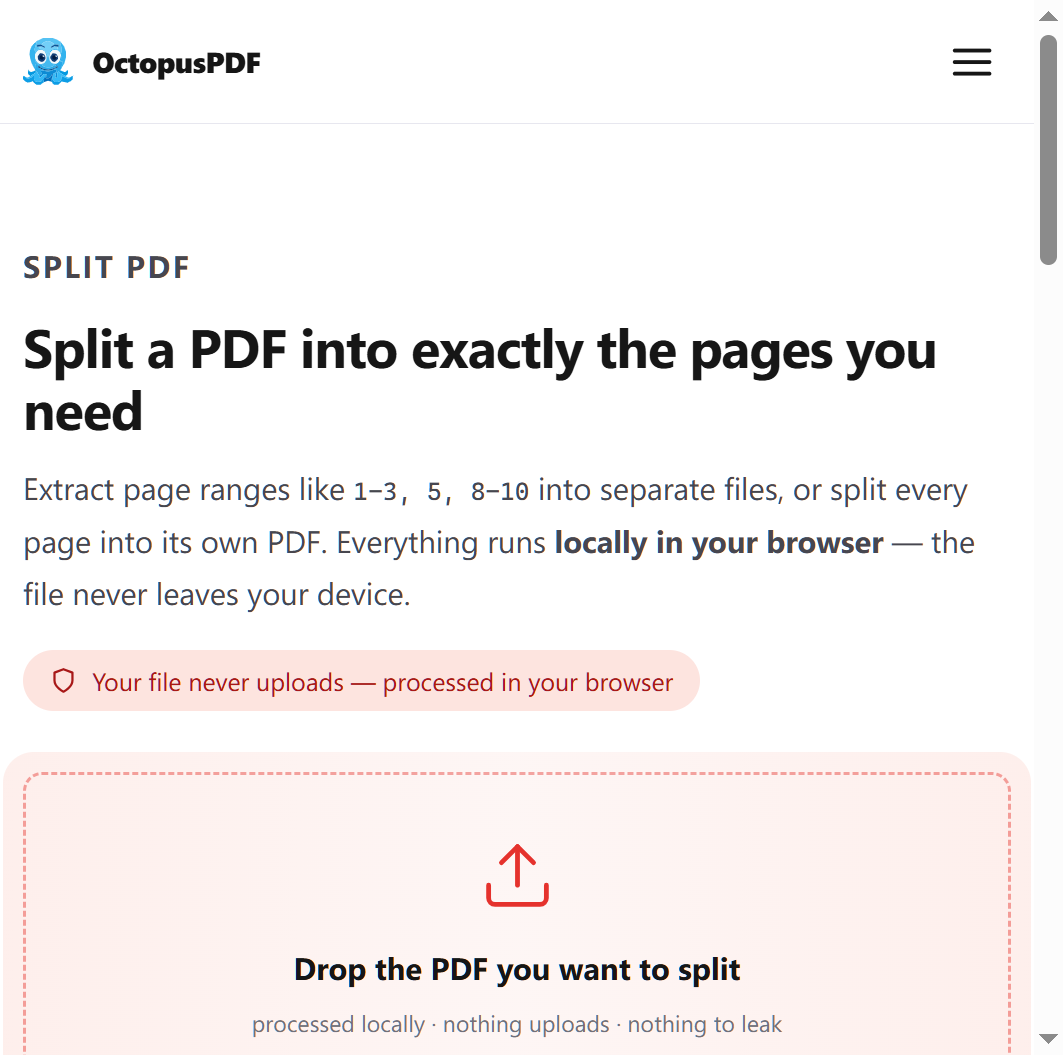
Many products claim to be "private" or "secure," but these words are often ambiguous. The local architecture used by tools like OctopusPDF has three distinct layers that, when combined, create a verifiable privacy boundary.
First, the parsing layer. The PDF is read and transcribed into text entirely within your browser using pdf.js, an open-source JavaScript library. This means the tool provider never receives the file bytes in the first place [K5]. If data never leaves your device, there is nothing for a malicious actor—or a well-meaning but compromised server—to intercept.
Second, the key management layer. Your API key lives in browser localStorage. It is not transmitted to the tool's backend, so the tool provider cannot harvest credentials or inadvertently leak them in a server breach [K5]. The key is used solely by your browser to authenticate requests to the AI endpoint.
Third, the connection layer. The browser connects directly to the AI model provider. Because the tool developer does not proxy the request, they cannot log the prompts, the responses, or the extracted text [K5]. This is architecturally different from a server-side integration where the tool's backend relays the prompt.
Boundary condition: While these three layers significantly reduce exposure, they do not make the process immune to all risks. The AI model provider you choose will still process the content. If you are working with top-secret material, a truly local model is the only fully private option. For most professional use cases, however, the BYO model offers a practical balance between capability and confidentiality.
4. Practical Workflows: When Local Summarization Shines
Core conclusion: Local PDF summarization is not just a nice-to-have; it is the right choice for several specific, high-stakes scenarios.
Scenario A: Legal and Contract Review
Lawyers and paralegals often receive PDFs containing draft agreements, amendments, or opposing counsel's submission. These documents may be shared under confidentiality obligations. Uploading them to a public cloud summarizer violates both professional ethics and client trust. With a local tool, you can quickly extract the key obligations, deadlines, and risks from a 60-page agreement without any data leaving your workstation.
Scenario B: Academic Literature Review
Researchers reviewing dozens of papers need quick summaries to decide what warrants a full read. The local approach allows them to process PDFs directly from their desktop, using their institutional API key. This setup also helps avoid issues with publisher data policies.
Scenario C: Healthcare and Insurance Documents
Medical records, claim forms, and policy documents contain protected health information (PHI) in many jurisdictions. Regulations like HIPAA and GDPR impose strict controls on data transfer. A browser-based local summarizer, combined with your own key, respects these constraints by minimizing the number of parties that handle the data.
Scenario D: Proprietary Technical Documentation
Engineers summarizing internal technical specs or engineering change orders can use the local workflow without triggering internal approval processes for cloud data transfers. This improves speed while maintaining data governance.
Recommendation: Map your workflow to these scenarios. If your PDFs fall into any of these categories, local summarization is not merely a preference—it is the responsible choice.
5. Key Comparison: Local AI Summarization vs. Traditional Cloud Tools
To help you make an informed decision, the table below compares the core characteristics of local BYO tools against conventional cloud-based summarizers.
| Aspect | Local BYO Summarization | Traditional Cloud Summarizer |
|---|---|---|
| File transfer | None—parsing happens in-browser [K5] | Full upload to remote server |
| API key handling | Stored in browser localStorage [K5] | Stored on provider's server |
| Connection path | Direct browser-to-AI endpoint [K5] | Browser → provider server → AI model |
| Data exposure | Only the chosen AI provider sees content | Provider server and AI model see content |
| Latency | Lower—no server relay | Higher—extra hop in the chain |
| Cost control | User pays only for their own key usage | Service may bundle or mark up tokens |
| Vendor lock-in | Minimal—switch API endpoints freely | Higher—moves with the service |
| Model choice | User controls which AI endpoint [K3] | Limited to provider's configured models |
| Offline capability | Requires internet for AI call, but not for parsing | Requires internet for everything |
This comparison makes the trade-offs visible. If your priority is minimizing data exposure and controlling model choice, local BYO tools win clearly. If you need a no-configuration solution and are less concerned about data flow, traditional cloud tools may be more convenient.
6. FAQ
Q1. Does "local processing" mean I can use it offline?
No. Local processing means the PDF file and your API key do not leave your browser. However, the summarization step requires an active internet connection to reach your AI provider's endpoint [K5]. If your use case demands fully offline operation, you would need to run a local LLM—a different setup than the browser-based BYO model.
Q2. What happens to my API key after I close the browser?
The key is stored in your browser's localStorage [K5]. Clearing your browser storage or cache will delete it. You should be cautious about using BYO tools on a shared computer, as localStorage is not a hardened credential store. Always log out and clear storage on public machines.
Q3. Can I use any AI provider with a BYO tool?
You can use any provider that offers an OpenAI-compatible API endpoint [K3][K5]. This includes many major providers and self-hosted models that expose a compatible interface. The tool does not proxy your request, so the only requirement is that your chosen endpoint accepts the API call format.
Q4. Is the "zero-upload" claim verifiable?
The architecture is verifiable in principle. Because the parsing uses pdf.js in the browser and the AI request is made directly from your browser to the endpoint [K5], you can inspect network traffic in the browser's developer tools to confirm that no requests go to the tool provider's servers. This transparency is a strong advantage over opaque cloud services.
7. Conclusion
Cloud-free PDF summarization is not a niche feature—it is a practical, privacy-conscious answer to the growing concern about data leakage in AI workflows. The BYO Key model, exemplified by tools like OctopusPDF, offers a transparent architecture: files are parsed locally, keys stay in the browser, and AI requests go directly to the model provider [K1][K5]. This approach resolves the central tension between the demand for AI-powered efficiency and the need for document confidentiality.
If you are a legal professional, researcher, healthcare administrator, or engineer handling sensitive PDFs, the shift from cloud uploads to local processing is not just wise—it is increasingly necessary. Start by testing a BYO tool with a non-sensitive document to confirm the workflow meets your needs. Then adopt it for your sensitive work, knowing that the architecture is designed to keep both your files and your keys exactly where they belong: with you.