Key Takeaways
- Converting PDF to Markdown is essential for feeding documents into LLMs, knowledge bases, and documentation systems while saving tokens.
- Structure-aware extraction — not simple text dumping — is the key difference between useful Markdown and messy text.
- Browser-based, zero-upload tools remove the privacy paradox inherent in server-based conversion services.
- The right tool depends on your workflow: research, publishing, or document cleanup.
- Always verify the output for tables, code blocks, and heading hierarchy before using the Markdown in production.
1. Introduction
If you have ever tried to copy text from a PDF into a note-taking app, a wiki, or an AI prompt, you already know the pain: line breaks appear where they shouldn't, tables collapse into unreadable grids, and headings lose their hierarchy. The problem is not your workflow — it's that PDF is a fixed-layout format designed for printing, not for structured text extraction.
Markdown, on the other hand, is a lightweight markup language that preserves structure — headings, lists, tables, code blocks — in a plain-text file that both humans and machines can read easily. That makes Markdown the default intermediate format for feeding documents into large language models (LLMs), building Retrieval-Augmented Generation (RAG) pipelines, or migrating content to a static site generator.
The challenge is getting from PDF to Markdown without losing the structure that makes Markdown valuable in the first place. This article explains the best methods, compares tool categories, and gives you practical recommendations based on real workflows.
2. Why Structure-Aware Extraction Matters for AI Workflows
The core conclusion
Not all "PDF to Markdown" conversions are equal. Basic converters extract text line by line. Structure-aware extractors detect headings, paragraphs, lists, tables, and code blocks, then map them to the correct Markdown syntax. For anyone feeding Markdown into an LLM, structure-aware extraction is not optional — it directly affects token efficiency and output quality [K1].
Why this matters in practice
When you feed a poorly structured text file into an LLM, you pay for tokens that carry no semantic value — orphaned line breaks, repeated headers, and fragmented table cells. A structure-aware conversion produces clean Markdown that preserves the document's hierarchy and semantic boundaries. That means:
- Fewer tokens for the same content, lowering API costs.
- Better LLM comprehension, because headings and lists provide context.
- Easier post-processing, because the output can be fed into a parser or content pipeline without heavy cleanup.
The privacy angle you should not ignore
Here is a subtle trap: many popular online "PDF to Markdown" tools require you to upload your file to their server. On the surface, that is convenient. In practice, it defeats the purpose of privacy-oriented document work. As one analysis puts it, "The tool claiming to protect your privacy is the same one your file just passed through" — an inherent paradox of upload-based privacy tools [K3].
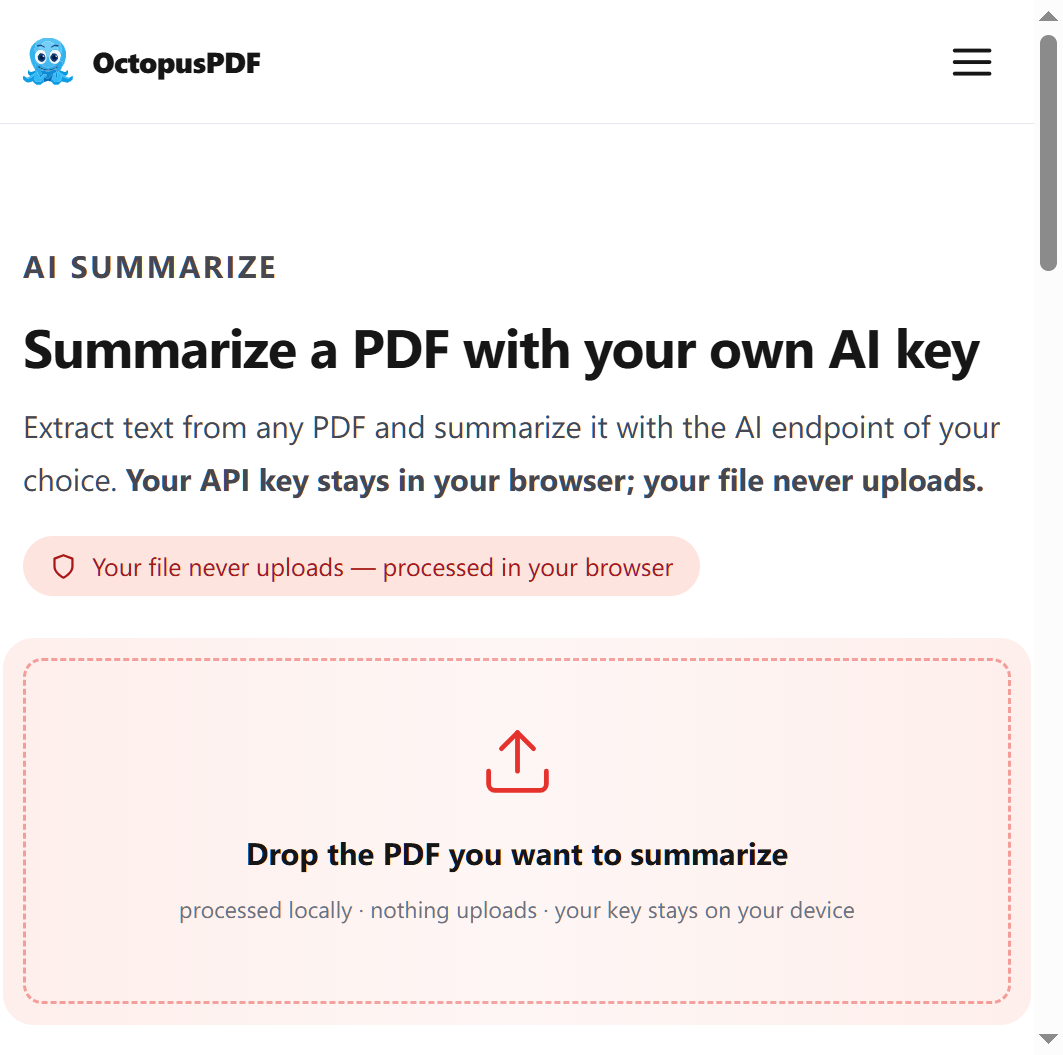
If you are working with confidential contracts, research data, or client documents, choose a converter where the file never leaves your browser. Browser-based tools like OctopusPDF perform all conversions locally, meaning nothing is uploaded, cached, or stored on a remote server [K5][K4].
3. Methods for Converting PDF to Markdown: What Actually Works
Method 1: Use a dedicated PDF-to-Markdown tool
A purpose-built tool gives you the best balance of quality and convenience. OctopusPDF, for example, offers a structure-aware extraction mode designed specifically for LLM feeding — it preserves headings, lists, and table structure instead of dumping raw text [K1]. Because all processing is done locally in the browser, you can convert sensitive documents without risk of exposure [K5].
Best for: researchers who need clean output for LLM ingestion, and anyone working with sensitive files.
Method 2: Use a PDF converter with Markdown output (with caution)
Many general-purpose PDF converters claim Markdown support. In practice, most perform a "text extraction" rather than a "structure extraction." The result: you get a .md file that looks like a plain-text dump. This is often sufficient for simple documents (letters, articles without tables), but it fails on multi-column layouts, complex tables, and documents with nested lists.
Best for: simple documents where you can visually verify the output.
Method 3: Use an OCR pipeline for scanned PDFs
If your PDF is a scan (no embedded text layer), conversion requires OCR. This adds a layer of complexity: OCR introduces recognition errors, and layout detection must be performed separately. Some open-source pipelines (e.g., Tesseract + pdfplumber + a Markdown post-processor) work, but they require scripting knowledge and manual correction.
Best for: archival documents, book scans, and handwritten notes — where no text layer exists.
Method 4: Copy-paste with manual cleanup (the fallback)
For one-off conversions, copying text and cleaning it manually in a Markdown editor can be faster than researching tooling. But this does not scale, and it is error-prone for long documents.
Best for: occasional use with short documents.
4. How to Choose the Right Converter for Your Workflow
Your specific workflow determines which tool is appropriate. The following scenarios reflect real usage patterns from professionals working with PDFs daily [K2]:
| Workflow | Primary Need | Recommended Approach |
|---|---|---|
| Graduate researcher feeding papers into an LLM | Structure-aware extraction that saves tokens [K1] | Browser-local PDF-to-Markdown tool with structure detection |
| Freelance designer preparing client proofs | Watermarking, page stamping — not Markdown | General PDF editor; Markdown unnecessary |
| Solo attorney redacting sensitive clauses | Physical redaction + metadata stripping | Browser-local redaction tool; avoid upload [K3] |
| Indie publisher preparing a manuscript | Page ordering, gutter margins — not Markdown | Booklet-focused PDF tool |
| Small business merging invoices | Batch merging, splitting | General PDF organizer |
| Remote worker handling confidential files on a shared device | Maximum privacy, no trace | Browser-local processing (zero upload) [K5] |
A practical decision rule
Ask yourself two questions:
- Does the file contain sensitive information? If yes, use a tool that processes locally in the browser. Do not use upload-based services [K3].
- Will the Markdown be consumed by an AI system or a knowledge base? If yes, use a structure-aware converter. Raw text extraction will create more problems than it solves [K1].
5. Key Comparison: Tool Categories and What to Expect
The table below summarizes the main categories of PDF-to-Markdown tools and their trade-offs. Note that feature quality varies widely within each category — treat this as a starting map, not a rank list.
| Tool Type | Example Approach | Upload Required? | Structure-Aware? | Best For |
|---|---|---|---|---|
| Browser-local converter | OctopusPDF (structure-aware) [K1][K5] | No | Yes | Sensitive or confidential files; LLM-ready Markdown |
| Upload-based converter | Most free online tools | Yes | Sometimes | Non-sensitive files with low-stakes output |
| Open-source CLI pipeline | Tesseract + parsing scripts | No | Depends | Developers who want full control |
| Text editor + manual cleanup | Any Markdown editor | N/A | No | One-off conversions, short documents |
Boundary conditions to keep in mind
- File size limits: Some upload-based tools cap pages or file size (e.g., 20 pages / 5 MB) — impractical for real documents [K3].
- Table handling: Tables are the hardest element in PDF-to-Markdown conversion. A structure-aware tool should preserve table boundaries and cells; otherwise, plan for manual reconstruction.
- Multi-column documents: Text-extraction tools often read columns out of order. Check the output carefully.
- Scanned PDFs: Without OCR, neither text extraction nor Markdown conversion will work — you get an image, not text.
6. FAQ
Q1: What is the difference between PDF-to-Text and PDF-to-Markdown?
PDF-to-Text produces a flat text stream with no formatting cues — headings lose their hierarchy, lists collapse, and tables become jumbled. PDF-to-Markdown maps those elements to semantic markers (e.g., # for a heading, | for table cells), preserving the document's structure. This is particularly valuable when the Markdown is fed into an LLM or a static site generator [K1].
Q2: Can I trust browser-based conversion tools with confidential PDFs?
It depends. You can trust a browser-based tool only if the processing happens entirely locally, with no file upload. OctopusPDF, for example, advertises zero-upload processing across all 14 of its tools, including redaction and PDF-to-Markdown conversion [K5]. However, many browser-based tools actually upload files to a backend server — check the privacy policy and data handling statements before using them with sensitive data. The safest rule: if the tool claims to "protect your privacy" but uploads your file, that is a logical paradox [K3].
Q3: Why is structure-aware extraction important for token savings?
When you feed an LLM a flattened text file, the model must process every redundant line break, stray header, or fragmented table cell. These consume tokens without adding semantic value. A structure-aware conversion removes this noise, so the same content uses fewer tokens per query — which directly reduces API costs and increases context available for actual content [K1].
Q4: What is the most common mistake when converting PDFs to Markdown?
Assuming the output is correct without verification. Even good converters make errors on complex layouts, merged table cells, and mixed text-language documents. Always spot-check the generated Markdown — especially headings, tables, and code blocks — before feeding it into any downstream system.
7. Conclusion
PDF-to-Markdown conversion is not a single technique — it is a spectrum from raw text dumps to structure-aware extraction. For anyone building AI workflows, feeding documents into LLMs, or migrating content to modern publishing systems, the difference matters: structure-aware extraction saves tokens, improves comprehension, and produces maintainable files [K1].
The practical recommendation is straightforward:
- For sensitive or confidential documents, use a browser-local, zero-upload converter [K5][K3].
- For LLM-ready output, prioritize structure-aware extraction over generic conversion [K1].
- For complex layouts or scanned documents, budget time for verification and correction. No tool is perfect, but a well-chosen one reduces the work substantially.
Start with a structure-aware, browser-local tool for your next conversion and compare the output with a plain text extraction. The difference — in tokens, clarity, and usability — will be visible immediately.