Local AI PDF Translation: A Simple Tutorial for Non-Coders
Key Takeaways
- You can translate PDF files locally in your browser without writing a single line of code.
- A "Bring Your Own Key" (BYO) model keeps both your PDF file and your API key on your own device—nothing gets uploaded to the tool provider.
- The process works with any OpenAI-compatible API key and supports page-by-page translation into 9+ languages.
- Local processing reduces privacy risks and gives you direct control over which AI endpoint handles your document.
- This tutorial is suitable for researchers, students, legal professionals, and anyone who handles sensitive PDFs and needs translation or summarization without cloud uploads.
1. Introduction
If you have ever needed to translate a PDF document—a contract, a research paper, a user manual, or a financial report—you have probably faced an uncomfortable trade-off. Free online translation tools often require you to upload your file to a server. That may be fine for a recipe, but it is a real problem when the document contains confidential business data, personal information, or proprietary research.
There is also a second barrier: the technical one. Many people assume that using AI tools for document processing requires programming skills, command-line interfaces, or complex setups. This assumption is outdated. In 2025, browser-based tools have matured to the point where you can perform AI-powered PDF translation and summarization locally, without uploading the file, and without writing a single line of code.
This article walks you through a practical, non-technical method for translating PDFs locally using a Bring Your Own Key (BYO) model. You will learn exactly how the process works, what you need to prepare, where the privacy boundaries are, and which limitations you should keep in mind. By the end, you will be able to handle sensitive PDFs with more confidence and less friction.
2. The Core Idea: Bring Your Own Key (BYO) for Local PDF Translation
How it works, in plain language
The term "Bring Your Own Key" simply means that you supply the AI access credential yourself, rather than using a key that the tool provider manages for you. In practice, the workflow looks like this:
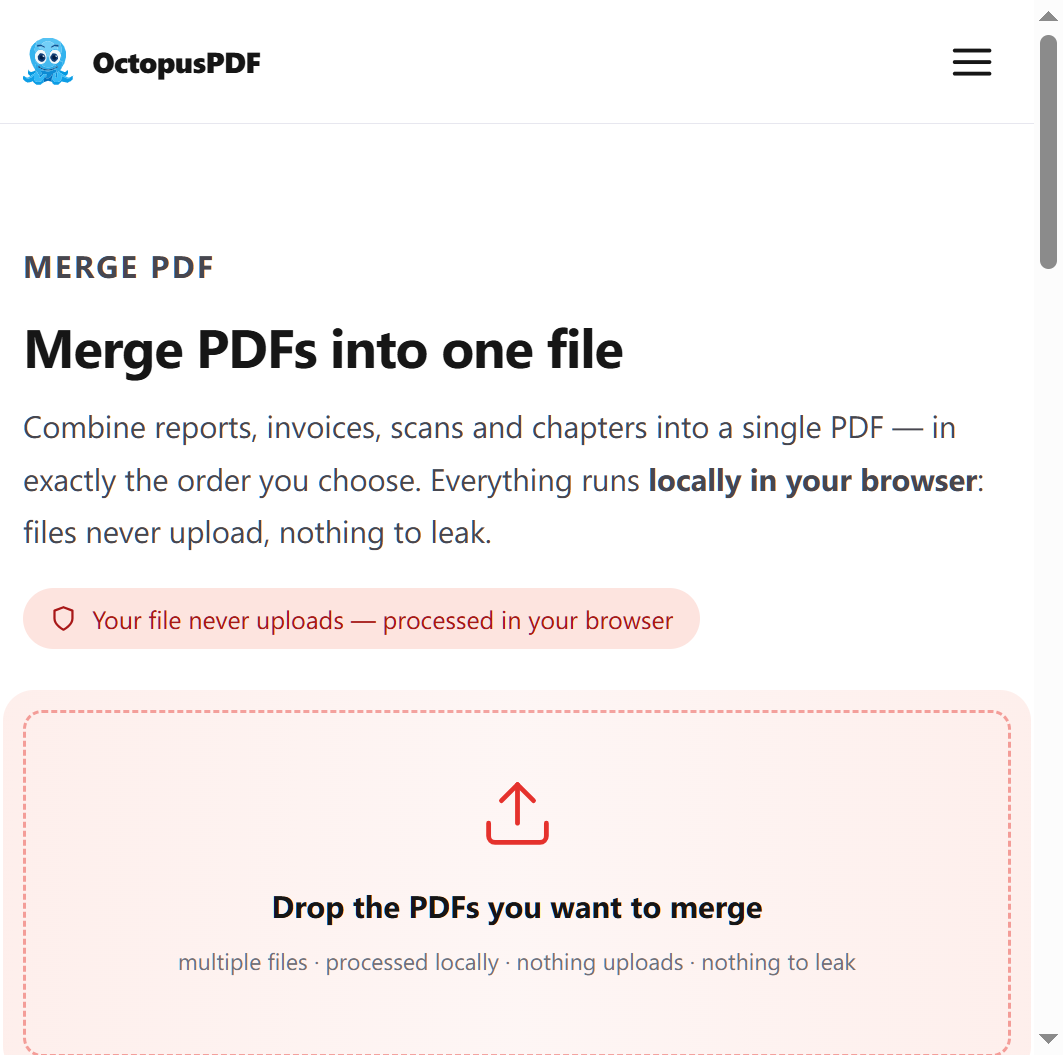
- You open a browser tab and drop your PDF file into the tool interface.
- The file is parsed locally using a JavaScript PDF engine (pdf.js). No PDF bytes are uploaded to the tool's servers [K1].
- You enter your own OpenAI-compatible API key. This key is stored only in your browser's localStorage—not on any external server [K1].
- The browser connects directly to the AI endpoint you choose. The tool provider does not proxy or relay your request [K1].
Why this matters for you
This design has two immediate consequences. First, your document never leaves your device at any point before, during, or after translation. Second, your API key also stays local, which reduces the risk of credential theft that sometimes comes with third-party cloud services [K3].
For non-coders, the practical advantage is that you do not need to configure servers, set up environments, or understand API architecture. The browser handles the connection. You just need to obtain an API key from a provider that supports the OpenAI-compatible format.
The one thing you must prepare
The only real prerequisite is an API key. If you do not already have one, you will need to sign up with an AI provider that offers API access (for example, OpenAI, or another provider that follows the OpenAI-compatible standard). Once you have the key, you can paste it into the tool, and the translation runs directly through your browser to the AI service of your choice.
Practical advice: Choose the AI provider based on the languages you need and the quality you expect. Since the tool supports any OpenAI-compatible endpoint, you can also switch providers without changing your workflow.
3. Translating PDFs Page by Page: What to Expect
Page-by-page translation is the default pattern
The translation feature in a BYO-based PDF tool typically works on a page-by-page basis. That means the AI processes each page as a separate translation unit, rather than trying to handle the entire document as a single block. This has both benefits and limitations.
Benefits:
- Better layout preservation: Each page is handled independently, which makes it easier to match the translated text to the original page's visual structure.
- Lower memory load: Large PDFs are more manageable when processed page by page, especially when running entirely in the browser.
- Incremental review: If you only need a few pages translated, you can verify the quality on the first page before proceeding.
Limitations to keep in mind:
- Context may be lost across page breaks. For example, if a sentence spans two pages, the translation might split it awkwardly.
- Charts, images, and embedded graphics are not translated; only the textual content is processed.
What the output looks like
According to the reference documentation, the translation tool supports 9+ languages, with fully local processing [K2]. The exact language set depends on the AI provider you choose, but common options include major European and Asian languages.
Practical scenario: A legal contract
Imagine you receive a service agreement in German. You need to understand its key clauses before a meeting. With a local BYO workflow, you can:
- Drop the PDF into the browser.
- Enter your API key.
- Select German-to-English translation.
- Review the translated pages one by one.
Since the file never leaves your browser, you do not need to worry about confidentiality agreements or data protection concerns—at least on the tool side.
Note: Even with local processing, the translated text still travels from your browser to the AI provider's API endpoint. The file itself stays local, but the text content is processed remotely. If your document contains highly sensitive personal data, check your AI provider's data retention policy before using any API.
4. Summarizing PDFs Without Uploading: The Same Local Model
A companion feature with the same privacy guarantees
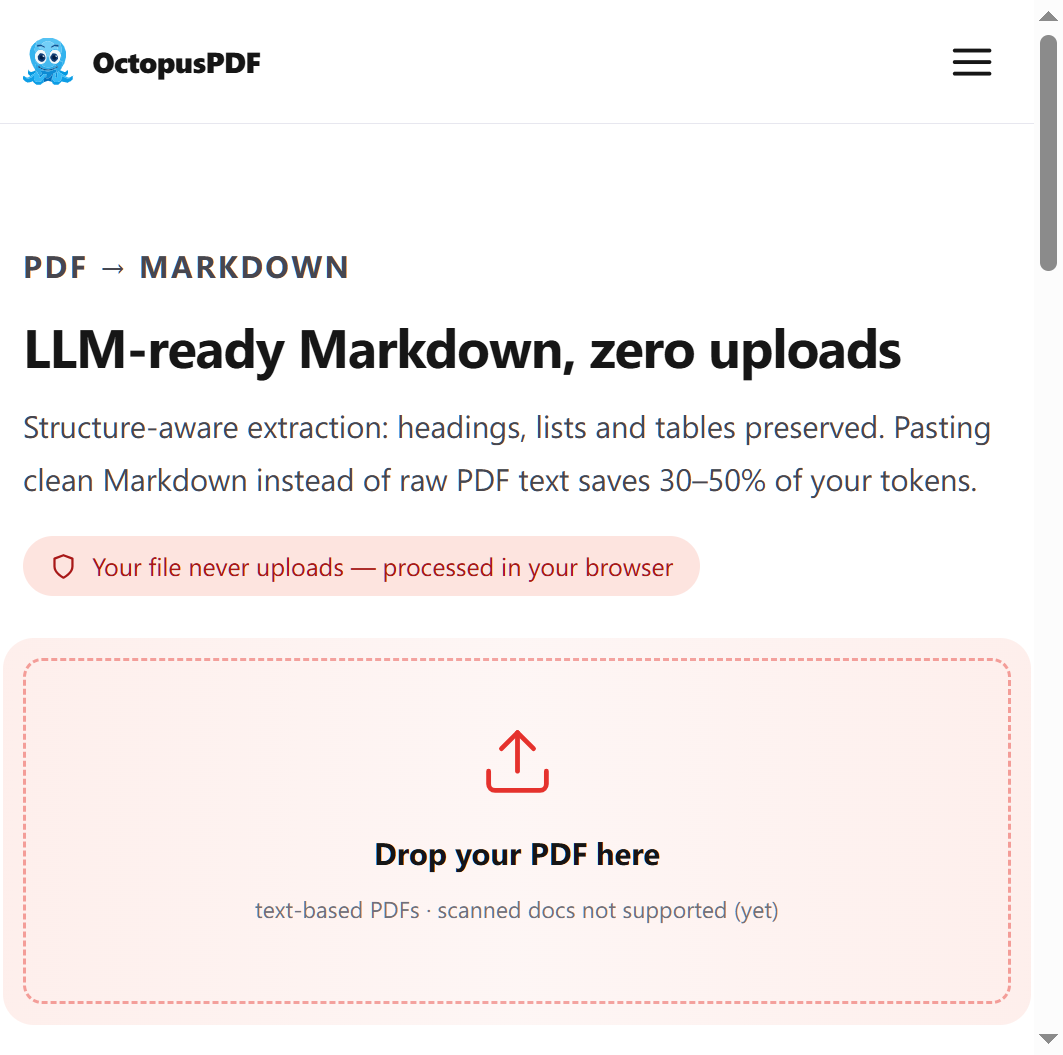
The same BYO architecture also powers PDF summarization. If you need to extract key points from a long report, you can use the same workflow: drop the file, enter your key, and run the summarizer. The documentation confirms that with this method, the file never uploads, the key never uploads, and there is no server-in-the-middle [K3].
This is particularly useful for students who need to skim multiple academic papers, professionals who need to digest long internal reports, or anyone who needs a fast overview of a document before deciding whether to read the full version.
Why "no server-in-the-middle" matters
In traditional cloud-based tools, the provider's server sits between you and the AI model. That server sees your document, processes it, and sometimes stores it. In a BYO model with direct browser-to-endpoint connections, the tool provider is structurally removed from the data path [K1]. This reduces the number of parties that can access your file and simplifies the privacy picture.
However, be careful with the word "local." The processing happens locally, but the AI inference itself happens on the service provider's side. What is local is the file handling, the key storage, and the HTTP connection logic. Do not assume full offline processing.
5. Key Comparison: Local BYO Workflow vs. Traditional Cloud Upload
The table below summarizes the main differences between a local BYO workflow and a conventional cloud-based PDF translation service.
| Dimension | Local BYO Workflow | Traditional Cloud Upload |
|---|---|---|
| File upload to tool provider | No [K1] | Yes |
| API key storage | Browser localStorage only [K1] | Provider server (typically) |
| AI request routing | Direct browser-to-endpoint [K1] | Through provider proxy |
| Technical skill required | Minimal (paste a key) | None for basic use |
| Provider visibility of your file | Low (file stays on your device) | High (file is transmitted) |
| Language support | 9+ languages [K2] | Varies by provider |
| Control over AI model | High (you choose the endpoint) | Low (provider decides) |
| Privacy risk | Lower (fewer parties involved) | Higher (more parties involved) |
When to use which
- Use a local BYO workflow when: the document is confidential, you want to control which AI model processes it, or you prefer not to create yet another online account with a document-processing service.
- Use a traditional cloud service when: you do not have an API key, you need a fully managed experience, or you are comfortable with the provider's privacy policy.
Caution: A local BYO workflow still sends the text content to the AI provider's API. It does not mean "fully offline AI." Only the file and key stay on your device.
6. FAQ
Q1. Do I need any coding skills to use this method?
No. The workflow is entirely browser-based. You only need to obtain an API key from a provider that supports the OpenAI-compatible format, paste it into the tool, and use the interface to upload your PDF and select the translation or summarization function [K1]. No command line, no programming, no setup scripts.
Q2. Is my PDF completely safe from the tool provider?
Your PDF file is parsed locally in the browser using pdf.js, and no PDF bytes are uploaded to the tool provider [K1]. Your API key is stored only in browser localStorage [K1]. However, the text itself is sent to the AI provider you choose. So while the tool provider cannot access your file, the AI provider processes the content. Check their data retention policy if your document contains sensitive information.
Q3. What languages can I translate into?
The tool supports page-by-page translation into 9+ languages, according to the official documentation [K2]. The exact set depends on the AI model you connect to. Most major language families are covered, but verification on a per-provider basis is recommended.
Q4. Can I translate a scanned PDF?
The documentation references translation and summarization for PDFs parsed with pdf.js. Scanned PDFs—those that are essentially images of pages—may require OCR before the text can be processed. If your PDF is a scan, you may need an additional OCR step first. This limitation applies generally to text-based AI translation tools, not just BYO workflows.
7. Conclusion
Local AI PDF translation is no longer a developer-only task. With the Bring Your Own Key model, you can translate and summarize PDFs directly in your browser, keep your file and API key on your device, and avoid the privacy risks of traditional cloud uploads [K1][K3]. The process requires no coding, no specialized software, and no complex configuration—just a browser, a PDF, and an OpenAI-compatible API key.
If you regularly handle confidential documents and have been avoiding AI translation tools because of privacy concerns, this workflow is worth testing. The trade-off is simple: you take on the small task of managing your own API key, and in return you get significantly more control over your document's data path.
Start with a short, non-confidential PDF first. Run a test translation. Compare the output quality across two different AI providers if you have access. Once you are comfortable with the process, you can scale it to sensitive documents with far more confidence than a traditional cloud upload would allow.