Key Takeaways
- Converting PDF to Markdown is no longer a niche technical task—it is a core workflow step for researchers, developers, and knowledge workers who need to feed clean, structured text into LLMs and documentation systems.
- Structure-aware extraction matters: Tools that understand headings, lists, and tables produce Markdown that saves tokens and improves output quality when used with AI models [K1].
- Privacy is a deciding factor: Local-only conversion ensures sensitive PDFs never leave your browser, eliminating upload risks such as server breaches, data retention, or metadata leakage [K2][K3].
- The best tool for you depends on your primary use case—batch OCR-heavy documents may need different handling than clean, digitally-born PDFs.
- Always verify output fidelity for complex layouts, especially when you plan to reuse the Markdown for training data, technical documentation, or legal review.
1. Introduction
PDF remains the universal format for sharing documents, but it is also one of the most inflexible when you need to reuse content. Copying text from a PDF often results in broken lines, lost tables, and mangled formatting. For anyone who writes documentation, trains language models, or maintains a knowledge base, the solution is clear: convert PDF to Markdown.
Markdown’s lightweight syntax makes it ideal for version control, static site generators, and AI pipelines. But not all conversion tools are equal. Many online converters require uploading your file to a remote server—a dealbreaker for confidential research, legal documents, or client work. Others produce output that is technically Markdown but structurally useless: tables become raw text, headings lose hierarchy, and the content becomes token-inefficient for LLM contexts.
This guide cuts through the noise. We will examine what "effortless" actually means in PDF to Markdown conversion, compare the practical trade-offs, and highlight a privacy-first approach that keeps your files local while delivering structure-aware output. By the end, you will have clear criteria for choosing the right tool and the confidence to integrate PDF to Markdown conversion into your daily workflow.
2. Why Markdown from PDF Is More Than a Format Shift
Core conclusion: The value of PDF to Markdown lies not in the text extraction itself, but in the structural fidelity of the output. A good conversion preserves the document’s hierarchy, making it both human-friendly and machine-readable [K1].
When you paste text from a PDF into a plain editor, you often lose:
- Heading levels (H1, H2, H3)
- Bullet and numbered lists
- Table structures
- Inline formatting (bold, italic, code spans)
- Links and image references
The result is a wall of text that requires manual cleanup. This is time-consuming and error-prone—especially when you are working with a 200-page manual or a research paper with complex tables.
Structure-aware extraction changes the game. In practical terms, it means the converter understands the PDF’s internal layout and maps it to Markdown syntax: a line styled as “Heading 1” becomes # Heading 1; a table grid becomes a Markdown table; a bulleted list retains its list markers. For users feeding content into LLMs, this matters for two concrete reasons:
- Token efficiency: A well-structured document uses fewer tokens than a messy one because formatting markers are simple and predictable [K1].
- Semantic clarity: The model can infer relationships between sections, which improves summarization, Q&A, and retrieval-augmented generation (RAG) performance.
Scenario-based advice: If you are a graduate researcher compiling a literature review, you want your sources converted in a way that preserves section order and citation context. If you are a technical writer migrating legacy PDF docs to a GitHub wiki, you need clean code blocks and nested lists. In both cases, a converter that only strips text will fail you—you need structure-aware output.
3. The Privacy Factor: Local-Only Conversion Is a Non-Negotiable for Sensitive Files
Core conclusion: The most overlooked dimension in PDF conversion is privacy. Up to a point, all converters do the same job; what differentiates them is whether your document ever leaves your device [K3].
Many popular online tools ask you to upload a file, and the file is processed on their servers. That creates risks:
- The document is temporarily stored, even if only in memory.
- The service provider may retain metadata or logs.
- Your IP address and file hash could be logged.
- If the service is compromised, your confidential data could leak.
For a freelance designer handling client proofs, a solo attorney redacting clauses, or a remote worker on a shared device, that risk is unacceptable [K4]. The alternative—fully local conversion—offers a clear guarantee: the conversion happens in your browser, using local compute. No upload, no server, no queue [K3].
What does local-only mean in practice? When you use a tool like OctopusPDF’s PDF to Markdown, the file is processed within your browser’s JavaScript runtime. The output is generated on your machine, and you can verify that no network requests are made—the browser’s network panel shows zero outbound traffic for the file content [K3].
Scenario-based advice: Consider these cases:
| Use Case | Why Local-Only Matters |
|---|---|
| Attorney preparing a settlement PDF for e-filing | Prevents unauthorized retention of client data |
| Researcher using confidential interview transcripts | Avoids exposing raw data to third-party servers |
| User on a public or shared computer | No lingering copies in remote caches |
| Developer feeding enterprise docs into an LLM | Keeps proprietary information behind the firewall |
If your workflow involves any of these scenarios, choose a converter that explicitly states its local-only processing. If a tool cannot show you network requests or does not disclose its upload behavior, treat it with caution.
4. How to Choose a PDF-to-Markdown Tool: Selection Criteria That Actually Matter
Core conclusion: A reliable PDF-to-Markdown workflow should combine structural fidelity, privacy, and practical usability. You do not need a Swiss-army knife—you need a tool that does the job without compromising your data or your time.
Here are the criteria we recommend evaluating:
4.1 Structural Awareness
Does the tool handle headings, lists, tables, and nested structures correctly? Ask to see a sample output from a test PDF that includes multiple heading levels, a data table, and a code block. If the table loses its columns, move on.
4.2 Processing Location
Is the conversion local in your browser, or does the file get sent to a server? Look for explicit statements like “processed entirely on your device” or “no upload” [K3]. If this information is buried in a privacy policy, be skeptical.
4.3 Batch Handling
If you process multiple PDFs daily (e.g., merging invoices, splitting statements), consider tools that support batch conversion or are part of a larger PDF suite [K4]. Standalone converters often lack batch options.
4.4 Output Quality and Extensibility
Good Markdown output should be ready for immediate use: clean heading breaks, proper spacing, and no stray page numbers or headers/footers bleeding into the body text.
4.5 Cost and Licensing
Free tools exist, but they may watermark output, limit file size, or restrict commercial use. For professional workflows, a tool that offers a free tier and a Pro tier with larger file limits (like up to 100 MB) is often a good compromise [K4].
4.6 A Practical Comparison Table
| Criteria | Local-Only Browser Tool (Recommended) | Server-Based Tool (Caution) |
|---|---|---|
| File Upload | Never leaves device | Sent to remote server |
| Privacy Risk | Low | Higher—depends on provider policy |
| Structural Fidelity | Depends on engine, usually high | Depends on engine, often lower |
| Batch Processing | Works inline, no queued uploads | May rely on server queues |
| Verifiability | Can inspect network panel | Cannot verify external handling |
| Typical Use Case | Confidential docs, LLM prep, professional work | Casual personal use, non-sensitive files |
5. Practical Steps: Converting PDF to Markdown with a Local-Only Workflow
If you are convinced that local-only conversion is the right way, here is a simple step-by-step method for turning a PDF into Markdown without losing structure or privacy.
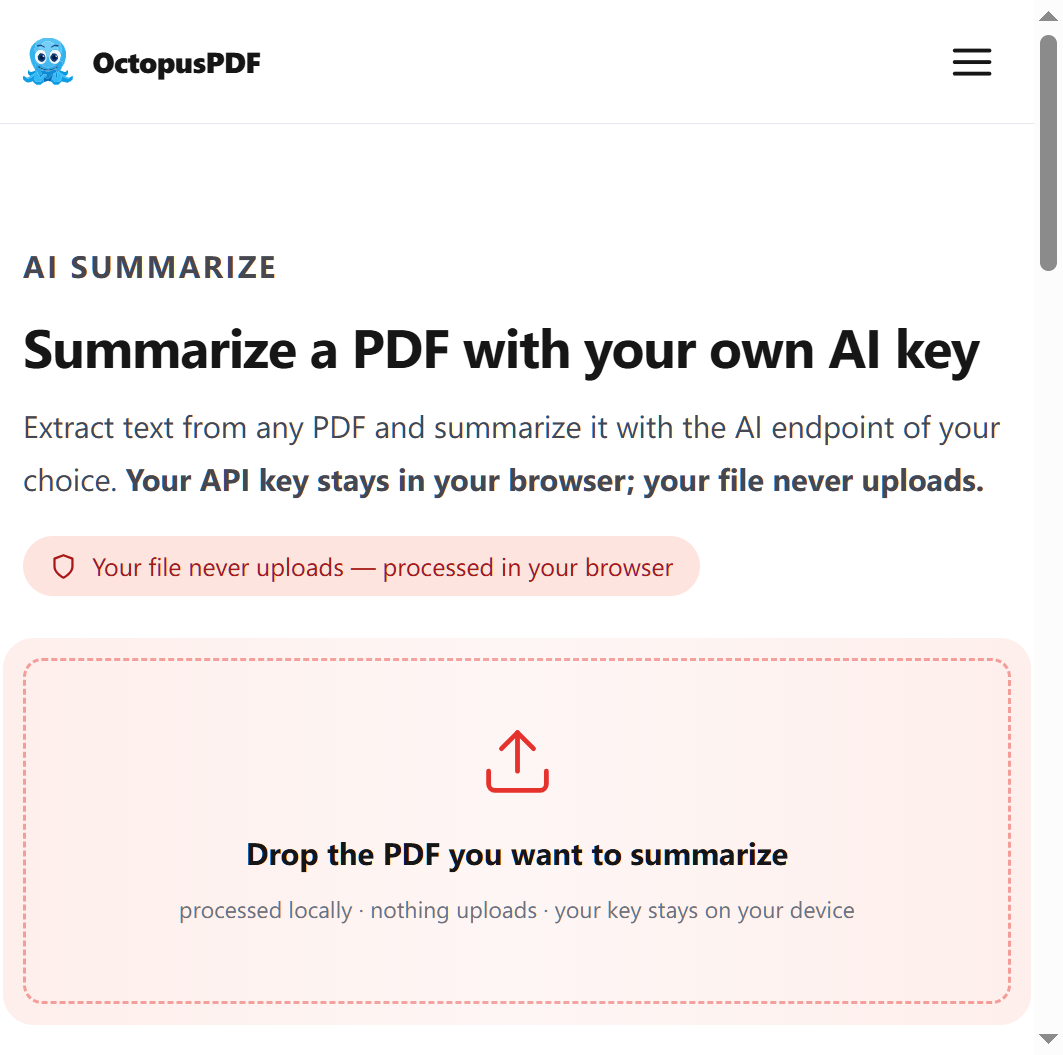
Step 1: Open your browser. Use any modern browser (Chrome, Edge, Firefox, Safari). No installation is required.
Step 2: Find a local-only converter. OctopusPDF’s PDF to Markdown tool is one example that processes everything in-browser [K1]. Confirm from the tool’s documentation that files will not be uploaded.
Step 3: Drag-and-drop your PDF. You do not need to register or log in.
Step 4: Review the output. Inspect the Markdown for:
- Correct heading levels (
#,##,###) - Intact table cells
- Code blocks preserved with triple backticks
- No random line breaks mid-sentence
Step 5: Verify no data leaves your machine. Open the browser’s network panel (F12 → Network tab) and re-run the conversion. You should see no requests to external domains containing your file content [K3].
Step 6: Save your Markdown. Copy the output to your clipboard or download the file, then integrate it into your documentation, wiki, or LLM pipeline.
A caution: Some PDFs contain scanned images (no text layer). A standard PDF-to-Markdown tool will only extract the text layer. If your document is a scan, you need an OCR step first; a converter alone will produce empty output. Understand this boundary before you waste time.
6. FAQ
Q1. Does PDF-to-Markdown conversion preserve images and charts?
No image files are typically extracted as separate files; instead, they are usually referenced as placeholders or lost in the text extraction. If your PDF relies heavily on figures, you may need to extract images separately and re-link them in the Markdown.
Q2. Can I convert a PDF with hundreds of pages?
Most local-only converters handle large files, but browser memory can be a constraint for very large files (tens of thousands of pages). A reasonable limit for a smooth experience is under 100 MB [K4]. Above that, consider splitting the PDF before conversion.
Q3. What should I do if the Markdown table output is malformed?
This typically happens when the original PDF uses nested tables, merged cells, or absolute positioning. Most converters handle simple tables well; for complex layouts, you may need manual cleanup. A structure-aware tool will preserve table syntax, but it cannot reconstruct a table that is not properly defined in the PDF.
Q4. Is “local-only” truly safe from a security standpoint?
In the strictest sense, yes: if your file never leaves the browser, remote servers cannot access it. However, you are still responsible for your own device’s security—malware on your machine or browser extensions that send data are outside the scope of the converter. The guarantee is about third-party servers, not your own system [K3].
7. Conclusion
PDF to Markdown conversion is no longer a manual chore reserved for tech-savvy writers. Modern tools offer structure-aware extraction that preserves heading hierarchy, tables, and lists, making the output ready for use in documentation, knowledge bases, and LLM pipelines [K1]. The most critical differentiator, however, is not the quality of the output alone—it is whether the conversion respects your data’s privacy.
For professionals handling confidential documents—attorneys, researchers, freelancers, and finance staff—the only responsible choice is a local-only converter that processes files within the browser and never uploads them [K2][K3][K4]. The peace of mind that comes from verifiable privacy, combined with accurate structural output, is the realistic meaning of "effortless."
Final recommendation: If you convert PDFs to Markdown regularly, adopt a tool that is:
- Structure-aware to save tokens and preserve meaning,
- Local-only for privacy,
- Part of a broader PDF toolkit so you can handle related tasks (like merging or redacting) without switching contexts [K4].
Start with a small test file, verify the output, and inspect your network traffic. Once you see the clean Markdown on your own device with zero outbound requests, you will understand why local-only is the benchmark for modern PDF workflows.