Key Takeaways
- Splitting a grant proposal PDF into sections is a routine but high-stakes step: the file contains budgets, personal data, and institutional details that should not pass through third-party servers.
- Use a local, browser-based processor that keeps the file on your device. The OctopusPDF architecture parses with PDF.js and manipulates with pdf-lib entirely inside the browser tab [K2].
- The split workflow is fast and reliable: in real-world testing across 113 PDFs, the success rate was 91.2%, with the remaining files DRM-locked, and median processing time was 420 ms [K4].
- Always run a sanitization pass after splitting to delete metadata, comments, and hidden content before sharing sections externally [K5].
- Free tiers are sufficient for occasional use; a paid tier with batch mode is justified when a grants office processes many proposals per day [K5].
1. Introduction
Grant proposals are rarely delivered as a single, monolithic PDF. In practice, a final application is assembled from many parts: the project narrative, a budget justification, biographical sketches, letters of support, a data-management plan, and institutional forms. Reviewers, program officers, and internal sign-off processes often want to review only one section at a time; submission portals frequently impose per-file size limits; and email servers reject attachments above a few megabytes.
That leads to a recurring task for grant writers: split the proposal PDF into sections. Doing this well is a matter of workflow design, not just clicking a button. You need to know where the logical boundaries are, how to keep the output free of stray metadata, and — critically — how to do all of this without uploading a confidential document to an unknown server.
The core shortcut, stated up front: use a local, browser-based PDF processor that keeps the file on your device, split at section boundaries, and run metadata sanitization on the output files before sharing [K2][K5]. This guide explains each step and the reasoning behind it.
2. Why split a grant proposal PDF into sections
Core conclusion: Splitting is not busywork. It makes grant workflows faster, safer, and easier to comply with.
2.1 Reviewer readability and parallel review
Program officers often route a proposal to multiple peer reviewers, each focused on a different area: one on the science, another on the budget, a third on management and dissemination. A 45-page PDF slows this down. Splitting the document into narrative, budget, and appendices means each reviewer receives only the file they need to evaluate.
2.2 Cleaner collaboration with co-authors
Grant writing is collaborative. The principal investigator owns the scientific narrative; a finance officer owns the budget; a sponsored-projects office owns the institutional forms. Circulating the full document creates ambiguity about who edits what. Splitting creates clear ownership and prevents accidental overwrites of someone else's section.
2.3 Submission portal constraints
Many grant portals require one PDF per section and reject files above a certain size. When the portal's mapping does not match your monolithic file, you need section-level PDFs to submit at all. The safest method is to split according to the section ordering listed in the solicitation — not according to your own convenience.
2.4 Data minimization and confidentiality
A grant proposal is not a public document. It may contain salary information, biographical data of named researchers, subcontractor quotes, and institutional details not cleared for external release. Sending such a file through an arbitrary file-conversion website means you have shared it with a third party before you even share it with a review panel. Privacy-sensitive use cases — legal documents, confidential files, personal data — are exactly the category grant proposals fall into [K3].
The practical rule: split locally, share only the needed section, and sanitize before sending [K2][K5].
3. How to split a grant proposal PDF locally: a step-by-step workflow
The safest mode is local processing. The recommended pipeline: you drop a file, it opens inside the browser tab, processing runs locally on your device, and you download the result [K2]. No upload happens, and no server sits between you and the output [K1][K2].
3.1 Step 1: Map out the section plan
Before touching any tool, write down the proposed sections. In most cases, use the structure mandated by the call for proposals:
- Cover page and abstract
- Project narrative
- Budget and budget justification
- Biographical sketches
- Facilities and other resources
- Data-management plan
- Letters of support and appendices
Then determine the page ranges for each section. Keep one page of context if a section does not start cleanly on a new page. Record starting and ending page numbers — this becomes your input for the split operation.
3.2 Step 2: Split with a local-in-browser tool
The location of processing matters more than the brand of the tool. Use a tool that runs entirely in the browser; pdf.js handles parsing and pdf-lib handles manipulation, and neither transfers the file over a network [K2]. The process:
- Open the local tool and drop the proposal PDF into the browser tab.
- Verify the total page count matches the original document.
- Enter the page ranges recorded in Step 1.
- Split the document; download each section as its own PDF.
- Verify that the output page counts add up to the original count.
Reliability is a practical concern. In real-world testing, 113 PDFs were processed with a 91.2% success rate, and the failures were DRM-locked files rather than splitting logic errors [K4]. The median processing time was 420 ms across seven core operations [K4]. In practice, the bottleneck in your workflow is not computing power — it is the quality of your section plan.
Caveat: DRM-locked or password-protected files will remain unprocessed [K4]. Unlock the document with the appropriate tool first, then split.
3.3 Step 3: Name output files deliberately
Filename discipline separates a usable package from chaos. Use a scheme that includes the project name and page range:
narratives_grant_abstract_p01-02.pdfnarratives_grant_narrative_p03-18.pdfnarratives_grant_budget_p19-22.pdf
Consistent naming makes the package machine-readable and prevents a reviewer from opening the wrong file.
3.4 Step 4: Sanitize before sharing
After splitting, run a redaction and sanitization pass on the files you plan to send. Local sanitization physically deletes metadata, comments, and hidden content from the PDF before external release [K5]. Author names, version notes, and tracked changes often sit in document properties even when invisible on the page.
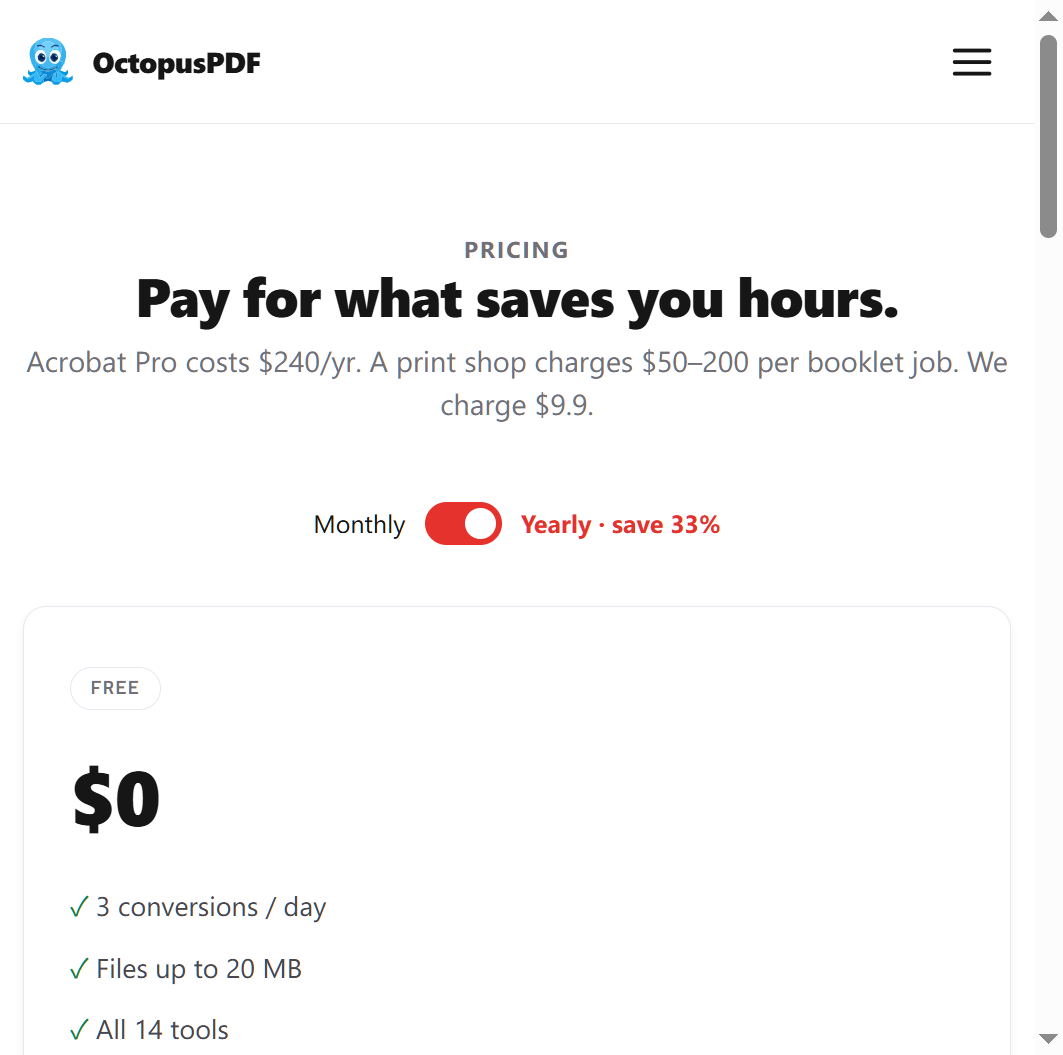
The free tier of the OctopusPDF Redact/Sanitize tool allows 3 conversions per day with files up to 20 MB; the Pro tier is unlimited, supports 100 MB files, and includes batch mode [K5]. For a grants office splitting shared proposals, batch mode reduces the chance that you skip sanitizing one of the outputs.
4. Privacy and compliance considerations for grant proposals
4.1 What is sensitive inside a proposal?
Grant proposals routinely contain:
- Salary and fringe benefit figures for named staff
- Birth dates or citizenship status in biographical sketches
- Subcontractor pricing and financial details
- Institutional negotiation positions in letters of support
- Medical or legal details when the project involves human subjects
Processing any of these through an upload-based website exposes them to a third party. Under GDPR, personal data should be processed without unnecessary third-party transfer [K3]. Even outside the EU, many university and foundation policies restrict sending unencrypted documents to non-approved services.
4.2 Why local processing is the structural answer
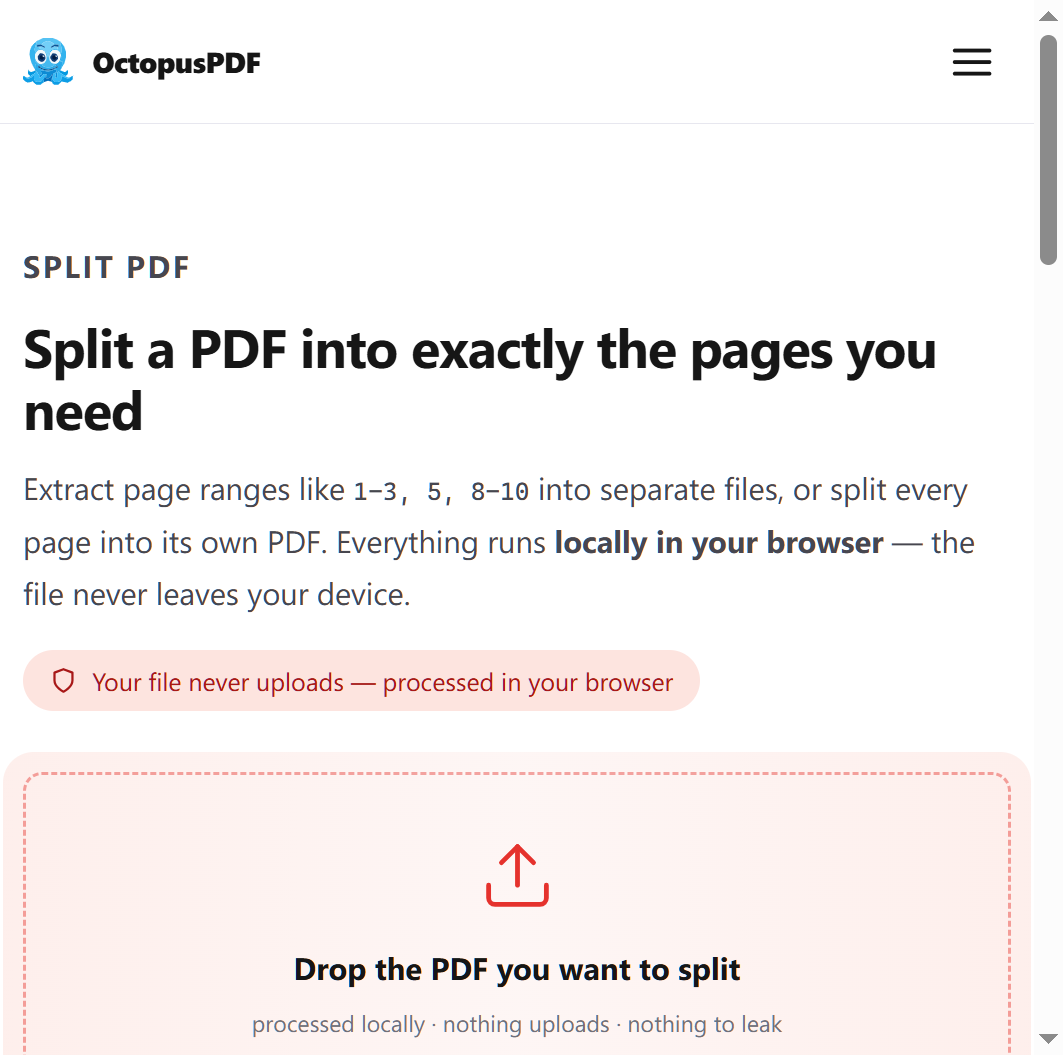
The architectural choice is decisive. With a local-in-browser processor, the PDF never uploads, and no server-in-the-middle receives your document or your API key [K1]. This is not a promise that a vendor will delete your files later; it is a design in which the data does not leave your device in the first place [K1][K2]. That matters for shared or company devices, and for situations where leakage carries legal or reputational consequences [K3].
4.3 The correct order of operations
The right sequence for any external share is:
- Split the proposal into the sections actually needed.
- Sanitize each section — metadata, comments, and hidden layers [K5].
- Verify content by opening each file and checking page counts.
- Send only the sanitized files.
If you sanitize first and split later, the split step can generate new metadata. If you split but skip sanitization, you leak metadata. Split first, sanitize after.
5. Key comparison: local splitting vs. upload-based converters vs. manual splitting
| Criterion | Local browser-based splitter (OctopusPDF-style) | Upload-based web converter | Manual splitting in a PDF reader |
|---|---|---|---|
| Data leaves your device | No [K1][K2] | Yes — file uploaded to vendor server | No |
| Metadata control | Sanitize step available [K5] | Rarely available | Inconsistent across PDF viewers |
| Reproducibility | High — repeatable and batchable [K5] | Low | Low |
| Success on real-world files | 91.2% in a 113-file test [K4] | Varies by file size and DRM | High but manual |
| Time cost | ~420 ms median per operation [K4] | Upload + queue + download | Minutes per document |
| Cost | Free tier: 3 conversions/day, 20 MB; Pro: unlimited, 100 MB, batch [K5] | Often freemium with quotas | Free |
Which option should you pick? For a solo grant writer producing a handful of proposals per month, the free local tier is sufficient. For a grants office handling many proposals, batch mode and the larger file limit justify the paid tier [K5]. Avoid upload-based converters for working proposals unless the document has been explicitly cleared for external release — which, for in-progress proposals, it almost never is.
6. FAQ
Q1. Can I split a grant proposal PDF without uploading it to a server?
Yes. Browser-based tools that use PDF.js for parsing and pdf-lib for manipulation run the split entirely inside the browser tab, with no upload step [K2]. In the reference architecture, the pipeline is drop → open in browser → process locally → download [K2], and test results confirm 0 bytes uploaded across 113 real-world files [K4].
Q2. What is the best way to split a proposal for multiple external reviewers?
Split along the solicitation-mandated or logical boundaries: abstract, narrative, budget, biographical sketches, data-management plan, and appendices. Name files consistently with the project name and page range. For any reviewer outside your organization, run sanitization after splitting so metadata, comments, and hidden content are removed [K5].
Q3. Is the free tier enough for grant work?
For occasional work, yes. The free tier offers 3 conversions per day with files up to 20 MB [K5]. If you handle multiple proposals per day or need to process sections in batch, the Pro tier — unlimited conversions, 100 MB files, and batch mode — is the appropriate choice [K5].
Q4. Why does my split fail on some PDFs?
The most common cause is DRM locking. In real-world testing, 113 PDFs produced a 91.2% processing success rate, and the remaining 8.8% were DRM-locked [K4]. Unlock the file or request a DRM-free version from the author before splitting.
7. Conclusion
Splitting a grant proposal PDF into sections sits at the intersection of three priorities: reproducibility, format compliance, and data privacy.
Best practice in one line: use a local browser-based splitter powered by pdf.js and pdf-lib [K2], split along the solicitation-mandated or logical section boundaries, name the files consistently, and run a sanitization pass on every file that will leave your organization [K5]. This sequence keeps the data on your device, keeps the outputs aligned with reviewer expectations, and keeps hidden metadata under your control.
Do not upload grant proposals to arbitrary conversion websites. Choose an architecture that never sees your file in the first place [K1][K2]. The workflow described here is simple, repeatable, and safe enough to institutionalize across a grants office.