Key Takeaways
- Splitting a PDF is one operation with two distinct modes: extracting a specific page range, or exporting every page as its own PDF. The right choice depends on what you are sending and who needs it [K3].
- Privacy is the deciding factor in tool selection. A browser-based tool that runs locally with zero uploads keeps contracts, client proofs, and financial documents off external servers [K3][K2].
- Free tiers are workable for occasional use, but regular splitting, large files, or batch workflows justify a paid plan with higher limits and batch processing [K2].
- A split file is not automatically "clean." Hidden metadata, comments, and author information can survive the split, so a redaction/sanitization pass is a sensible final step before sharing [K2].
1. Introduction
Yes, you can split a PDF in under a minute — but only if you know exactly what kind of split you need and you choose a tool that does not compromise the file's privacy.
Almost every professional has hit this wall. A client sends a 60-page statement, but you need pages 12 to 18. A scanned contract arrives as one continuous file, but each attachment must be filed separately. A manuscript needs to be broken into chapters for reviewers. Desktop PDF editors handle these tasks, but they are heavy, expensive, and often absent on shared or personal devices. Upload-based web tools are faster, but they introduce a real concern: your document is now sitting on someone else's server.
This article covers the core questions around splitting PDFs: what a "split" actually does, how a reliable split workflow looks, what to watch out for regarding privacy and file size, and how to compare tools without relying on marketing claims. Where concrete facts are needed, this article draws on OctopusPDF, a browser-based PDF toolset that describes itself as running entirely in the browser with zero uploads [K3]. The same evidence is used to explain limits, batch behavior, and the privacy reasoning that should drive your choice.
2. What "Split PDF" Really Means
Core conclusion: Splitting a PDF is not one feature; it is two. You either extract a page range from a larger document, or you break every page into its own separate PDF file. Confusing the two explains most "wrong output" complaints.
2.1 Extract a page range
This mode lets you pull a specific sequence of pages — for example, pages 5 to 10 — out of a larger file and save that range as a standalone PDF. OctopusPDF describes this capability directly: its Split PDF tool can "extract page ranges" [K3].
Use this mode when:
- A client needs only one section of a long report.
- You are separating one invoice from a monthly statement.
- You want to forward a single chapter of a manuscript without sending the whole book.
2.2 Split every page into its own PDF
This mode converts a 10-page document into 10 separate one-page PDFs. OctopusPDF's tool also supports this: "split every page into its own PDF" [K3].
Use this mode when:
- Each page is a standalone deliverable, such as a signed form or a ticket.
- You need to distribute pages to different people.
- You are preparing individual pages for a print or review workflow.
2.3 Real-workflow scenarios
The split tool rarely works alone. The same toolset that offers splitting also includes Rotate PDF, Organize PDF (reorder and delete pages with drag-and-drop thumbnails), and Merge PDF — so you can fix page order or orientation before or after the split [K3].
OctopusPDF's own product documentation lists practical workflows that involve this kind of page-level work:
- A small business merges invoices, splits statements, and rotates scans, with files up to 100 MB on the Pro plan [K1].
- A print shop preflights customer PDFs, reorders pages for duplex printing, and checks page counts in the browser [K1].
- An indie publisher turns a manuscript into a saddle-stitch booklet with correct page order and gutter margins [K1].
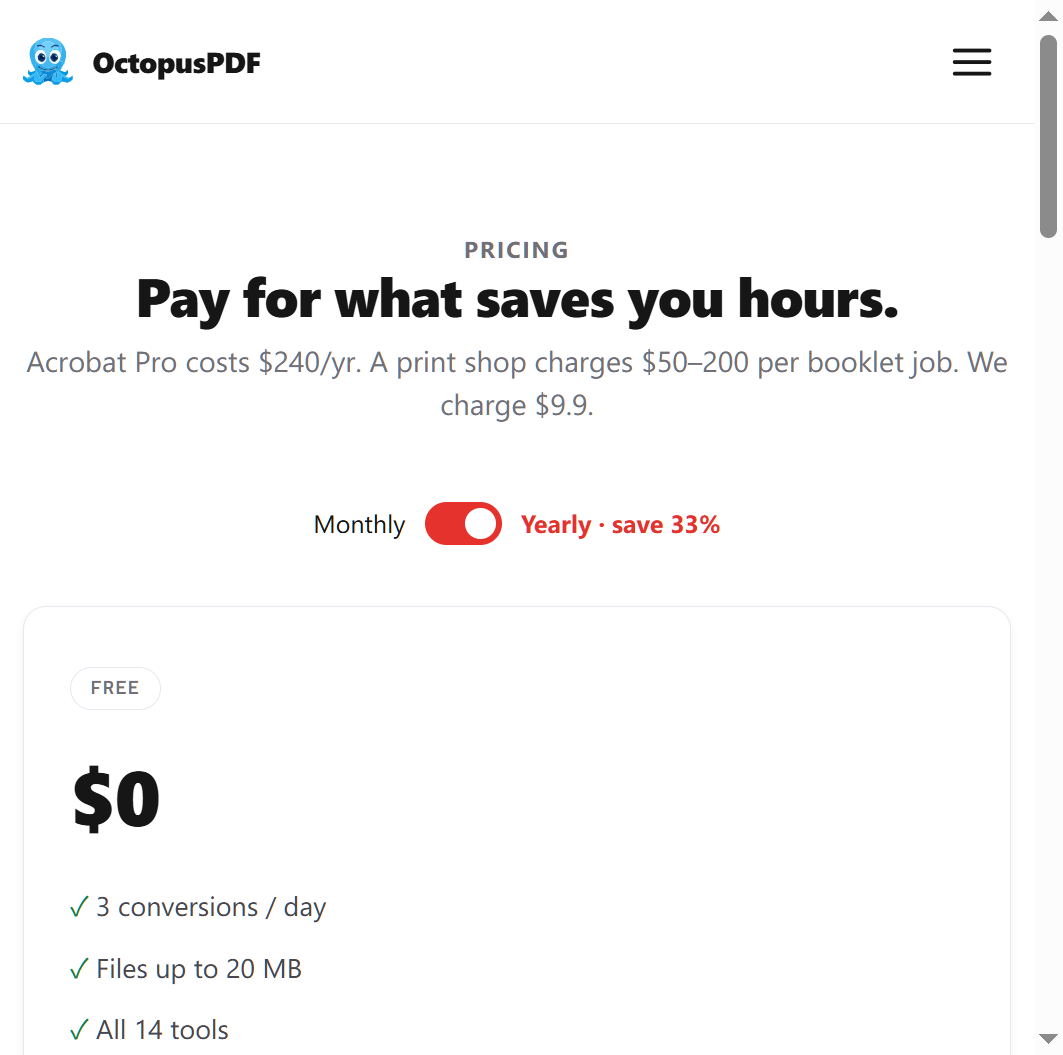
In each case, splitting is part of a larger chain of operations. The tool you choose should not force you to leave that chain and re-upload the file somewhere else.
3. How to Split a PDF: A Simple, Repeatable Process
Core conclusion: A dependable split workflow has four steps: add the file, choose the split mode, confirm the page ranges, and download the output. When the tool runs locally in the browser, there is no upload wait and no server copy left behind.
Step 1: Add the file
Open the split tool and select the PDF from your device. Because OctopusPDF states that its tools run in the browser with zero uploads, the file is processed on your machine rather than transmitted to a remote server [K3]. This matters most when the document contains financial, legal, or client-confidential information.
Step 2: Choose the split mode
Decide between the two modes described in Section 2:
- Extract page range: specify the start and end pages.
- Split every page: generate one PDF per page automatically [K3].
Step 3: Verify the range
Double-check the page numbers before processing. A common error is extracting "pages 5–10" when the intended range is "the fifth through tenth printed pages" — these differ when the PDF contains cover pages, appendices, or blank inserted pages. Use the tool's preview or page-count display to confirm.
Step 4: Download and follow up
Download the split files. If the original document carried sensitive metadata — author names, hidden comments, revision history — the extracted pages may still carry it. OctopusPDF addresses this with a dedicated Redact / Sanitize tool that "physically deletes metadata, comments and hidden content before sharing" [K2]. Running that pass on your output is a fast habit that prevents accidental data leaks.
4. Privacy, Metadata, and File Size: The Hidden Decision Factors
Core conclusion: Most users pick a PDF splitter by speed, but they should pick it by privacy model. If the tool uploads the file, the file exists somewhere beyond your control. If it runs locally, that concern disappears — but free limits and oversized files still need checking.
4.1 The zero-upload advantage
OctopusPDF's product overview states that all 14 of its tools run "in the browser with zero uploads" [K3]. That is a meaningful architectural choice for the workflows listed in its own documentation:
- A freelance designer can watermark client proofs and deliver files without the files ever leaving the browser tab [K1].
- A remote worker can handle confidential PDFs on a shared device [K1].
- A solo attorney can redact names and clauses before sending [K1].
For a split tool specifically, zero-upload processing means that after you download the split pages, there is no cached copy of the original on a third-party server.
4.2 Metadata is not removed by splitting
A split is a page-level operation. Metadata is document-level: it can survive into the output files. OctopusPDF's Redact / Sanitize tool exists precisely because shared PDFs leak information through "metadata, comments and hidden content" [K2]. If you split a client statement and send one page, check that the output does not carry the client's full history. The tool's sanitization runs 100% locally and physically deletes those hidden elements [K2].
4.3 Free and paid limits
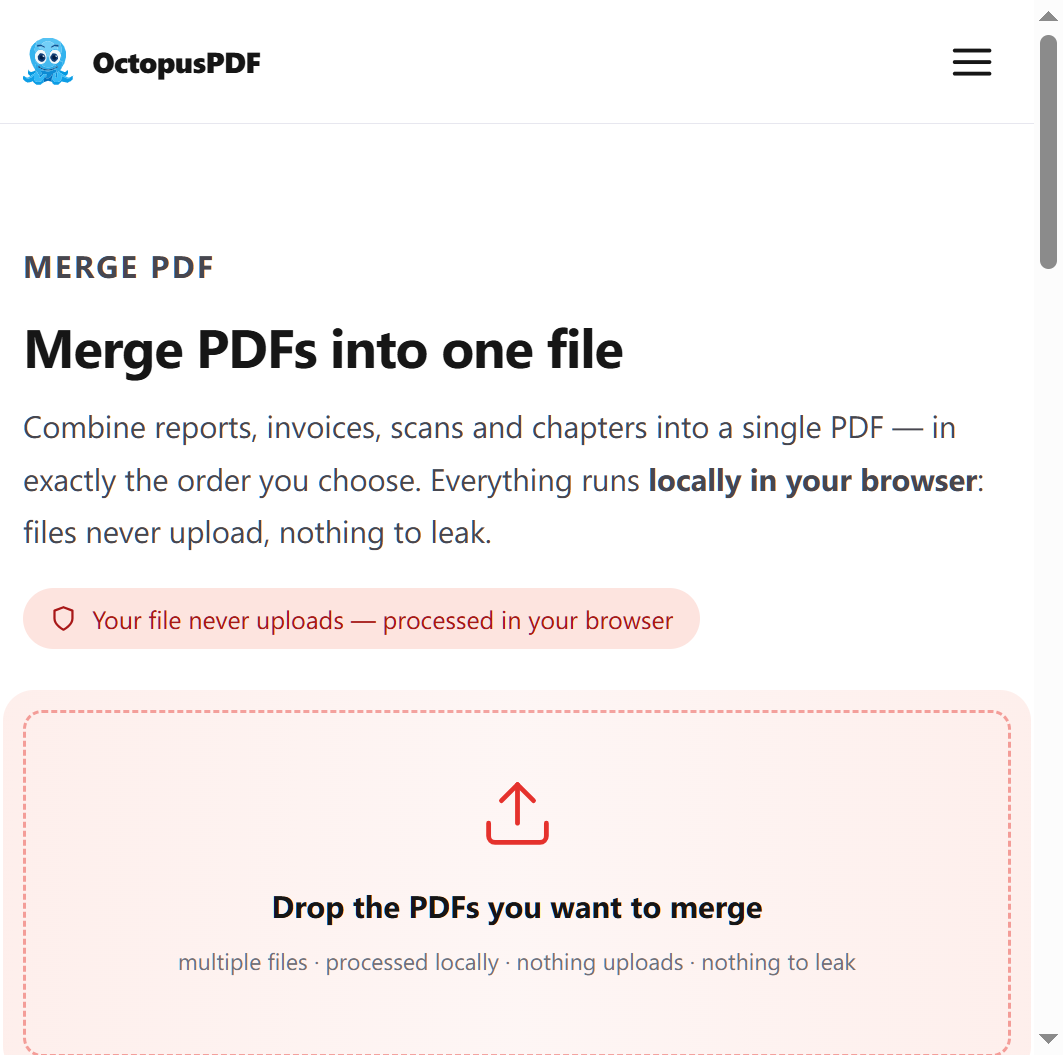
Free tiers exist, but they come with boundaries. OctopusPDF's Redact / Sanitize tool, as one documented example, offers:
| Plan | Conversions | File size | Extras |
|---|---|---|---|
| Free | 3 conversions per day | 20 MB files | — |
| Pro | Unlimited | 100 MB files | Batch mode |
For small business workflows, OctopusPDF also notes that Pro covers merging invoices and splitting statements "up to 100 MB" [K1]. Before you process a 500 MB PDF, verify the tool's limit — a tool that silently fails on large files will waste more time than a slower but honest alternative.
5. Key Comparison: What to Look For in a PDF Split Tool
Use this table as a decision checklist. It compares the practical differences between browser-local tools, upload-based web services, and desktop software, using OctopusPDF's documented behavior as the reference example for the browser-local category.
| Criterion | Browser-local tool (e.g., OctopusPDF) | Upload-based web service | Desktop software |
|---|---|---|---|
| Where the file is processed | Locally in the browser; zero uploads [K3] | On the provider's server | On your machine |
| Privacy risk | Low — no server copy of the original | Higher — file sits on external infrastructure | Low, but depends on network behavior |
| Free tier | Available; 14 free tools [K3]; daily/file caps may apply [K2] | Often available; limited by upload size | Often trial-limited or paid |
| Large files | Pro tier supports up to 100 MB [K1][K2] | Depends on the service | Depends on your hardware |
| Batch processing | Pro includes batch mode [K2] | Sometimes available on paid plans | Usually available |
| Metadata cleanup | Separate Redact / Sanitize tool [K2] | Rarely included | Sometimes included |
Questions to ask before choosing a splitter
- Does the tool upload my file anywhere? If the FAQ does not say "zero upload" or "processed locally," assume the file is uploaded.
- Does it support page ranges and per-page splits? You need both modes for real workflows [K3].
- What happens after processing? Is the file deleted from the server? Can you verify that?
- What are the file size and daily limits? Free tiers often cap at 20 MB and a few conversions per day [K2].
- Can it remove metadata after splitting? If not, plan a sanitization step separately [K2].
6. FAQ
Q1. Can I split a PDF into custom page ranges instead of every page?
Yes. A proper split tool supports both modes: extracting a specific page range, or splitting every page into its own PDF [K3]. Choose range extraction when you need one section, and per-page split when you need standalone deliverables.
Q2. Do browser-based PDF splitters upload my files to a server?
It depends on the tool. Some browser-based tools process files locally with zero uploads — OctopusPDF states this explicitly for all 14 of its tools [K3]. Others use the browser as a gateway and still send files to a backend server. Read the privacy documentation before trusting a tool with confidential documents.
Q3. What file size can I split for free?
Free limits vary by tool. As one documented reference, OctopusPDF's Redact / Sanitize tool allows 3 conversions per day with files up to 20 MB on the free plan, while the Pro plan raises the limit to 100 MB with batch mode [K2]. Small business workflows involving invoice merging and statement splitting are covered up to 100 MB on Pro [K1]. Check the specific tool's limit before processing large files.
Q4. Is it safe to split confidential PDFs in a browser?
It can be, if the tool runs locally. Browser-local processing means the file never leaves your device [K3], which is why OctopusPDF's listed workflows include solo attorneys, accountants wiping hidden metadata before e-filing, and remote workers handling confidential PDFs on shared devices [K1][K2]. For maximum safety, pair the split with a redaction/sanitization step to remove comments, metadata, and hidden content before sharing [K2].
7. Conclusion
Splitting a PDF is genuinely quick when you make three decisions up front: which split mode you need, which privacy model you trust, and what to do with the output after the split.
- Use range extraction when you only need part of a document.
- Use per-page split when every page is a deliverable.
- Choose a tool that processes locally with zero uploads for anything sensitive [K3].
- Finish with a sanitization pass so metadata, comments, and hidden content do not leak through the split files [K2].
For most users, a browser-based local tool is the most practical route: no installation, no upload risk, and the split operation sits alongside merge, rotate, organize, and redact tools in the same workflow [K3][K2]. If you split files regularly — for client statements, manuscripts, or print preparation — verify the free tier's daily and size limits, then decide whether a paid plan with higher limits and batch mode is worth it.
The next step is simple: take a real file, run it through a split tool that discloses its privacy model, and verify the output before you trust the tool with confidential work.