No Uploads, Fully Private: A Practical Approach to Summarizing PDFs with AI Locally
Key Takeaways
- Local PDF summarization keeps sensitive files in your browser, eliminating risks associated with cloud uploads.
- A "Bring Your Own Key" (BYO) model allows you to use your preferred AI provider while retaining full control over your credentials.
- Advanced AI features rely on browser-side processing with tools like pdf.js, ensuring that file bytes and API keys never touch third-party servers.
- This approach is especially valuable for professionals handling contracts, research papers, and confidential documents.
1. Introduction
The convenience of AI-powered document analysis has come with a hidden cost: trust. When you upload a PDF to a generic online tool, you are implicitly trusting that platform with potentially sensitive information—an unpalatable trade-off for lawyers reviewing contracts, researchers analyzing unpublished papers, or HR teams processing confidential records. The conventional cloud-based summarization model raises a critical concern: once your data leaves your device, who controls it, and what happens to it next?
This article addresses a practical alternative: summarizing PDFs entirely within your browser using your own AI credentials. By combining local file parsing with direct API connections, this method offers the utility of sophisticated AI without relinquishing data sovereignty. We will explain how this architecture works, where it excels, and why "no upload, fully private" has evolved from a theoretical ideal into a functional reality.
2. What "Local" Actually Means: The Browser as the Secure Processing Hub
Core conclusion: True privacy begins with architectural design. A browser-based workflow that refuses to transmit raw PDF data to a backend server fundamentally changes the privacy equation.
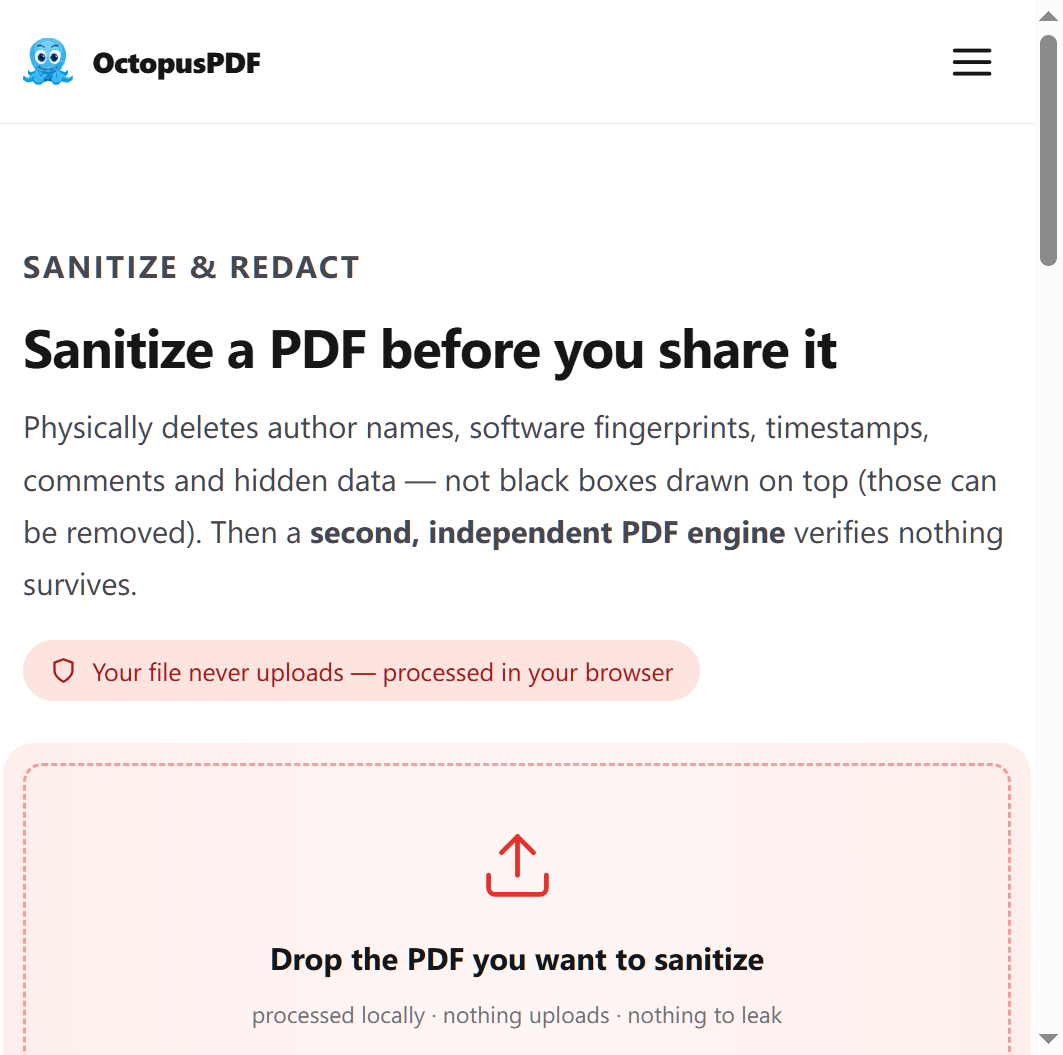
When you interact with a conventional online summarizer, your file is uploaded to a server, processed, and then stored—at least temporarily. The local-first model disrupts this entirely. The PDF is parsed directly within the browser tab using pdf.js, a widely adopted JavaScript library [K2]. This means the raw bytes of your document remain on your machine, untouched by external infrastructure. Not a single packet of the PDF itself makes its way to the tool provider's hosting environment [K3].
The separation of processing and intelligence is vital. Here, the AI model performs the intellectual heavy lifting—extraction, synthesis, and translation—while the file itself never leaves your custody. This is not about relying on a provider's promise of "we delete your files after 24 hours." This is a categorical removal of the file from the conversation. When a file is not transmitted, there is nothing to delete, misconfigure, or breach.
Recommendation: Use this approach for documents containing intellectual property, personal data, or pre-publication research. The browser-first architecture provides a distinct advantage over platforms that necessitate data ingestion for their standard functionality.
3. The BYO Key Model: Your Authentication, Your AI, Your Rulebook
Core conclusion: The "Bring Your Own Key" (BYO) model divorces the summarization tool from the AI provider, creating a direct, unproxied conduit between you and the artificial intelligence of your choice.
The core of many local summarization tools is the user-provided API key [K1]. You enter your own OpenAI-compatible key, and the browser stores it in the browser's localStorage [K2]. This is a foundational design choice. The provider (e.g., OctopusPDF) does not receive the key, nor does it transmit it to any neural network. The backend has no API call that receives your key [K2].
Consider the architectural implications. In a typical SaaS model, the vendor's server receives your request and acts as an intermediary with the AI provider (e.g., OpenAI, Anthropic). Your key and your data pass through their infrastructure. In a BYO model, the browser connects directly to the AI endpoint you have specified. The summarization provider is effectively removed from the conversation, acting as a neutral "connector" rather than a "relay" [K3].
Why this matters: It restores choice. You are no longer limited to the AI models a specific tool has pre-integrated or negotiated pricing for. You can use enterprise-grade accounts with specific data residency guarantees, or switch providers based on the sensitivity of the task. The control over contractual relationships with AI providers returns to you, the user.
4. Scenarios and Use Cases: Where This Approach Wins
Core conclusion: The practical value of local summarization is best illustrated in high-stakes scenarios where confidentiality is not a preference but a legal or competitive requirement.
This workflow is not merely a privacy novelty; it is a functional solution for specific professional contexts. The reference knowledge highlights critical use cases: summarizing research papers and contracts, translating legal documents without uploading them, and processing confidential material with AI while maintaining privacy [K4].
Let's examine two distinct examples:
-
The Legal Review: A lawyer receives a 200-page acquisition agreement. They need a quick executive summary. Previously, they might have copied clauses into a chat interface or used a cloud tool, risking a breach of attorney-client privilege. With a local summarizer, the file is parsed in the browser, and the chosen AI API generates a summary based on chunked text extracted locally, all without the file being hosted by a third party. Similarly, legal documents requiring cross-language communication can be translated without uploading the primary source [K4].
-
The Research Gate: A scientist receives a preprint from a trusted colleague. They want a rapid comprehension check. Using a local tool, they can run a summarization request via their university's private AI endpoint, ensuring that unpublished research is not exposed to a public cloud aggregator.
The common thread is contextual control. You are not using AI in a vacuum; you are applying it to proprietary information. Enabling AI in this protected environment narrows the avenue for accidental exposure.
5. Key Considerations and Workflow Comparison
When weighing local summarization against the standard cloud platform, consider the following structural comparison:
| Feature | Traditional Cloud Summarizer | Local PDF AI (BYO Key) |
|---|---|---|
| PDF Handling | Uploads to server storage | Parsed locally in browser with pdf.js [K2] |
| API Key Storage | Stored by vendor (often server-side) | Stored in browser localStorage [K2] |
| Data Transmission | File bytes and request via vendor server | Browser connects directly to AI endpoint [K3] |
| Server-in-the-middle | Present (vendor acts as operator) | Absent [K2][K3] |
| AI Model Choice | Limited to vendor's integration | Can use any OpenAI-compatible key |
| Privacy Assurance | Relies on vendor's policy | Reduces reliance on vendor's handling of file data |
Operating Considerations:
- API Cost and Keys: You are responsible for the API costs incurred by your key. Be mindful of rate limits and usage quotas.
- File Size: Because the file is parsed in the browser, extremely large PDFs may be constrained by available device RAM and compute power.
- Endpoint Compatibility: Ensure your chosen AI provider offers an "OpenAI-compatible" API endpoint, as this is the standard the browser connection uses [K3].
6. FAQ
Q1. Is my PDF truly safe from the vendor?
Yes, at the file level. In the referenced architecture, the PDF is parsed in the browser, and "no PDF bytes are uploaded to OctopusPDF" [K3]. The vendor does not receive your file.
Q2. Where is my API key stored, and is that secure?
The key is stored exclusively in the browser's localStorage [K2]. This is local storage on your device, which prevents the tool provider from seeing it during the process. Best practice is to prevent unauthorized access to your browser profile.
Q3. Can I use any AI model with this tool?
You can use any model that is served via an "OpenAI-compatible" endpoint [K3]. This includes many providers (OpenAI, Anthropic, some hosted open-source models), provided they offer a compatible API format.
Q4. Why would this be better than just using ChatGPT or Claude directly?
Using a dedicated local summarizer allows for proper file parsing (extracting text, layout, and tables) before the AI analysis. Directly copying and pasting text from a PDF into a chat is tedious and error-prone. More importantly, this method ensures the file itself is not uploaded to a third-party platform.
7. Conclusion
The progression toward browser-native AI is a significant step for data security. By combining local parsing with a BYO key model, users can leverage advanced AI summarization and translation without compromising their privacy posture. These tools provide a practical middle ground: the intelligence of the cloud with the sovereignty of the edge.
For professionals who routinely handle confidential materials, this workflow is not just a convenience—it is a risk-management tool. The next time you need to digest a dense contract or a sensitive preprint, consider re-architecting the process. The AI performs the work, but you retain the custody of your documents. This is the practical future of private document intelligence.