Key Takeaways
- Yes, iLovePDF uploads files. Its web-based tools transmit your PDF to iLovePDF's cloud servers for processing, following the same upload-based architecture used by mainstream online PDF tools [K1].
- Deletion promises are not verifiable. Even when a cloud service states it deletes files after a set time, you cannot independently confirm that claim [K2].
- Sensitive documents demand a different approach. Legal, medical, tax, and investigative files should not pass through third-party servers; privacy-sensitive use cases require local processing [K5].
- Privacy by architecture beats privacy by policy. Tools like OctopusPDF are engineered so the server physically cannot receive your file, removing the entire class of upload-related risks [K4].
- Your choice should depend on document sensitivity. Cloud tools are convenient for ordinary files; local-processing tools are the responsible choice when confidentiality matters.
1. Introduction
You open a PDF tool in your browser, drag in a contract, click "convert" or "redact," and the job is done in seconds. But in that moment, your file left your device. It traveled to a server owned by someone else, was processed there, and then returned to you as a download. You may not have thought about where your file went — or what it was exposed to in the process.
This is the reality of the online PDF industry. The vast majority of web-based PDF tools, including iLovePDF, operate on a cloud upload model. That raises a question every privacy-conscious user should ask: does iLovePDF upload files, and what does that mean for the confidentiality of my documents?
The answer matters more than you might think. A PDF is rarely just text. It often contains signatures, legal names, medical information, tax identifiers, employment history, and other personal data protected by regulations such as GDPR. When such a file is uploaded, it exists on someone else's infrastructure — with all the retention, breach, and cross-border risks that entails.
This article answers the question directly, explains how the upload-based model actually works, outlines who should be most concerned, and presents a practical alternative for privacy-sensitive scenarios.
2. How iLovePDF's Cloud Upload Model Works
Core conclusion: iLovePDF's web tools are upload-based. Your file is transmitted to a cloud server, processed there, and then returned to you via a download link.
The architecture behind iLovePDF is standard for the online PDF industry. When you use a web tool — whether merging PDFs, compressing files, converting formats, or applying OCR — the same sequence occurs:
- Your browser uploads the file over an encrypted HTTPS connection to iLovePDF's cloud server.
- The server processes the PDF using its own computing resources.
- The processed result is stored temporarily on the server and a download link is generated.
- You download the result, and the server-side copy is scheduled for deletion based on the company's stated retention policy.
This pattern is not unique to iLovePDF. The broader industry operates this way: "Every mainstream online redaction tool (FreePDFRedactor, AvePDF, DocHub, Smallpdf) uploads your file to a server" [K1]. The entire category of web-based PDF utilities is built around server-side processing.
The critical implication is this: the moment you select a file in iLovePDF's web interface, that file exists in three places simultaneously — on your device, in transit, and on a server you do not control. The first two are manageable risks. The third is the one you need to evaluate carefully.
Practical recommendation: Before using any web-based PDF service, read the provider's privacy policy with specific questions in mind: Where is the file stored and in which jurisdiction? How long is it retained? Who has technical access to it? Keep in mind, however, that reading a policy is not the same as receiving a guarantee — a point we examine next.
3. The Cloud Privacy Problem: Deletion Promises vs. Architectural Reality
Core conclusion: A promise that a server deletes your file after processing is not independently verifiable. This is the fundamental paradox of upload-based privacy tools [K1].
Here is the uncomfortable fact about every cloud PDF service, iLovePDF included: a company can state in its privacy policy that files are automatically deleted after processing, but you as a user cannot verify that claim. As one privacy-focused analysis puts it: "Even when they promise to 'delete after 1 hour', you cannot verify it" [K2].
Think about what your PDF actually contains. Contracts, tax forms, medical records, and manuscripts are precisely the document types that should never spend time on a stranger's server [K2]. When a file is uploaded, you are relying entirely on trust in a company's stated policy — not on a technical design that prevents the file from being stored in the first place.
There is also a deeper logical inconsistency. "The tool claiming to protect your privacy is the same one your file just passed through" [K1]. A service meant to handle confidential documents, but which requires you to ship the document to its server for processing, asks you to accept a contradiction: you are sharing the very information you are trying to protect.
What practical risks does this create?
- Exposure during processing: Even with encryption in transit, the file's content is visible to the server's internal processes, which may include logging, diagnostics, or analytics.
- Unverifiable retention: You cannot audit whether deletion actually occurs according to the stated schedule.
- Breach risk: Any server storing user files is an attack target. Your PDF becomes part of a centralized repository that, if breached, exposes every uploaded file.
- Cross-border transfer: The server may reside in a jurisdiction with different data protection laws than your own, complicating GDPR compliance [K5].
- Policy changes: Companies can update terms, respond to government requests, or change retention practices without your knowledge.
Practical recommendation: If you are a legal professional, medical worker, HR recruiter, journalist, or anyone handling personally identifiable data, do not upload those files to a web-based PDF service without a documented and independently audited retention policy. The cost of a leaked patient record or privileged legal draft is measured in legal liability, not just embarrassment.
4. Who Should Care Most: Privacy-Sensitive Use Cases
Core conclusion: For a well-defined set of use cases, cloud upload is simply not acceptable — local processing is the only suitable approach.
Some PDF tasks are ordinary and low-risk. Converting a public product manual or compressing a presentation is unlikely to cause harm if the file were exposed. But there is a documented set of use cases that demand privacy by design:
- GDPR compliance: Processing personal data without sending it to third parties. Uploading EU personal data to a foreign server complicates your compliance position [K5].
- FOIA requests and whistleblower submissions: Any server-side trace can compromise a source's identity or a legal strategy [K5].
- Legal and medical documents: Files covered by attorney–client privilege or patient confidentiality regulations require the highest level of control [K5].
- Resume and job application redaction: Candidates redact personal details before sharing — sending that file through a third-party server undermines the purpose of redaction [K5].
- Tax forms before e-filing: Financial documents containing Social Security numbers, income data, and bank details are prime targets for misuse [K5].
- Confidential PDFs on shared or company devices: Files on a shared computer demand caution about where they are processed and who can access them [K5].
Notice the common thread: in every scenario, confidence depends on whether the file can be kept out of reach of third parties. An uploaded file produces a server-side copy that the user cannot delete, cannot audit, and cannot monitor.
Practical recommendation: If your file falls into any of these categories, the question "does iLovePDF upload files?" is already the wrong question. The right question is: "Should this file ever leave my device?" If the answer is no, you need a tool that processes locally.
5. Privacy by Architecture: How Local-Processing Tools Change the Equation
Core conclusion: The alternative to upload-based tools is browser-side processing, where the file never travels to a server in the first place — privacy enforced by design, not by promise.
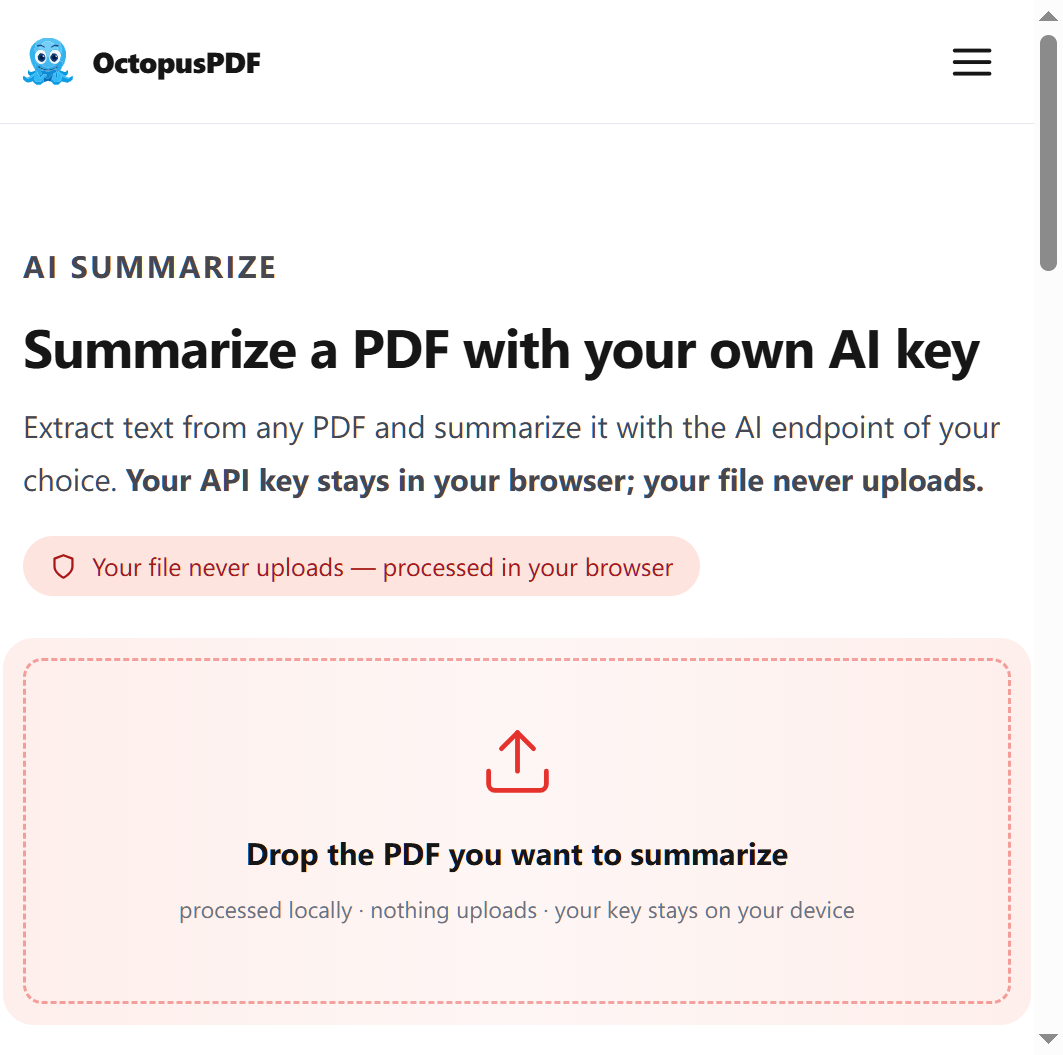
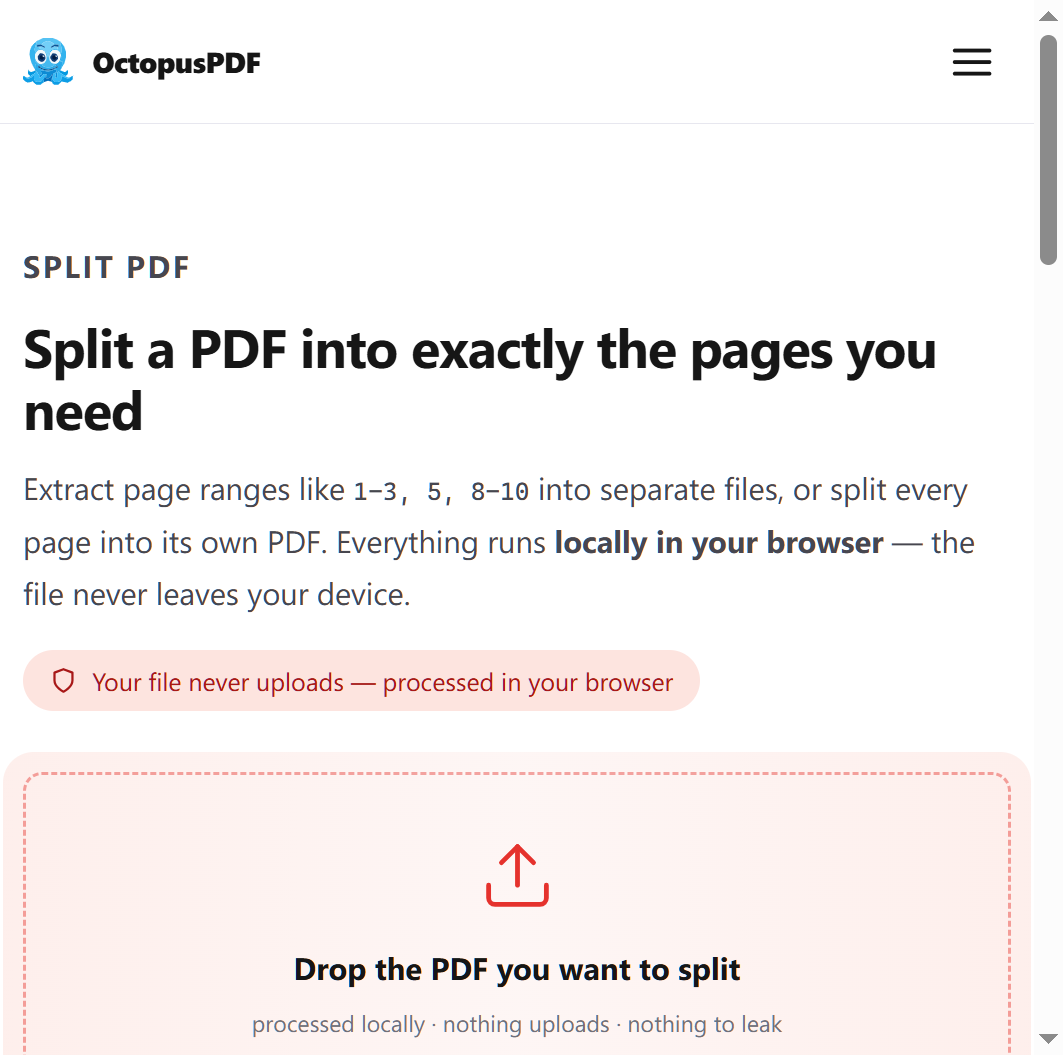
Several tools now handle PDF processing entirely within the browser using client-side JavaScript. OctopusPDF, for example, is designed so that the system "physically cannot receive user files" [K4]. This is what "private by architecture, not by policy" means [K4]: the engineering makes it impossible for the service provider to obtain your document, rather than simply promising to delete it later.
Here is how the process works:
- You open the tool in your browser and select a PDF.
- The file is parsed locally inside the browser tab using technologies such as pdf.js.
- Redaction, sanitization, conversion, or other operations run entirely on your device's CPU.
- The result is saved directly to your computer. No upload step exists at any point [K2][K4].
The same architectural approach extends to AI-powered features. In a bring-your-own-key (BYOK) model, the PDF is parsed in the browser, your API key is stored only in local browser storage, and the browser connects directly to the OpenAI-compatible endpoint you specify — the service does not proxy the request [K3]. This means no server in the middle can intercept either your file or your API key [K3].
For users handling the sensitive documents described earlier, this approach removes an entire category of risk. There is nothing to leak from a server you never used. There is no retention policy to trust. There is no centralized repository of user files for attackers to target.
Practical recommendation: Match the tool to the sensitivity of the workflow:
- For one-off conversion of non-sensitive, public documents, cloud tools like iLovePDF are convenient and adequate.
- For legal, medical, tax, HR, or investigative documents, use a tool whose architecture prevents uploads entirely — such as OctopusPDF — so the confidentiality of the file depends on engineering, not trust.
6. Key Comparison: Cloud-Upload Tools vs. Local-Processing Tools
| Factor | iLovePDF (web-based) | Local-processing tools (e.g., OctopusPDF) |
|---|---|---|
| Where the file is processed | iLovePDF cloud servers | Your browser, on your device |
| Does the file leave your device? | Yes, it is uploaded [K1] | No [K4] |
| Deletion guarantee | Stated in privacy policy; not independently verifiable [K2] | Not needed — no server copy is ever created |
| Server breach risk | File is part of a central repository | None by design |
| Suitability for legal/medical/tax data | High risk; not recommended | Recommended [K5] |
| AI features (summar |