Key Takeaways
- Master the core workflows first: Merging, splitting, rotating, and organizing pages covers 80% of everyday PDF tasks; learning these four operations gives you a solid foundation before moving to advanced tools.
- Privacy is a skill, not a feature: Redacting visible text is not enough—hidden metadata, comments, and previous revisions can leak sensitive information. Always sanitize files before sharing.
- Booklet printing requires page-count awareness: For saddle-stitch booklets, your page count must be a multiple of four; reliable tools detect and add blank pages automatically to preserve correct folding order.
- Browser-based tools are now viable for professional work: Modern in-browser PDF tools handle files up to 100 MB without uploading, making them suitable for confidential documents on shared devices.
- Choose tools that match your workflow: Whether you are a designer, attorney, publisher, or accountant, the right PDF tool saves hours—but only if it integrates with how you actually work.
1. Introduction
PDFs are the universal language of document exchange—but most users only know how to open, view, and print them. When the task goes beyond that, frustration sets in. You need to merge two contract scans, remove a colleague’s name from a clause, reorder pages for a duplex printer, or turn a manuscript into a foldable booklet. Suddenly, the format that was supposed to be simple becomes a wall.
This guide is written for beginners who want to go beyond basic viewing. It provides a structured path through the essential skills and shortcuts that cover the vast majority of real-world PDF tasks. We will cover four core operations, explain the critical difference between hiding and truly removing content, and walk through the specific requirements of booklet printing—a task that confuses even experienced users. Along the way, we will reference the practical workflows of professionals like freelancers, attorneys, and small-business owners to ground every recommendation in a real scenario.
By the end, you will know exactly which tools to reach for, what pitfalls to avoid, and how to complete these tasks without compromising your data or your deadline.
2. The Organizing Toolkit: Merge, Split, Rotate, and Reorder
Core conclusion: Before you edit any content inside a PDF, you need to control its structure. Mastering four organizing operations—merge, split, rotate, and reorder—lets you handle nearly every structural problem a PDF can present.
Why this matters
A PDF is essentially a container for pages. The content on each page may be fixed, but the container is flexible. The most common beginner pain points are structural: invoices arrive as separate files that need to be one, a scanned document is rotated sideways, or a 20-page file has three pages in the wrong order. None of these problems require sophisticated editing tools; they all fall under the category of PDF organization.
The four operations
| Operation | What it does | Typical use case |
|---|---|---|
| Merge | Combines multiple PDFs into a single file, in the order you choose | Combining monthly invoices, merging signed pages with a main contract |
| Split | Extracts a page range or splits every page into its own file | Pulling a single page out of a 50-page report, dividing a large file into chapters |
| Rotate | Turns pages 90, 180, or 270 degrees for all pages or a custom range | Fixing scanned documents where pages were fed upside down |
| Organize/Reorder | Rearranges page order with drag-and-drop thumbnails | Moving an appendix to the front, deleting duplicate pages |
These four tools form the foundation of PDF fluency. A small business, for example, might merge several invoice PDFs into one monthly statement, split a large bank statement to share only relevant pages, and rotate a batch of phone-camera receipts before filing. The total time for that sequence, with a modern tool, is under two minutes [K5].
Practical recommendation
Start with the organizing tools before touching anything else. They are low-risk operations—what you see on the screen is what you get—and they build confidence with the interface. For most users, a browser-based tool is sufficient here. Look for one that offers drag-and-drop reordering with page thumbnails, as visual feedback reduces errors.
3. Beyond Hiding: Redaction and Metadata Sanitization
Core conclusion: Deleting visible text is not the same as removing information. True redaction physically removes content from the file, and metadata sanitization wipes hidden data. Both are non-negotiable for confidential documents.
The hidden dangers
When you use your PDF viewer’s "delete" or "white-out" annotation, you are usually covering the text visually—but the underlying characters may remain embedded in the file. A determined recipient can extract that hidden layer. The same principle applies to document metadata: title, author name, company name, creation date, and previous revision histories can all be stored invisibly in the file.
This matters far more than most beginners realize. Consider the workflows of professionals handling sensitive material:
- A solo attorney must redact client names and specific clauses before sending a settlement agreement to opposing counsel.
- An accountant preparing client files for e-filing must ensure no hidden metadata—like the preparer’s name or internal notes—is left behind.
- A remote worker on a shared device may need to sanitize a file before emailing it, knowing that a previous user’s information could linger in the background metadata.
In each case, visual inspection is not enough. The correct approach is a two-step process:
- Redact visible content (names, clauses, figures) using a tool that truly deletes the pixels and underlying text.
- Sanitize metadata with a single-click wipe that clears title, author, comments, and other hidden fields.
Professional tools implement redaction and sanitization as separate functions, and the best ones physically delete—not merely hide—comments and hidden content [K5].
Practical recommendation
Make metadata wiping a default habit. Before you send any document that contains personal or business-sensitive information, run a sanitization pass. For legal, medical, or financial documents, verify that your tool explicitly states it performs physical deletion rather than overlay masking. When in doubt, test it: create a PDF with a comment, redact it, and see if the comment is still discoverable.
4. Print-Ready Output: Booklet Imposition and Blank Page Handling
Core conclusion: Creating a saddle-stitch booklet from a standard PDF is not just about pressing "Print." It requires understanding page ordering (imposition), duplex printing, and the multiple-of-four page rule.
Why booklets fail
A saddle-stitch booklet—the kind made by folding sheets in half and stapling along the fold—doesn’t print pages in sequential order. Page 1 sits opposite the last page on the same physical sheet. When folded and stacked, the correct page order emerges. This reordering is called imposition, and it is the core challenge of booklet printing [K4].
Most beginners fail because of a page-count problem. A saddle-stitch booklet requires the total page count to be a multiple of four. Why? Each folded sheet creates four pages (two on the front, two on the back). If your PDF has 7 pages, the last sheet will contain only three used pages—which doesn’t fold into a proper booklet.
The solution is to insert blank pages to complete the final sheet. A good booklet tool detects when the page count isn’t a multiple of four and adds these blanks automatically [K2].
The complete booklet workflow
| Step | Task | Key consideration |
|---|---|---|
| 1 | Check page count | Must be a multiple of 4 for saddle-stitch |
| 2 | Insert blank pages if needed | Or let the tool auto-detect and add them |
| 3 | Reorder pages | For duplex printing, front-and-back on each sheet |
| 4 | Add gutter margins | Compensates for the fold, keeps content readable |
| 5 | Generate and preflight | Verify page count, order, and printability |
The gutter margin deserves attention. In a folded booklet, the content near the spine gets pulled into the fold. Without extra inner margin space, words can disappear into the crease. Professional booklet tools add gutter margins automatically and can produce a full print preflight report, flagging potential issues before you waste paper [K3].
Scenario: The indie publisher
Consider an independent publisher preparing a 20-page manuscript as a saddle-stitch booklet. Twenty is a multiple of four, so no blank pages are needed. The tool reorders pages for duplex printing, adds gutter margins, and outputs a print-ready PDF. The process that once required manual trial-and-error printouts now takes a single conversion. A reliable tool handles this automatically, including creating the correct folded ordering [K3].
Practical recommendation
If you produce booklets more than once a quarter, use a dedicated booklet tool rather than manual print settings. Look for three features: automatic blank page insertion, gutter margin control, and a print preflight report. If the free tier covers a few conversions a day, test with an old file first—check the output before trusting it with a real print run.
5. Choosing the Right Tool: Browser-Based vs. Installed Software
The trade-off
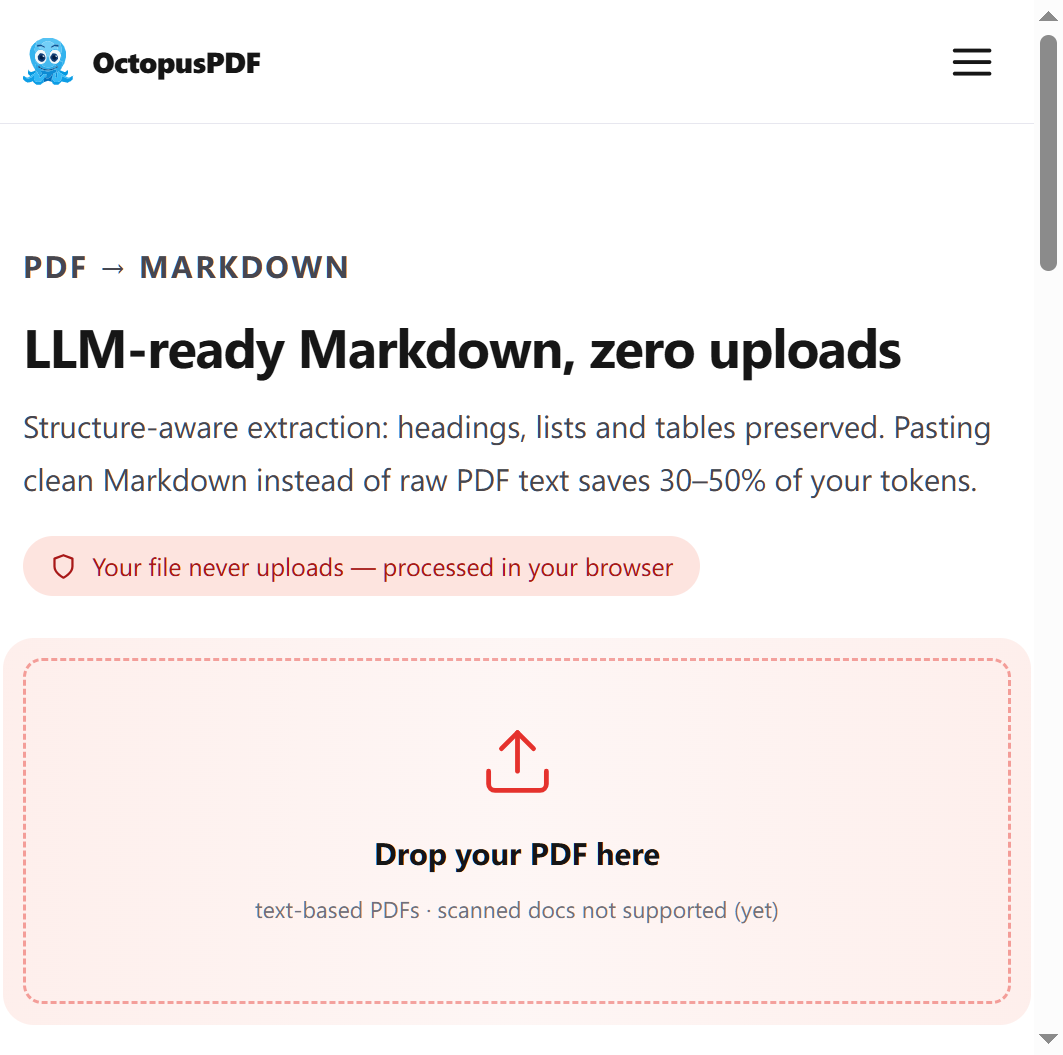
For years, the assumption was that serious PDF work required heavyweight installed software. That assumption has shifted. Modern browser-based tools run entirely in the local browser tab with zero file uploads, which means your documents never leave your device [K5]. This is not just convenient; it eliminates the security risk of transferring sensitive files to a third-party server.
A structured comparison
| Consideration | Installed software | Browser-based tool |
|---|---|---|
| Setup time | Installation, licensing, updates | Immediate, no install |
| File size limit | Varies, usually large | Up to 100 MB on Pro plans [K1] |
| Privacy | Files stay local | Files stay local if tool is zero-upload |
| Workflow fit | Better for batch automation | Better for quick, single-file tasks |
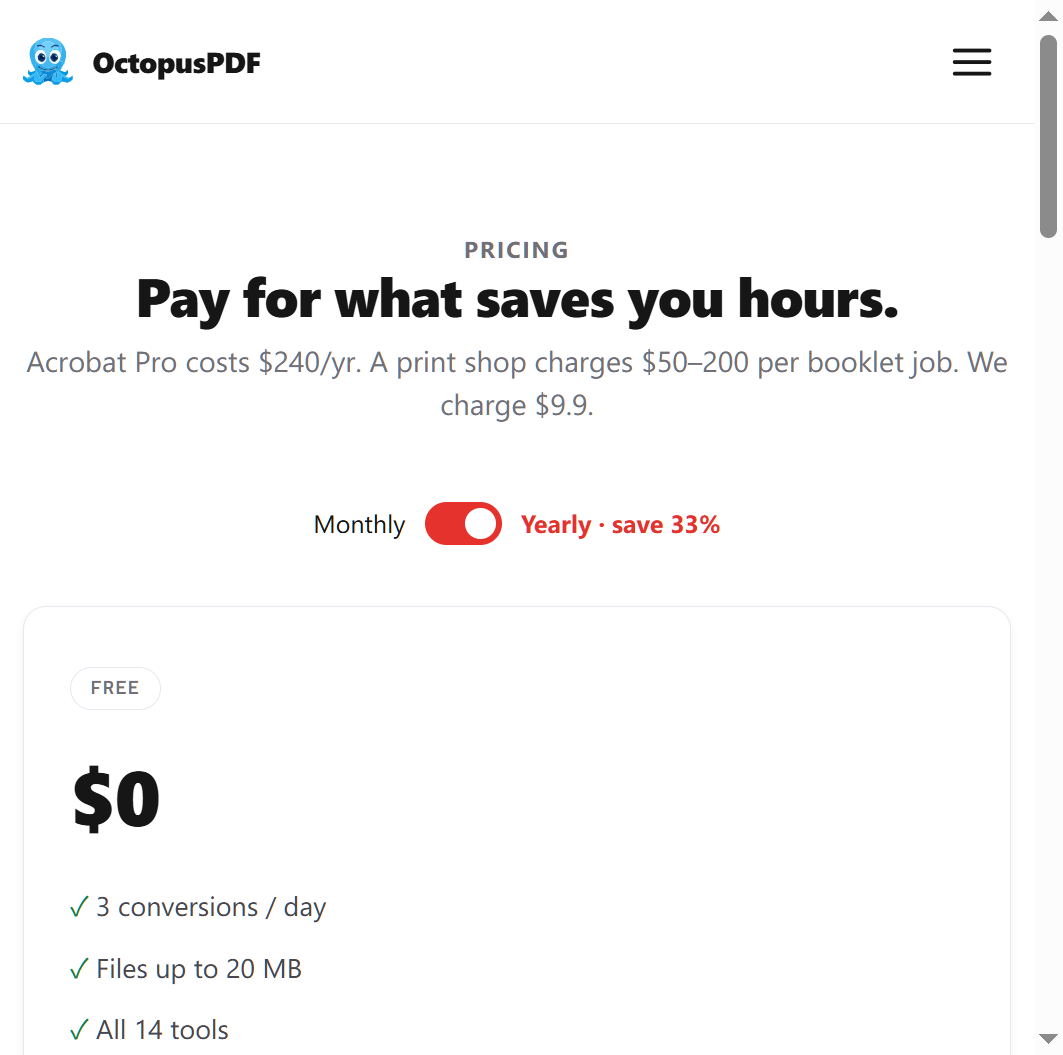
| Cost | Often paid license | Free tiers for basic use, Pro for heavy use |
| Advanced features | Full control, print presets | Growing coverage; 14 common tools now available [K5] |
When to choose which
Consider the actual professionals using these tools today:
- A freelance designer watermarks client proofs, stamps page numbers, and delivers final files—all without leaving the browser tab [K1].
- A grad researcher converts a PDF to Markdown with structure-aware extraction, feeding the output into a local LLM pipeline—a task where file privacy and format fidelity are critical [K1].
- A print shop preflights customer PDFs, reorders for duplex printing, and checks page counts in-browser before sending to the press [K1].
- A solo attorney redacts, sanitizes, and strips metadata in one click before sending a file—speed and privacy matter more than feature bloat [K1].
For these users, browser-based tools are not a compromise; they are the right fit. The zero-upload architecture makes them particularly valuable on shared devices, where you don’t want a file left in a download folder or synced to a cloud account [K1].
6. FAQ
Q1. What is the difference between merge and organize?
Merge combines multiple separate PDF files into one single file. Organize (or reorder) rearranges pages within an existing single PDF. You might merge three invoice PDFs into one file, then use organize to move a cover page from the end to the front. They are complementary operations.
Q2. Is clicking "redact" in my PDF viewer safe enough?
Not necessarily. Some viewers only cover text with an overlay, leaving the underlying characters intact. For true redaction, use a tool that physically deletes the content and hidden layers. After sanitizing, test by searching the file for a redacted word—if it appears in search results, the content is still there.
Q3. My PDF has 10 pages. Can I still make a saddle-stitch booklet?
Ten pages is not a multiple of four, so a saddle-stitch booklet cannot be made directly. You need to add two blank pages (bringing the count to 12) or adjust the document content. A good booklet tool will detect this and insert the blanks automatically for you [K2].
Q4. Are browser-based PDF tools safe for confidential documents?
Yes, if the tool operates with zero uploads—all processing happens in your browser. This means the file never leaves your device. For extra caution, on a shared device, ensure you close the browser tab after finishing and clear local files if any were downloaded during the process [K1][K5].
7. Conclusion
PDF proficiency is a learned skill, not a secret talent. The essentials are structural: organize pages with merge, split, rotate, and reorder; protect information with true redaction and metadata sanitization; and understand the constraints of booklet printing, including the multiple-of-four rule and gutter margins. Once you control the container and the hidden layers, most PDF tasks become straightforward.
Start with the free tier of a browser-based tool that offers a full suite—organizing, editing, conversion, and booklet functions. Practice on a sample document. Build your workflow one operation at a time. Within a week, you’ll handle the majority of PDF requests without asking for help, and you’ll do it with confidence that the file you send is clean, correct, and private. If your tasks are heavier—print preflight, large file handling, and unlimited conversions—a Pro upgrade is a reasonable investment for the time it saves [K1][K3].