Translating PDFs with AI Without Losing Formatting: Five Tips for Local Tools
Key Takeaways
- Local-first PDF translation tools process files directly in your browser, which means files and API keys never leave your device—a significant privacy advantage over cloud-only services.
- Format preservation is not automatic; it depends on how the tool parses the document and whether it uses page-by-page or flow-based translation methods.
- Bring Your Own Key (BYOKey) models give you cost control and flexibility by letting you use your own OpenAI-compatible API credentials, but they require technical setup on your end.
- Structure-aware extraction (like PDF-to-Markdown conversion) can save tokens and reduce formatting errors when feeding translated content into LLMs or knowledge bases.
- The best workflow combines local processing, page-by-page translation, and a structured review step to ensure both visual fidelity and linguistic accuracy.
1. Introduction
Translating a PDF while preserving its original layout—tables, columns, headers, footers, and images—has historically been one of the most frustrating tasks for professionals who work with international documentation. Whether you're translating a legal contract, a research report, or a product manual, the pain points are consistent: copy-pasting text into Google Translate distorts formatting, online translation services require uploading confidential documents, and most AI translators treat a PDF like a plain text file, stripping away the visual structure that makes it readable.
The shift toward AI-powered translation has improved the quality of translated text itself, but the formatting problem persists. Many users have experienced the disappointment of receiving a translated PDF where tables have collapsed, paragraphs have merged, and page breaks land in awkward places.
This is where local AI translation tools step in. By processing files on your own device using your own API keys, these tools offer a middle path: they use the power of large language models (LLMs) for translation while ensuring that your documents and credentials remain private. In this article, we'll walk through five practical techniques for using local AI tools to translate PDFs without sacrificing formatting—and we'll explain why the "local-first" approach is gaining traction.
2. Choose a Browser-Based, Local-First Tool That Never Uploads Your File
The first tip is also the most critical one: choose a tool that processes your PDF entirely in your browser. Not in a company server, not in a "secure cloud" that you have to trust—but literally on your machine.
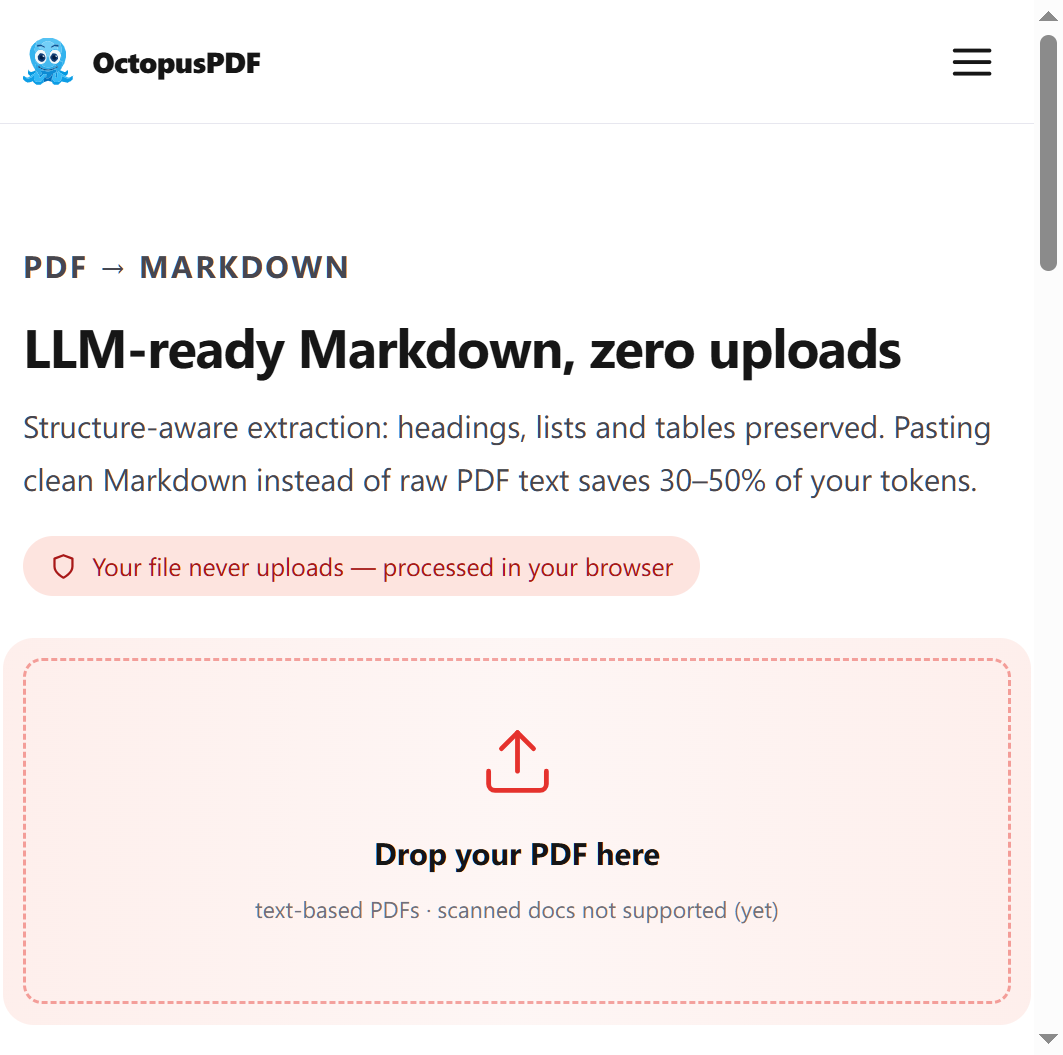
A growing category of PDF utilities now advertises what could be called the “zero-upload guarantee.” These tools parse your document directly in the browser tab using JavaScript libraries such as pdf.js, and the raw PDF file never leaves your device. For example, the OctopusPDF AI tools (which include both Summarize and Translate functions) explicitly follow this architecture: the file is parsed in the browser, and both the file and the user’s API key remain local throughout the process [K1].
Why does this matter for formatting? Because when a file is uploaded to a remote server, it often needs to be converted to images or re-parsed server-side, which can introduce layout compression, resolution loss, or encoding errors. Local processing, by contrast, preserves the original PDF structure and page geometry before translation begins [K3].
Practical advice: When evaluating a translation tool, look for explicit privacy statements that mention "local processing," "no server-in-the-middle," or "file never uploads." Be wary of tools that only promise "secure upload" and "deletion after 24 hours"—those are still uploading your document somewhere.
3. Use the Bring Your Own Key (BYOK) Model to Keep Your Credentials Private and Control Costs
The second technique concerns how you authenticate with the AI service. Instead of relying on the tool's built-in API quota (which usually requires you to pay a subscription and often routes requests through a middleman server), use a tool that supports the Bring Your Own Key model.
In this approach, you supply your own OpenAI-compatible API key. The tool uses that key to send requests directly from your browser to the AI provider's endpoint. The key itself is stored only in the browser’s localStorage, and the backend never sees or handles it [K1]. This arrangement offers two benefits for PDF translation:
- Cost transparency — You pay only for the tokens you consume on your own API account, rather than paying a monthly subscription fee that bundles all users' usage.
- Reduced interception risk — Since the browser connects directly to the AI endpoint, there is no third-party server in the middle that could log your content or your credentials [K5].
For formatting preservation, this architecture has a subtle but important implication. Since the API call is made from the same browser context that parsed the PDF, the tool can send richer context (like layout metadata, page dimensions, and table coordinates) to the model. This makes it easier for the AI to generate output that the tool can re-map back into the original PDF structure.
Practical advice: Choose tools that allow you to configure your own endpoint URL. This is especially useful if you use a local LLM server (such as Ollama or LM Studio that exposes an OpenAI-compatible API) or a private gateway—your data never even reaches a third-party provider if you're using your own local endpoint.
4. Prioritize Page-by-Page Translation Over Whole-Document Translation
Formatting often breaks when the translation tool tries to process an entire document in one pass. The AI model has limited token context, and when it processes a 20-page PDF in a single request, it must compress the content representation—which is where layout information gets lost.
The more reliable approach is page-by-page translation. This technique processes one page at a time, which means the model can focus on the complete content of a single page (including its layout context) and produce output that is easier to map back to the original coordinates. This is the approach used by some modern PDF translation tools, which explicitly offer page-by-page translation across more than nine languages [K4].
| Dimension | Whole-Document Translation | Page-by-Page Translation |
|---|---|---|
| Context window | Can exceed model limits on long docs | Always within per-page token limits |
| Format retention | Poor; tables/columns often collapse | Better; retains page-specific layout |
| Error isolation | One bad generation corrupts everything | Errors are contained to a single page |
| Use of spatial metadata | Low; text is re-ordered | High; preserves reading order units |
| Token efficiency | High risk of re-processing due to context overflow | Predictable, incremental token usage |
Practical advice: Set your translation tool to "page-by-page" mode if it offers that option. After translation, spot-check a few pages to ensure that headers and footers remain aligned.
5. Use Structure-Aware Extraction to Maintain Layout and Save Tokens
One of the most overlooked techniques for preserving formatting is pre-processing the PDF into an intermediate format before translation. Specifically, converting the PDF into Markdown (or another structured text format) can preserve the logical structure of headings, bullet lists, tables, and numbered sections, providing a much richer input to the LLM than raw text.
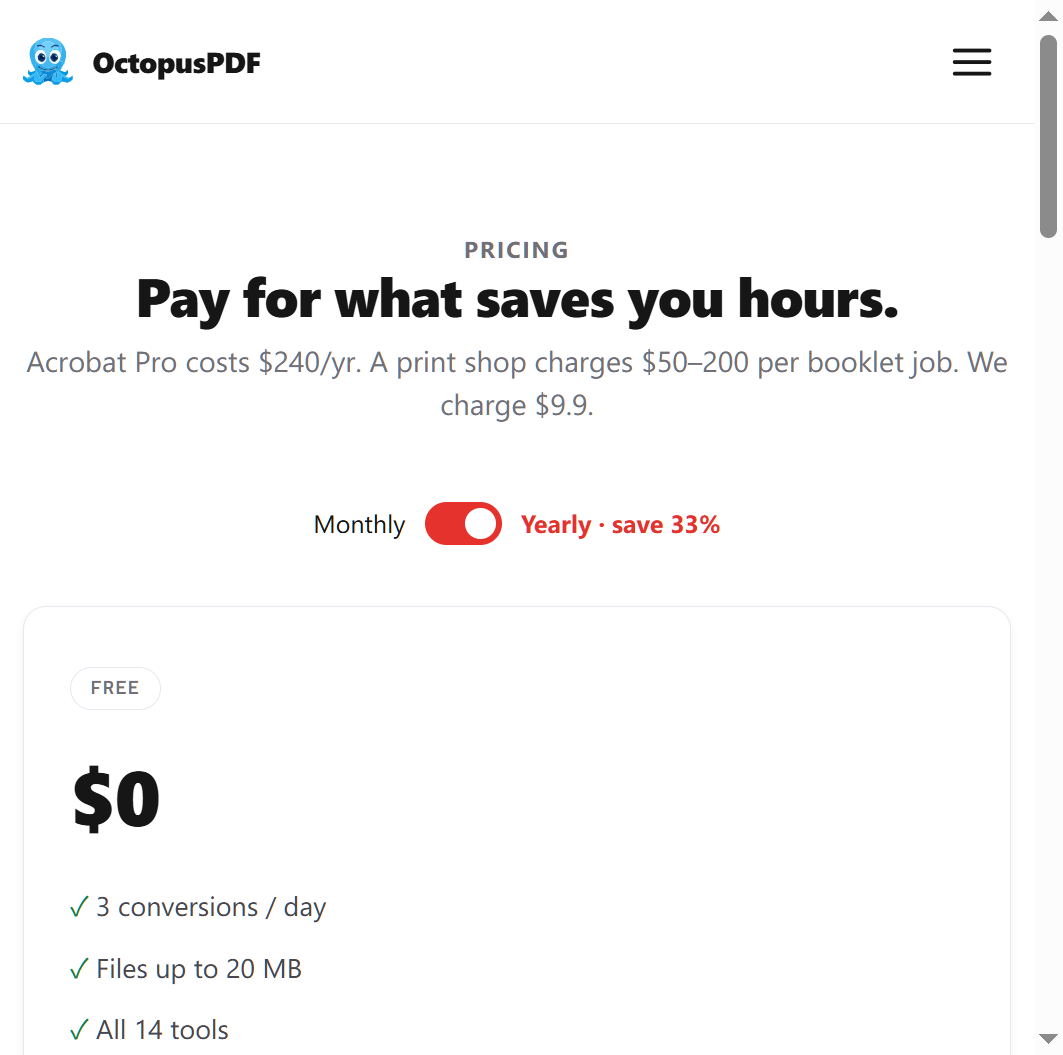
Structure-aware extraction is a core feature of some tools, including the PDF-to-Markdown converter available in the OctopusPDF suite [K2]. When you convert a PDF to Markdown first, you get a text file that contains explicit markers for headings (e.g., ## Section 1), lists, bold text, and table rows. The AI model can then translate this Markdown while preserving the structural elements, and the result can be converted back into a formatted PDF (or an HTML file, which is easier to style).
This approach has two major benefits:
- Better semantic accuracy — The AI understands the relationship between paragraphs and headings, so it produces translations that respect the document's hierarchy.
- Token efficiency — Markdown is more compact than the original PDF's internal representation. When feeding Markdown to an LLM, you consume fewer tokens than you would if you sent the raw text with multiple formatting artifacts [K2]. This saves on API costs if you're using your own key.
Practical advice: If your translation tool doesn't directly handle PDFs, use a two-step approach: convert the PDF to Markdown, translate the Markdown file, and then convert it back to PDF or HTML using a tool like pandoc. This may be the most format-safe method available.
6. Scenario-Based Workflow: When to Use Each Approach
Not every PDF translation task is the same, and the right technique depends on your specific scenario. The table below summarizes the recommended approach based on typical use cases.
| Scenario | Recommended Technique | Why |
|---|---|---|
| Confidential legal or medical document | Local browser processing + page-by-page translation | Zero-upload processing ensures confidentiality [K3][K5] |
| Technical manual with tables and diagrams | PDF-to-Markdown conversion first, then translate | Preserves table structure and reduces token usage |
| Short press release (1–3 pages) | Page-by-page translation with BYO key | Quick, cost-effective, minimal formatting risk |
| Long academic paper (20+ pages) | PDF-to-Markdown conversion + translation | You can review section headings for accuracy |
| Multilingual documentation (9+ languages) | Use a tool that supports multi-language output in one workflow [K4] | Avoids re-formatting or re-translation from an intermediate language |
7. FAQ
Q1: Is it safe to use a free online PDF translation service?
It depends on your threat model. If you are translating publicly available material, a free service is convenient. However, for documents containing personal data, business secrets, or research in progress, you should choose a tool that offers local processing and BYOK functionality. The key criterion is not whether the tool is "free" but whether your file and your API key ever transit through a third-party server [K1][K5].
Q2: Does the "Bring Your Own Key" model cost less than a subscription?
In most cases, yes. With a subscription-based tool, you pay a fixed monthly fee regardless of how many pages you translate. With the BYOK model, you pay only for the exact number of tokens consumed by your API calls. If you translate infrequently or have short documents, BYOK is almost always cheaper. If you translate daily, a subscription to the AI provider may still be more economical than pay-as-you-go—but it's your choice how to optimize this [K1].
Q3: Will translated PDFs always look perfect?
No. Even with the best tools, you may encounter minor issues with complex layouts, such as multi-column pages or forms with absolute positioning. The techniques described here—local parsing, page-by-page translation, and structure-aware extraction—minimize these issues but don't eliminate them entirely. A quick post-translation review is recommended, especially for documents with unusual fonts or script directions (e.g., right-to-left languages).
Q4: Can I translate a scanned PDF with local tools?
A scanned PDF contains images, not text. Local tools that rely on text extraction (like pdf.js) cannot directly translate images. You would need an OCR step first to convert images to text, then translate. Some tools include OCR in their pipeline, but if not, you should use a dedicated OCR converter before the translation step.
8. Conclusion
Translating PDFs with AI while preserving formatting is not a single technique—it's a mindset shift toward local-first processing, transparent authentication, and structure-aware workflows. By choosing tools that keep your files in the browser [K3], supporting the BYOK model to maintain control over credentials and costs [K1], using page-by-page translation to preserve layout [K4], and leveraging structured extraction like PDF-to-Markdown [K2], you can achieve professional translation output without sacrificing privacy or visual integrity.
Our recommendation: Start with the scenario table above to determine the simplest workflow that meets your needs. If privacy is paramount, prioritize local-first tools. If cost is your main concern, compare BYOK token costs against subscription fees. And regardless of the tool you choose, always budget time for a final formatting review—it's the last step that separates a usable translation from a frustrating one.
Last updated: August 2026. Based on product documentation from OctopusPDF's AI tools and PDF processing suite [K1][K2][K3][K4][K5].