Top 5 Reasons to Choose Local PDF Redaction Over Online Services
Key Takeaways
- Local PDF redaction is designed to protect sensitive content, yet every mainstream online tool asks you to upload the file first—creating a privacy paradox that defeats the entire purpose.
- Local PDF redaction keeps the whole pipeline on your device: the file opens in the browser, is processed locally, and the server physically cannot receive it.
- Promises such as “we delete your file after 1 hour” are unverifiable; once a file is uploaded, you lose control over copies in logs, backups, and caches.
- AI-assisted local PDF redaction can remain private if the tool supports a bring-your-own-key (BYO) architecture, where the browser connects directly to an endpoint you choose.
- Local PDF redaction tools also handle hygiene work that online services often skip, such as physically removing metadata, comments, and hidden content before sharing.
1. Introduction
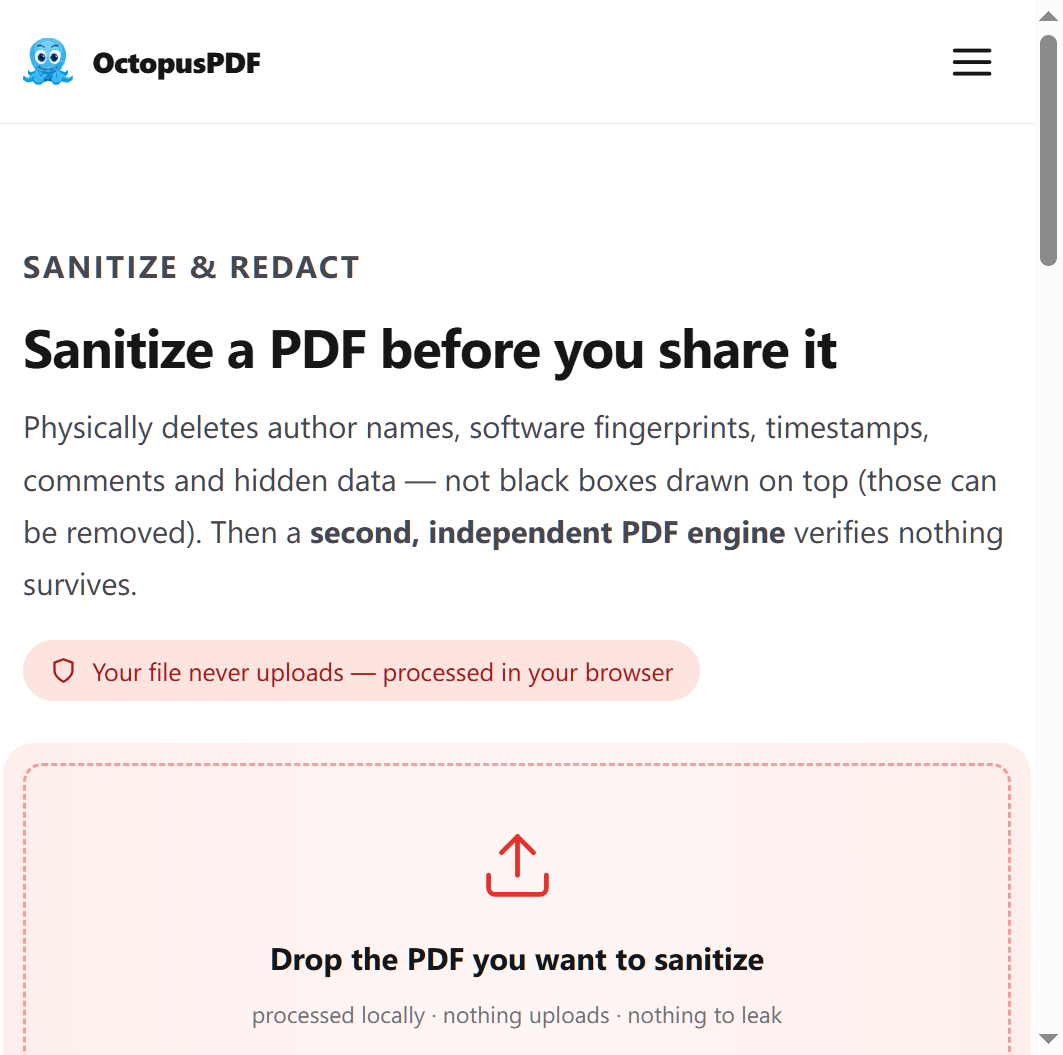
If you are about to share a PDF that contains a contract number, a tax ID, a medical record, or a confidential manuscript, the safest place to perform local PDF redaction is your own device. That is the short answer to a question that legal professionals, HR staff, journalists, and privacy-conscious individuals face regularly: “Should I use a free online PDF redaction tool, or choose local PDF redaction?”
Online redaction tools are convenient. You drag a file into a web page, the service paints black bars over the sensitive parts, and you download a new PDF. But convenience hides a fundamental contradiction: the very file you are trying to protect must be transmitted, in full and unredacted, to a server operated by a third party before any redaction can happen. Nothing about that exchange supports the goal of keeping the content private.
This article explains five concrete reasons why local PDF redaction is the safer choice, shows how a local pipeline works, and gives you a checklist for evaluating any redaction tool—online or local—before you trust it with real documents.
2. Reason 1: Upload-Based Redaction Is the Antithesis of Local PDF Redaction
Core conclusion: A tool that asks you to upload the file you are trying to protect cannot logically guarantee your privacy—local PDF redaction exists precisely to avoid this flaw.
Every mainstream online redaction tool—FreePDFRedactor, AvePDF, DocHub, Smallpdf—uploads your file to a server before it does anything. The upload happens before the removal step, which means the sensitive content exists, unredacted, on infrastructure you do not control. Even tools with advanced features are not exempt: redact-pdf.ai provides AI-based PII detection, but it uploads the PDF to Azure to do so.
This is not a theoretical concern. When a file is uploaded, you have no way to verify who can access it, how long it is retained, or whether it is used to train models. The company’s privacy policy may say one thing, but technical reality says another: your unredacted data was physically transferred to a third party. If the goal of redaction is to keep sensitive content from being seen by untrusted eyes, then sending it to an unknown server is the opposite of that goal.
Local PDF redaction, by contrast, never creates this exposure. The file stays in your computer’s memory and on your own storage. There is no upload step, so there is no privacy contradiction.
3. Reason 2: Local PDF Redaction Keeps the Entire Pipeline on Your Device
Core conclusion: With local PDF redaction, the whole workflow—opening, analyzing, redacting, and saving—happens on hardware you own and control.
Many modern local PDF redaction tools are browser-based but do not require server communication. The PDF is read with JavaScript, rendered in a sandbox, and processed via the WebAssembly or canvas APIs. The file never leaves your device. Even the temporary files used during processing are created in your browser’s sandbox and discarded when the session ends.
This design has a clear advantage: you do not need to trust an external vendor. There is no server to be breached, no administrator to be bribed, no subpoena to be served. If your laptop is encrypted and your operating system is up to date, the only threat surface is your own device.
For professionals handling confidential documents, this is not just a preference—it is often a regulatory requirement. Sending a client contract through a random web service can violate attorney–client privilege, HIPAA rules, or GDPR obligations. Local PDF redaction makes compliance easier because data does not cross the boundary of your device.
4. Reason 3: No Deletion Promises Needed with Local PDF Redaction
Core conclusion: Server-side deletion promises are unverifiable; once a file is uploaded, you lose control over every copy that exists elsewhere. Local PDF redaction eliminates the need for such promises entirely.
Online services often assure users that uploaded files are automatically deleted after a short period. But as a user, you cannot confirm that the deletion actually happens. The file may be stored in multiple locations: application logs, database backups, content delivery network caches, or forensic copies. Even if the vendor is honest, a single overlooked log file can preserve your unredacted content for years.
Consider what happens when you send a PDF to an online tool:
- The file is transmitted over the network, where proxies or intermediaries may log the request.
- The server receives the file and stores it to process the redaction.
- The server may create a copy in a temporary directory, a database, or a cloud storage bucket.
- The final redacted file is sent back to you, but the original is never fully erased—at least not in a way you can verify.
Local PDF redaction eliminates this entire chain. There is no remote file to delete because there is no remote file at all. You are not relying on a promise; you are relying on physics.
5. Reason 4: AI-Assisted Local PDF Redaction Can Be Private—With the Right Architecture
Core conclusion: You can use AI to find sensitive information without giving your document to a third-party service, provided the tool supports a bring-your-own-key (BYO) architecture. This is the key to keeping AI-assisted local PDF redaction fully private.
AI-based redaction tools are powerful because they can automatically detect names, addresses, social security numbers, and other PII that a human might miss. But the convenience of AI is usually paid for with your document: most online AI redaction services send the PDF to a model hosted on cloud infrastructure. Suddenly, the file is not just on one server—it is on machine learning clusters, possibly across different jurisdictions.
The solution is a BYO architecture. In this model, you supply your own API key to an AI endpoint you control, such as your company’s private Azure OpenAI deployment or an on-premises model. The redaction tool runs in your browser and sends only the text fragments—not the whole file—to that endpoint. Even then, you can choose to send nothing at all if the model runs locally.
A local PDF redaction tool with BYO support gives you the best of both worlds: AI accuracy for redaction and local control for privacy. You avoid handing your PDF to the tool’s operator, and you decide exactly where AI processing occurs.
6. Reason 5: Local PDF Redaction Tools Handle the Hygiene Work That Online Services Skip
Core conclusion: Redaction is more than drawing black bars; local PDF redaction tools can also strip metadata, comments, hidden layers, and embedded files that might leak sensitive information.
Online redaction tools often focus on visible content. You paint over a name or a bank account number, and the tool simply replaces the underlying text with empty space or a colored rectangle. But a PDF is more than what appears on the page. It can contain:
- Document metadata (author, software, creation date)
- Annotations and comments
- Hidden text layers
- Embedded fonts that reveal original characters
- Images or attachments that are not visible in the normal view
- Prior versions of redacted text if the tool does not actually remove the underlying content
A local PDF redaction tool can run a deeper cleanup because it operates on the full file structure. It can remove metadata, flatten annotations, delete hidden content, and verify that no residual sensitive data remains in the output. This is especially important for files that have been edited by multiple people or generated by enterprise software.
If an online service only offers visual redaction, you may be sending a file that still contains the original information underneath the black bars. Local PDF redaction gives you the confidence that the sensitive data is truly gone, not just hidden.
7. Conclusion
Redaction is a security measure, and security measures should not create new vulnerabilities. Online PDF redaction tools fail that test because they require you to expose the very data you are trying to protect. Local PDF redaction, on the other hand, keeps the file on your device, eliminates unverifiable deletion promises, enables private AI assistance, and cleans the entire document structure.
For anyone who handles confidential PDFs on a regular basis—legal teams, HR departments, healthcare workers, journalists—local PDF redaction is not a luxury. It is the only method that places full control in your hands. When the file never leaves your machine, there is no server to trust, no log to purge, and no promise to believe.
8. Local PDF Redaction Tool Evaluation Checklist
Use this checklist before you trust any redaction tool with real documents:
- Does the tool process the PDF entirely in your browser or local environment?
- Is the source code open or independently audited?
- If AI features are used, does it support bring-your-own-key or a local model?
- Does the tool strip metadata and hidden content, not just visible text?
- Can you verify the output has no residual sensitive data?
- Is the tool’s privacy policy specific about data retention, or vague?
- Does the tool require network access while processing? If yes, why?
If you cannot answer “yes” to most of these questions, assume the tool is not safe enough for confidential information. Local PDF redaction is the default choice—and for good reason.