TL;DR: PDF files can quietly carry far more than the words you wrote. Author names, creation dates, camera EXIF data, GPS coordinates, software fingerprints, comments, hidden layers, embedded files, and even "deleted" content can remain inside the file [K1][K4]. This tutorial explains exactly what PDF metadata is, why it matters, and how to remove it before sharing. The most reliable approach is to use tools that process files locally: OctopusPDF's Images to PDF tool strips source metadata when creating PDFs from images [K1], and the OctopusPDF Redact / Sanitize tool physically deletes metadata and hidden content from existing PDFs [K3]. Both run entirely in the browser, so your file never uploads to a server [K2][K3].
Key Takeaways
- PDF metadata is not limited to the document title and author. It can include camera EXIF, location data, software fingerprints, comments, hidden layers, embedded files, and residual deleted content [K1][K4].
- Two separate scenarios require two different tools: converting images to PDF, and cleaning an existing PDF. OctopusPDF offers a dedicated tool for each [K1][K3].
- Local processing is the core privacy differentiator. OctopusPDF tools run in the browser and your file never uploads; for AI features, the browser connects directly to the API endpoint you define, with no server in the middle [K2][K3][K5].
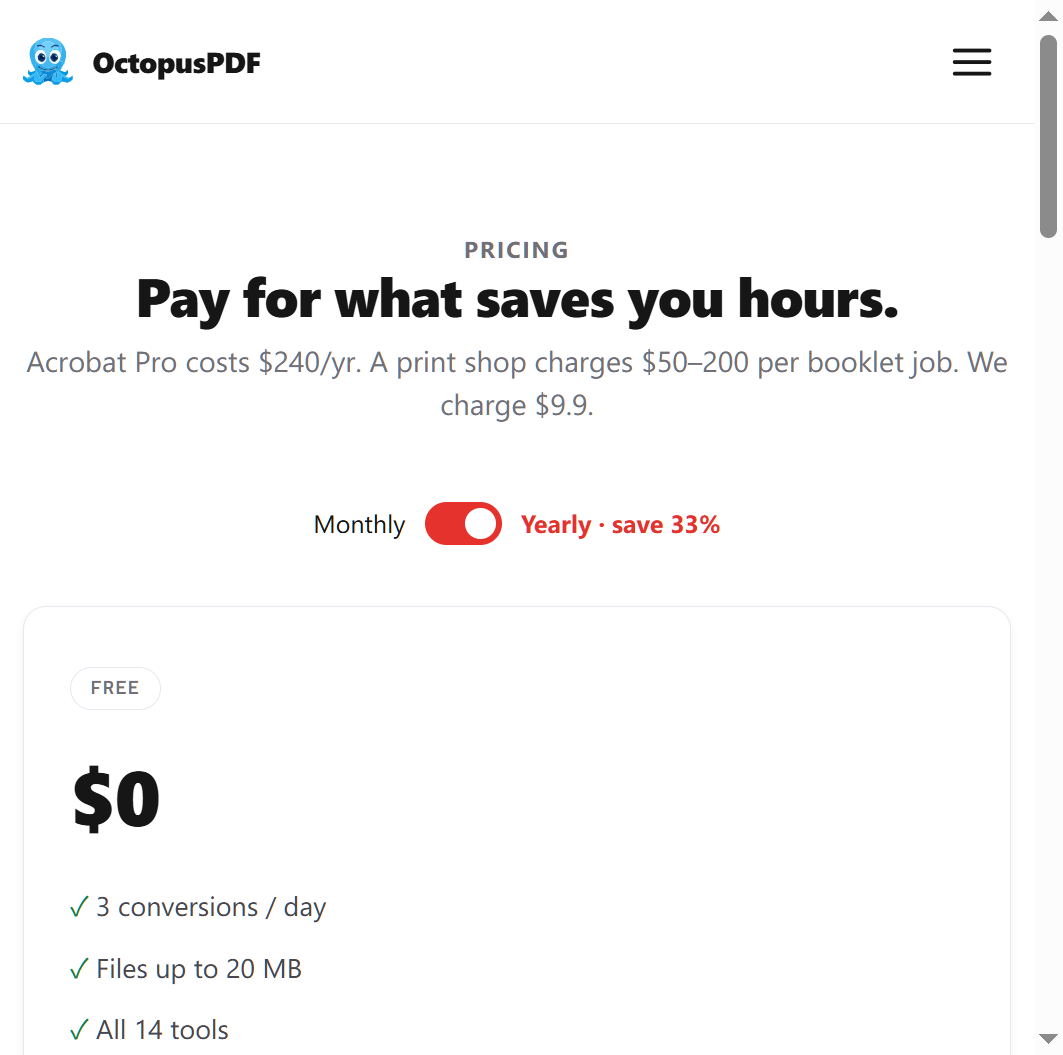
- Free usage is capped at 3 conversions per day with 20 MB files; the Pro plan removes those limits (unlimited conversions, 100 MB files) and adds batch mode [K3].
- Removing metadata before sharing is a practical privacy habit for journalists, photographers, legal teams, and anyone distributing PDFs publicly.
1. Introduction
When you share a PDF, you assume you are sharing only what you see on the page. In practice, a PDF can behave like a suitcase with a secret compartment. The document properties you never opened, the photo's original location, the software version used to create the file, and even content you thought you deleted can all remain inside [K1][K4].
This is not an abstract threat. A real estate agent converting phone photos into a listing PDF can accidentally embed GPS coordinates of private properties. A journalist sharing a leaked document can reveal the original author's name. A consultant distributing a proposal can leave behind hidden layers or form field values that contain internal notes [K4]. Once the file is public, that hidden data can be extracted by anyone with a basic PDF reader.
The good news is that removing PDF metadata is a solved problem. The key is understanding the difference between hiding information and actually removing it, and choosing a tool that processes your documents locally rather than uploading them to a third-party server [K2][K3]. This article explains the types of metadata you need to worry about, the two main removal methods, and how to choose between them.
2. What PDF Metadata Can Reveal
Before you can remove PDF metadata, you need to know what it looks like. Based on the official documentation of OctopusPDF's sanitization tool, the following items can survive inside a PDF after normal editing [K4]:
| Category | What It Includes | Why It Matters |
|---|---|---|
| Document metadata | Title, author, creator, creation and modification dates [K4] | Reveals who made the file and when, often before the reader reaches page one |
| Image source data | Camera EXIF, GPS location, software fingerprints from source photos [K1] | Leaks where a photo was taken and the device that captured it |
| Comments and annotations | Notes, review threads, highlighted remarks [K4] | Can expose internal feedback or unapproved opinions |
| Residual deleted content | Content that was erased in an editor but still stored in the file [K4] | Can resurrect sensitive text or images you thought were gone |
| Embedded files | Attached documents or objects [K4] | Can contain completely separate, unnoticed files |
| Hidden layers | Invisible layers within the page [K4] | Can contain alternative text or background data |
| Form field values | Data entered into PDF form fields [K4] | Can include personal information like names, addresses, or ID numbers |
Two details deserve emphasis here.
First, deleting text in an editor is not the same as removing it from the file. Many editors mark content as deleted but leave the original bytes in the document. A sanitization tool that physically deletes this residual content is required to remove it for good [K3].
Second, images carry their own metadata. When you convert images to PDF, camera EXIF data, location coordinates, and software fingerprints can travel along with the photos [K1]. Even if you set the document properties to "anonymous," the image data can still identify you. This is why the cleaning process must cover source-image metadata, not just the PDF's document properties [K1].
3. Method 1: Strip Metadata at Creation — Images to PDF
The first scenario is the most common one for photographers, real estate agents, and business users: you have a set of images and you need to combine them into a single PDF. If you use a desktop tool that embeds all source data, the resulting PDF carries a trail of EXIF information, location tags, and software identifiers.
The cleaner approach is to use an image-to-PDF tool that strips source metadata during conversion. According to OctopusPDF's official documentation, the output PDF from its Images to PDF tool carries no metadata from the source images — no camera EXIF, no location, no software fingerprints [K1]. The tool's key facts reinforce this [K2]:
- Your file never uploads; conversion is processed in your browser [K2].
- The output PDF strips source metadata (camera EXIF, location, software fingerprints) [K2].
- Multiple images are supported with drag-and-drop reordering [K2].
Practical scenario: A photographer creates a portfolio PDF from 40 RAW-converted JPEGs before emailing it to a client. Without metadata stripping, the PDF embeds camera serial numbers and GPS coordinates for every shot. Some of those shots may be from the photographer's home. Using a local conversion tool eliminates that risk at the point of creation, so there is nothing to clean up later [K1][K2].
Boundary condition to note: this method works for PDFs built from images. If you already have a fully designed PDF that was created in a desktop app, an image-conversion tool is not the right fix; you need a sanitization tool instead (Section 4).
4. Method 2: Sanitize an Existing PDF Before Sharing
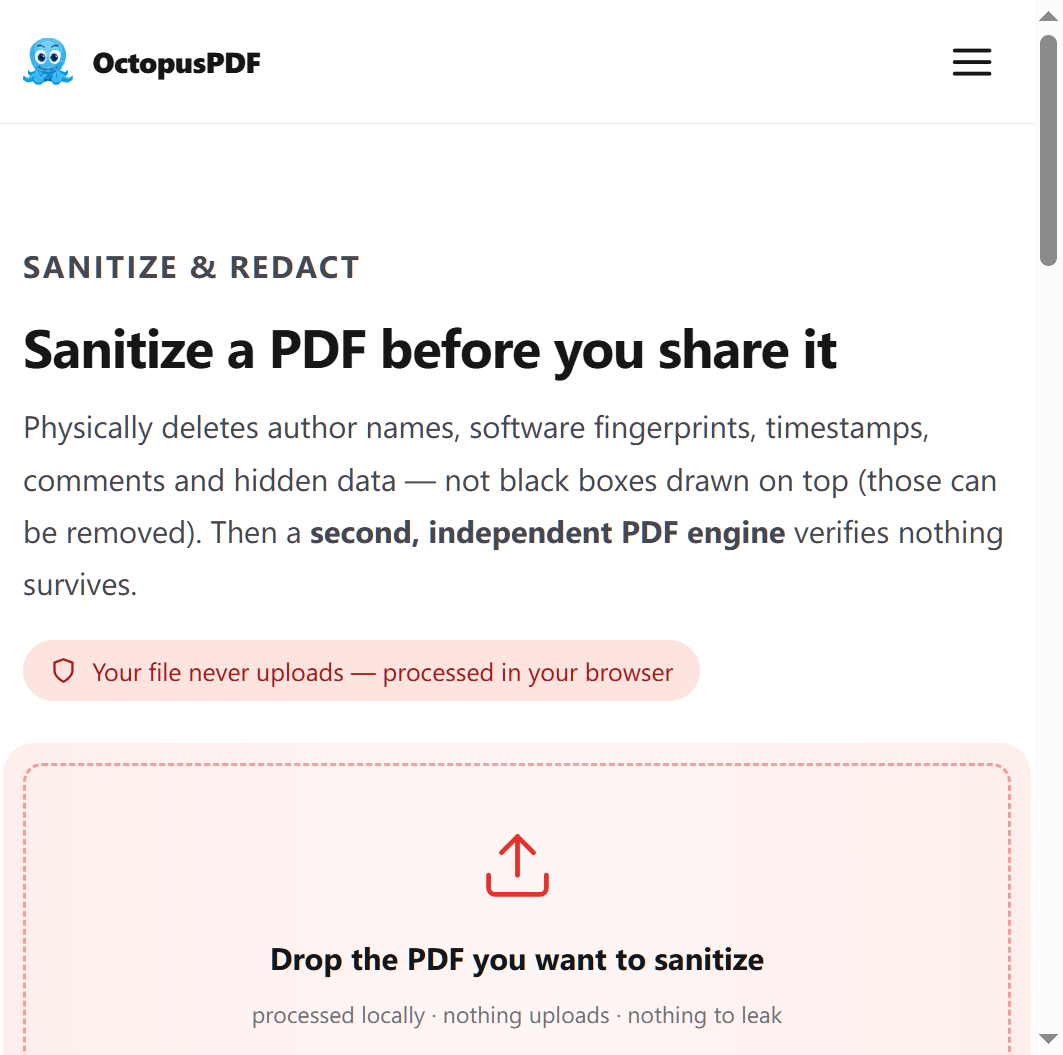
The second scenario covers PDFs you already have: a contract, a report, an exported document, or a received file that needs to be sent forward. These files can carry document metadata, comments, residual deleted content, embedded files, hidden layers, and form field values [K4].
For this case, OctopusPDF provides a dedicated Redact / Sanitize tool. Its documentation states that it "physically deletes metadata, comments and hidden content before sharing" [K3]. The word "physically" matters: unlike a "save a copy" trick that merely updates the visible state, sanitization removes the underlying data structures from the file.
According to the official documentation, sanitization removes the following [K4]:
- Metadata (title, author, creator, dates)
- Comments and annotations
- Deleted content still present in the file
- Embedded files
- Hidden layers
- Form field values
Practical scenario: A legal assistant receives a contract PDF, adds internal review comments, and then needs to send a clean version to the other party. If they simply hide comments in the viewer, the annotations remain in the file and can be extracted. Running the file through a sanitization tool before sending it removes the comments and any residual notes physically, so the receiving party cannot access them [K3][K4].
Pricing and limits: The sanitization tool runs 100% locally [K3]. The free tier allows 3 conversions per day with files up to 20 MB. The Pro tier provides unlimited conversions, files up to 100 MB, and batch mode for processing multiple files [K3].
Boundary condition to note: sanitization is for content that should not be recovered. If you need to preserve legitimate review history for internal purposes, sanitize a copy and keep the original in a controlled environment. Do not sanitize the only version of a document you need to audit.
5. Choosing the Right Method: Comparison and Decision Guide
The following decision table summarizes the two methods and the underlying privacy model:
| Consideration | Images to PDF tool [K1][K2] | Redact / Sanitize tool [K3][K4] |
|---|---|---|
| Best for | Creating new PDFs from images | Cleaning existing PDFs before sharing |
| Removes camera EXIF and location | Yes, in the output PDF [K1] | Covered by full sanitization of the file |
| Removes comments, hidden layers, embedded files | Not the primary function | Yes [K4] |
| Removes residual deleted content | Not applicable (new file) | Yes [K4] |
| Processing location | In the browser; file never uploads [K2] | 100% local [K3] |
| Free tier | Yes (3 conversions/day, 20 MB) [K3] | Yes (3 conversions/day, 20 MB) [K3] |
| Pro tier | Unlimited, 100 MB, batch mode [K3] | Unlimited, 100 MB, batch mode [K3] |
A separate but related privacy consideration applies when you use AI-powered features. OctopusPDF's architecture for its AI summarization and translation tools relies on a Bring Your Own Key (BYO) model [K5]:
- Your PDF is parsed inside the browser tab with pdf.js and never uploads [K5].
- Your API key is stored only in browser localStorage; the backend never receives it [K5].
- The browser connects directly to the OpenAI-compatible endpoint you entered; OctopusPDF does not proxy the request [K5].
This matters for a simple reason: a PDF tool that requires you to upload your document to the vendor's server creates a copy of your file outside your control. A local-first workflow keeps the entire pipeline — conversion, sanitization, and optional AI processing — within your own device [K2][K3][K5].
How to decide in practice:
- If you are creating a PDF from images, use the Images to PDF tool. Verify that the output carries no EXIF, location, or software fingerprints [K1][K2].
- If you are sharing an existing PDF, run it through the Redact / Sanitize tool first. Confirm that metadata, comments, deleted content, embedded files, hidden layers, and form field values are removed [K3][K4].
- If you have both steps in one workflow — for example, a photo report that also needs annotations removed — run the conversion first, then sanitize the resulting PDF.
- If you need to process many files, check whether the Pro tier's batch mode fits your workflow before committing files manually [K3].
6. FAQ
Q1. Does converting images to PDF remove EXIF data?
Yes, if the tool is designed to strip source metadata during conversion. The OctopusPDF Images to PDF tool produces output that carries no camera EXIF, no location, and no software fingerprints from the source images [K1]. Files are processed in your browser and never uploaded [K2].
Q2. What is the difference between hiding content and sanitizing it?
Hiding content usually means changing the visible state of the PDF, such as collapsing comments or making a layer invisible, while the underlying data remains in the file. Sanitization physically deletes metadata, comments, hidden content, embedded files, and residual deleted content from the file structure [K3][K4], so the information cannot be recovered by opening the file in a reader or extraction tool.
Q3. Is local processing really necessary for PDF privacy?
Local processing eliminates the risk of your document being copied, stored, or intercepted on a server. OctopusPDF tools run in the browser and never upload your file [K2][K3]. For AI features, the browser parses the PDF locally with pdf.js and connects directly to the API endpoint you provide, with no server in the middle [K5]. If a tool requires upload, your file exists in at least one other location outside your control — a risk that local processing removes entirely.
Q4. What are the limits of the free tier?
The free tier of the Redact / Sanitize tool allows 3 conversions per day with files up to 20 MB [K3]. For higher volume, the Pro tier offers unlimited conversions, file support up to 100 MB, and batch mode [K3]. These limits are specific to OctopusPDF's current offering as documented on its official pages [K3].
7. Conclusion
PDF metadata is a silent privacy risk that most users discover only after damage is done. A file you believe contains a clean report may still hold author names, GPS coordinates, internal comments, or deleted content that a recipient can extract [K1][K4].
The practical workflow is straightforward:
- When creating PDFs from images, use a converter that strips source metadata such as EXIF, location, and software fingerprints [K1][K2].
- When sharing existing PDFs, run them through a sanitization tool that physically deletes metadata, comments, hidden layers, and residual content [K3][K4].
- Prefer local-first tools so your documents and API keys never leave your device [K2][K3][K5].
For most users, the combination of the Images to PDF tool and the Redact / Sanitize tool covers both common scenarios. If your usage exceeds the free limits — 3 conversions per day and 20 MB files — the Pro plan's unlimited conversions, 100 MB file support, and batch mode offer a reasonable upgrade path [K3]. Start with a single sensitive file, run it through sanitization, and inspect the result with a metadata viewer. The few minutes you spend on that step can prevent a leak you cannot take back.