Key Takeaways
- Most PDF organization tasks—reordering, deleting, or rotating pages—can be done in seconds with dedicated PDF tools, and many modern tools run entirely in your browser without uploading files.
- Image-based PDFs (scans, screenshots, photos) follow a simple "one image per page" rule compared to text-based PDFs, so knowing your file type determines your approach [K1][K4].
- For privacy-sensitive documents, prioritize tools that process files locally (in the browser) rather than those that upload to a server [K5].
- The most practical workflows combine two actions: bulk operations (merge, split) followed by fine-grained adjustments (reorder, delete, rotate) [K2].
- A structured comparison of tool capabilities helps you choose the right approach, whether you work with a few pages or a large report.
1. Introduction
If you have ever tried to reassemble a 50-page PDF report, you know the pain: a scanned contract arrives in the wrong order, a presentation has a duplicated slide, or your merged PDF places page 12 before page 7. While PDFs are the standard for fixed-layout documents, organizing their pages is still a task that frustrates many users.
The difficulty usually is not the action itself—reordering, deleting, or rearranging pages is conceptually simple—but rather choosing the right tool and the right workflow. There are several approaches: desktop software with advanced controls, online services that upload your files to remote servers, or modern browser-based tools that process everything locally on your machine.
This article explains how to organize PDF pages in practical terms. We will look at the most common tasks, what to watch out for, and how to pick a tool that is both safe and effective. The guidance is based on the working principles of established PDF tools, particularly those that prioritize local processing and privacy-first design [K2][K5].
2. Understanding Page Organization Tasks
Before choosing a tool, it helps to break down exactly what "organizing PDF pages" means. In practice, this covers four core actions:
- Reorder: Move pages into a new sequence. Typical use cases include fixing a scanned document that was captured in reverse order, or rearranging slides in a pitch deck.
- Delete: Remove unwanted pages such as blank pages, duplicates, or outdated cover sheets.
- Rotate: Turn pages 90, 180, or 270 degrees. This is especially common for mixed landscape/portrait documents [K2].
- Merge and Split: Combine several PDFs into one file or extract a page range into a separate PDF. These operations often go hand-in-hand with reordering and deletion [K2].
The concept of "rearrange" generally includes any combination of the above. For instance, you might split a PDF into sections, delete the unwanted sections, reorder the rest, and merge them back into a single clean document.
One detail that is easy to overlook: the nature of the pages themselves matters. In an image-based PDF (for example, a JPG or PNG photo converted to PDF), each page is essentially a picture. Tools that handle this type of file follow a straightforward rule: one image per page [K1][K4]. If you are working with scanned documents (which are also images), the same logic applies. Text-based PDFs, on the other hand, allow for finer control like copying text or adjusting text flow.
3. Method 1: Reordering and Deleting Pages with Drag-and-Drop Tools
The most conventional method to organize pages is using a tool with a visual "drag-and-drop" interface. This is the approach used by desktop applications like Adobe Acrobat and also by modern browser-based tools.
How it works
The interface displays thumbnails of each page, in order. You drag a page thumbnail to a new position and release. Deletion is typically a one-click action (e.g., selecting a thumbnail and pressing the delete icon).
The browser-based advantage
A growing number of recent tools run entirely in the browser. For example, OctopusPDF’s "Organize PDF" tool provides drag-and-drop reordering and deletion with no upload required [K2]. Another example is the "Images to PDF" workflow, which lets you drop multiple JPG/PNG images, then arrange the page order top-first, one image per page [K1]. The entire operation happens locally on your device.
Why local processing matters for this specific task
There is a privacy paradox in online PDF tools. As one industry blog notes, "The tool claiming to protect your privacy is the same one your file just passed through." Many mainstream online tools upload your document to a server, sometimes to third-party cloud providers (e.g., Azure) [K5]. If your PDF contains personal data, financial figures, or legal content, an upload-based tool increases exposure.
Browser-based tools that process locally avoid this by keeping the file on your machine. If privacy is a requirement, choose a tool that explicitly states "no upload" or "runs locally." The OctopusPDF suite is one example of this approach, handling all operations in the browser with zero uploads [K2][K5].
When to use this method
- You need full visual control.
- You have a small to medium number of pages (up to a few hundred).
- Your priority is speed over advanced batch operations.
4. Method 2: Combining Merge, Split, and Rotation for Complex Rearrangements
Reordering and deleting work well when your file is already a single PDF. But many real-world tasks involve multiple files or specific page rotations. This is where a broader set of tools comes into play.
Step 1: Merge PDFs
If you need to combine files, use a merge tool. The key is controlling the final order. A good merge tool lets you arrange the source files in the order you want them to appear in the combined output [K2].
Step 2: Split individual files
Sometimes it is easier to split a large PDF into smaller ranges, correct each range, and then merge. For example, a 100-page report might have a section where pages 5–10 are upside down. Splitting out that range, rotating those specific pages, and re-merging is often faster than attempting to rotate only a range within a large file.
Step 3: Rotate selectively
Rotation is a standard operation. Look for the ability to rotate all pages, or a custom page range, by 90, 180, or 270 degrees [K2]. This is especially handy for documents that mix portrait and landscape orientations.
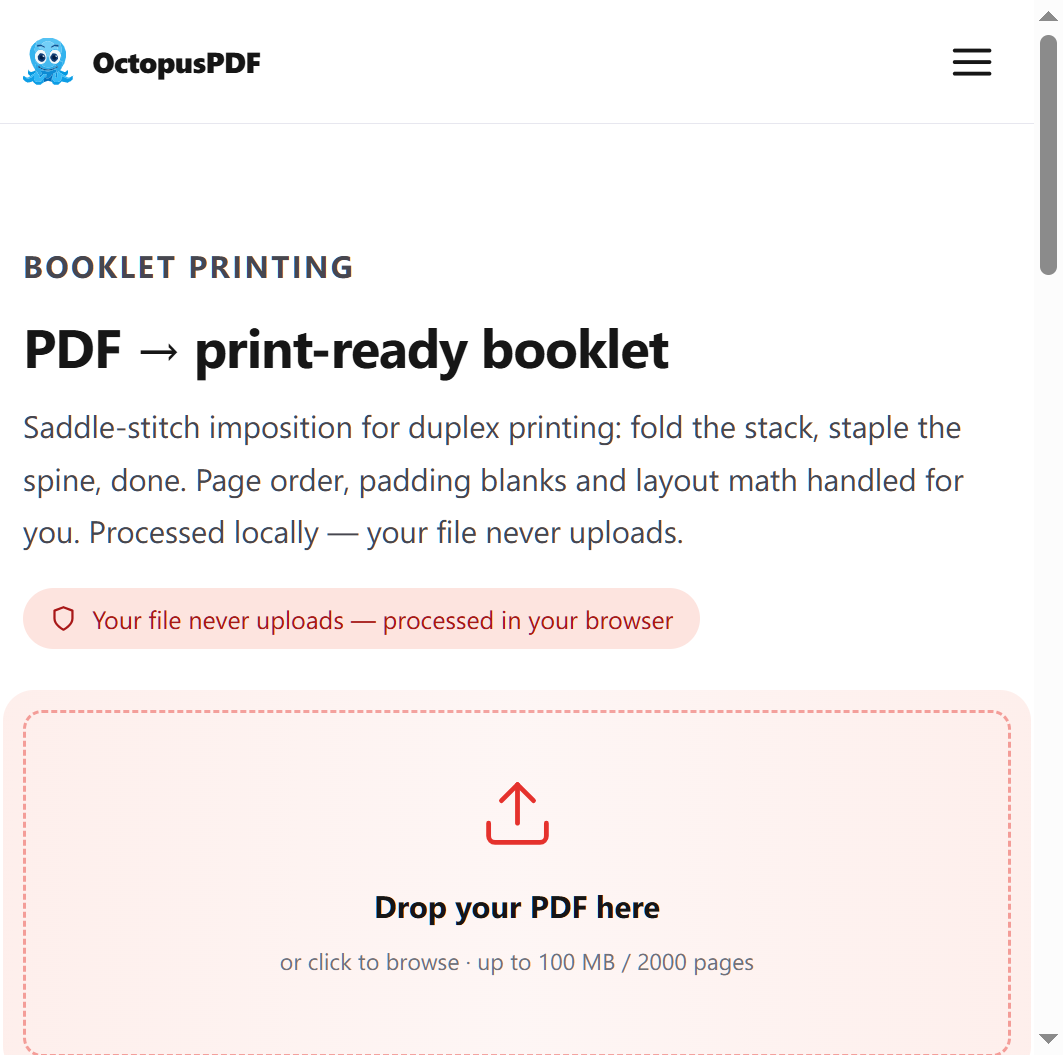
For printable booklets, some tools go a step further. They automatically reorder pages for duplex printing and folding, including gutter margins [K3]. If your goal is a physical booklet, choose a tool with this specific feature rather than attempting to calculate the fold order manually.
When to use this method
- You are working with multiple source files.
- You need to handle page rotations in a large document.
- You are preparing a print-ready booklet.
5. Method 3: Handling Image-Based PDFs (Scans, Photos, Screenshots)
Scanned documents and photo-based PDFs present unique requirements. Because each page is an image, the only way to rearrange content is by moving the entire image page, not the underlying text.
The one-image-per-page rule
When converting images (JPG, PNG) into a PDF, tools typically place each image on its own page, in the order you choose [K1][K4]. This means your organization workflow is essentially "sequence first, convert later."
Practical workflow:
- Rename your image files in the desired order (e.g., 01_page, 02_page).
- Drop the images into an "Images to PDF" tool [K1].
- Reorder the images in the thumbnail view if necessary.
- Generate the PDF.
A second workflow is to start with an existing PDF (perhaps converted from images) and then apply reorder/delete/rotation as described in Section 3.
The privacy angle for scans
Scanned documents are often sensitive (contracts, IDs). If you are using an online converter, verify the tool does not upload the images. Tools that process locally—like the OctopusPDF "Images to PDF" utility—ensure photos and scans never leave your device [K4].
When to use this method
- You are creating a PDF from photos or scans.
- You need to guarantee privacy for image-based content.
- You are working with a mixed batch of images that require sorting.
6. Key Comparison: Cloud-Upload vs. Browser-Local Tools
For easy decision-making, here is a structured comparison of the two main approaches to organizing PDF pages. This table uses data from the reference knowledge base [K2][K4][K5].
| Factor | Browser-Local Tools (e.g., OctopusPDF) | Traditional Cloud-Upload Tools (e.g., Smallpdf, DocHub) |
|---|---|---|
| File handling | Processes entirely in the browser; no upload [K2] | Uploads file to a remote server [K5] |
| Privacy risk | Low—files stay on your device | Higher—file is temporarily stored on third-party servers [K5] |
| File size limits | Limited by your device/browser (not explicitly stated, but generally storage-based) | Often imposed by server-side limits (e.g., 20 pages/5MB on some services) [K5] |
| Typical use case | Sensitive documents, quick tasks, private scans | Convenience when server-based storage is acceptable |
| Core tools available | Merge, Split, Rotate, Organize, Images to PDF, PDF to Markdown, Summarize [K2][K3] | Similar, but with server-side processing |
| AI processing | Can run AI tools with your own API key; file still not uploaded [K3] | Typically requires file access for AI features |
Key takeaway: If your document contains personal or proprietary information, choose the local-processing option. If you are only working with public or non-confidential files, either method works fine.
7. FAQ
Q1. What is the fastest way to reorder pages in a large PDF?
For a large PDF, the fastest approach is a drag-and-drop organizer with a thumbnail view. Tools like OctopusPDF's "Organize PDF" allow you to reorder pages without uploading the file [K2]. If the document has more than 200 pages, consider sorting in batches (e.g., as part of a merge sequence) rather than trying to reorder all pages at once.
Q2. Can I delete pages from a PDF after it has been converted from images?
Yes. The PDF is a standard file format, and page deletion applies regardless of whether the pages are images or text. You can use any standard "Organize PDF" tool to delete unwanted pages [K2]. If you want to avoid the upload, choose a browser-local tool.
Q3. Do tools that run locally in the browser actually protect my privacy?
Yes, if they are genuinely built to run locally. Such tools execute the logic in JavaScript and never send the file to a server. However, verify each product's documentation. Some tools claim encryption but still upload. Always check the privacy policy for explicit statements like "no upload" or "file never leaves your device" [K4][K5].
Q4. What should I use if I need to prepare a PDF for duplex printing?
For duplex printing booklets, use a tool that has a "booklet" mode, which automatically reorders pages for folding and adds gutter margins [K3]. Manual reordering for printed booklets is error-prone and not recommended when the tool can handle it automatically.
8. Conclusion
Organizing PDF pages—whether reordering, deleting, or rearranging—is a routine task that should take seconds when you have the right tool and workflow. For most users, the practical choice is between a desktop application with heavy features and a browser-based tool that runs locally.
If your files are sensitive, choose a tool that never uploads your document. Modern tools like the OctopusPDF suite (including "Organize PDF" and "Images to PDF") run entirely in the browser, covering everything from image conversion to page reordering while maintaining total privacy [K2][K4][K5].
Practical next step: Identify the specific action you need (reorder, delete, rotate, or merge), select a local-processing tool that supports that action, and test it with a small file first. Once you confirm the workflow, the rest is a matter of seconds.
This article is based on knowledge sources from OctopusPDF documentation as of August 2026 [K1][K2][K3][K4][K5].