Local AI Meets PDF: Summarizing, Translating, and Pre-Processing in One Workflow
Key Takeaways
- Privacy-first AI document processing is now practical: With a Bring Your Own Key (BYO) model, both your PDF file and your API key remain in the browser, eliminating server-side data exposure [K2].
- Local processing is a core security feature, not a side note: The file is parsed directly in the browser using pdf.js, meaning the raw PDF bytes are never uploaded to a third-party server [K5].
- The user controls the AI endpoint: Because the browser connects directly to your chosen OpenAI-compatible API endpoint, the tool never acts as an intermediary [K5].
- Pre-processing tools add tangible value: Features like PDF-to-Markdown and high-resolution image conversion help you prepare documents for LLM ingestion or archiving [K3].
- Best suited for: Professionals dealing with sensitive contracts, researchers handling proprietary data, or anyone who needs a streamlined pipeline from raw PDF to structured, translated, or summarized text.
1. Introduction
For anyone working with documents, the workflow often breaks down at the same point: you receive a dense, multi-page PDF and need a summary or a translation—fast. The typical solution, however, requires a leap of faith. You upload your confidential strategy document to a cloud service, hoping the provider’s data retention policies align with your compliance requirements. Even then, you face another bottleneck: manual pre-processing. Converting a PDF to a readable format for an AI model, or extracting high-resolution images, often requires a separate set of tools.
This article explores a different approach. It details a workflow that combines local, in-browser processing with AI summarization and translation, all without leaving your desktop. We will examine a specific implementation—OctopusPDF’s suite of tools—to understand how the BYO (Bring Your Own Key) model works, why it matters for security, and how you can build a practical, privacy-preserving document pipeline. We’ll cover the core functions, the technical process, and the supporting pre-processing tools that make this local workflow viable.
2. The Shift: Why Local Processing is the Real Feature
The jargon around AI tools often focuses on the model’s power—its ability to understand context, generate text, or translate nuance. However, for enterprise users and privacy-conscious individuals, the architecture matters just as much as the algorithm.
In a conventional setup, you upload a file, send it to a server, wait for a response, and hope the provider deletes the data. The process is opaque. The alternative, demonstrated by the OctopusPDF model, is different. When you use their AI tools, the file is parsed locally using pdf.js [K5]. This means the PDF is read and analyzed within your browser’s memory and processing space, not on a remote server.
This is the core conclusion: The primary value proposition is not just "AI can summarize," but "AI can summarize without seeing your data." This distinction is critical. It converts a generic AI feature into a compliance-friendly utility. You are not trusting a vendor with your raw data; you are simply supplying your own API key to access an AI model, which then operates on the local copy of the file.
Reasoning: The architecture removes the "server-in-the-middle" [K4]. Typically, data can be exposed during transit, at the server during processing, or in server logs. By keeping the analysis local, the only external communication is the API call between your browser and the AI endpoint you selected. This is a smaller attack surface, reducing opportunities for data leakage or unauthorized retention.
Practical Scenario: Imagine a legal associate who receives a 200-page merger agreement. They need a summary of key clauses. In a cloud-based system, they might have to redact parts of the document or get approval to upload it. With a local BYO system, they can process the entire document immediately, knowing it hasn't left their workstation [K5]. This speeds up workflows without compromising risk management.
3. Demystifying the BYO Key Model
The "Bring Your Own Key" (BYO) model is the engine that makes local AI processing possible. At its core, it is a simple transaction:
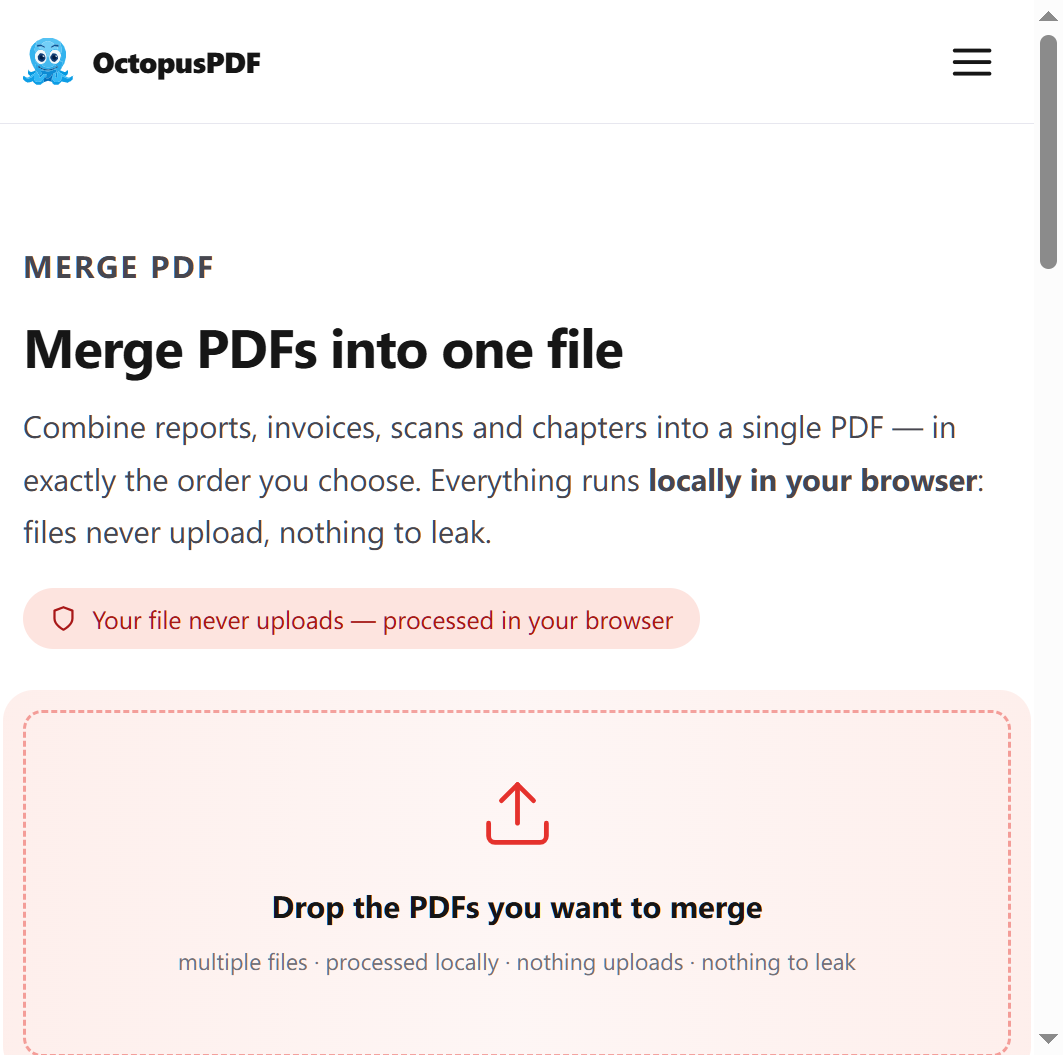
- You supply an OpenAI-compatible API key.
- You choose the endpoint (e.g., OpenAI, a local model server, or a custom gateway).
- The software in your browser uses that key to connect directly to that endpoint for the text analysis phase [K2][K5].
The understanding here is that the tool provider (in this case, OctopusPDF) does not proxy your request or see your key. Your key is stored only in your browser's localStorage [K5]. This means the provider cannot revoke your key, cannot see your usage, and crucially, cannot intercept the data being sent to the AI model.
Why this matters for decision-making: It decouples the utility of the AI tool from the security of the vendor. If you have a secure, internal AI gateway, you can connect OctopusPDF to it. If you prefer to use a specific model version, you can point the tool to that API. This flexibility is the hallmark of a mature ecosystem. It moves the software from being a "black box" service to a "client application" that you control.
Caveat: This model relies on the security of your browser and your own API endpoint. If your endpoint is compromised, your data is at risk. However, the risk is now on your infrastructure, not a third-party vendor’s.
This process also directly addresses a common user question: "Where is my file going?" In this architecture, the answer is: Nowhere. It stays on your local machine [K5].
4. The Pre-Processing Pipeline: More Than Just Summaries
While summarization and translation are the headline features, the pre-processing tools are the unsung heroes of a local workflow. The reference knowledge highlights several utilities that prepare documents for consumption by other systems [K3]. These tools are critical for data hygiene and efficiency.
The Tools in Focus
The suite includes:
- PDF to Markdown: This converts the PDF into a structured text format. This is particularly useful for feeding tokens into an LLM without the "noise" of headers, footers, and column layouts [K3].
- PDF to Images: For documents where layout matters (e.g., scanned diagrams), converting pages to PNG/JPG at up to 216 DPI ensures that visual data is preserved [K3].
- Images to PDF: The reverse process, which is useful for archiving photo-based documents [K3].
- Booklet creation: For physical printing, reordering pages with gutter margins [K3].
A Practical Workflow
Here is a scenario-based recommendation for a researcher:
- Ingest: You have a scanned research paper (PDF).
- Extract for AI: Use "PDF to Markdown" to get clean, text-based data that you can paste into any LLM without content loss [K3].
- Extract for Reading: Use "PDF to Images" to generate high-resolution slides for a presentation or detailed review [K3].
- Summarize: Use the BYO "Summarize PDF" feature to get a quick overview of the paper’s abstract and findings [K4].
This pipeline ensures that the PDF is not a monolithic obstacle, but a source file that can be repurposed into multiple formats for different downstream tasks.
5. How It Works: A Step-by-Step Process
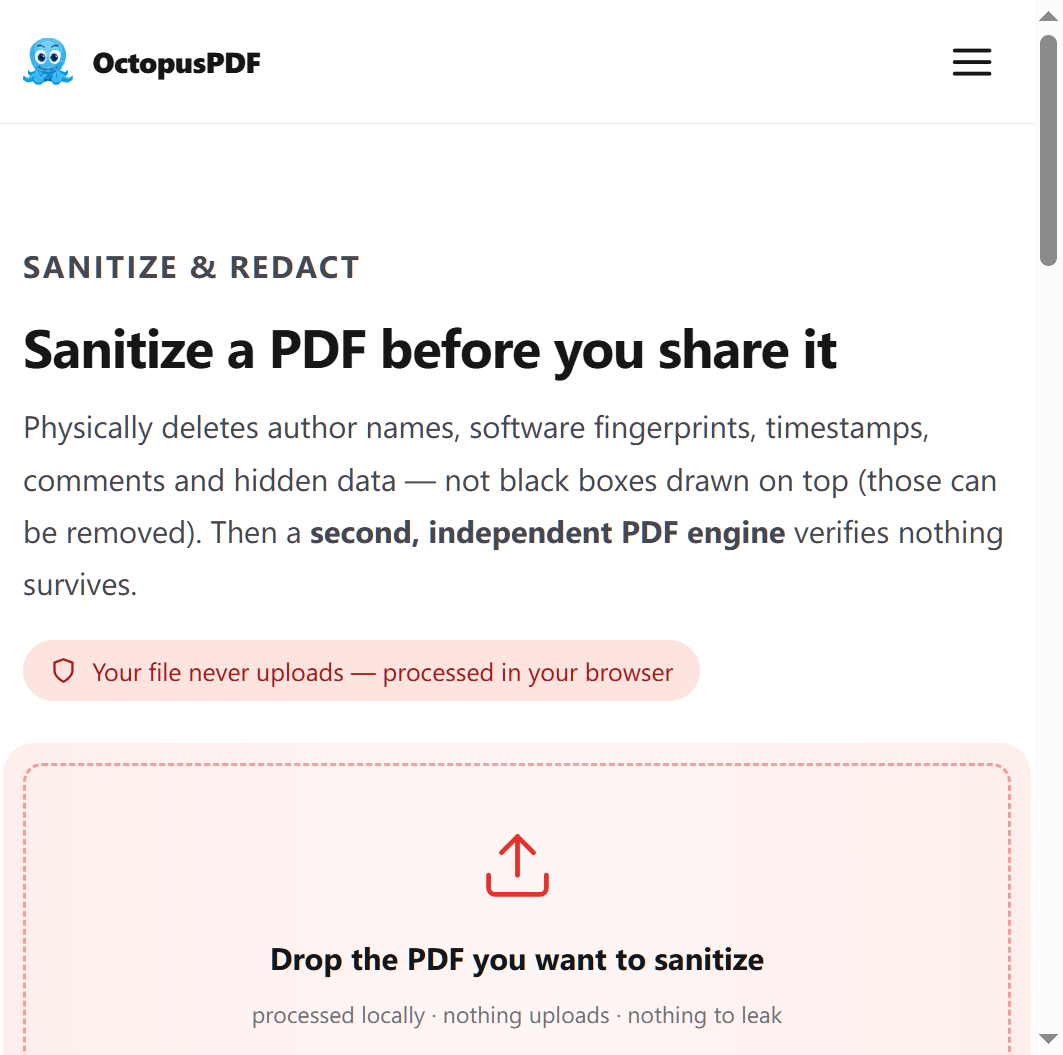
To understand the reliability of the local approach, it is helpful to look at the exact mechanics. The process, according to the official documentation, is straightforward [K5]:
| Step | Action | Location | Data Exposure |
|---|---|---|---|
| 1 | User drops a PDF into the browser tab. | Local Browser | None - File remains on device. |
| 2 | File is parsed with pdf.js. |
Local Browser | None - Parsing happens in-browser. |
| 3 | User enters their own OpenAI-compatible API key. | Local Browser | Key stays local - Stored in localStorage. |
| 4 | Browser connects directly to the chosen AI endpoint. | Direct API Call | Only the text content is sent to the AI provider chosen by the user. |
| 5 | Translation or Summarization occurs. | AI Endpoint | The user's selected provider processes the text. |
| 6 | Result returns to the browser. | Local Browser | None - The response is rendered locally. |
Key Considerations
- File Size: Since processing is local, very large PDFs may depend on your browser’s memory limits, not the server’s.
- API Cost: You are paying for the API usage directly. There is no "free" AI—it is fully metered at your provider’s rate.
- Security: This setup is not for those who want to "remove" responsibility for security. It shifts the responsibility to the user. You must trust your own API provider, but you do not have to trust the PDF tool vendor with your data.
6. FAQ
Q1. Is "local AI" just a marketing term, or does it actually offer better security?
It is a specific architectural choice. In this context, it means the processing pipeline (file parsing and text extraction) happens entirely in your browser [K5]. The only data that leaves your machine is the text sent to the AI endpoint you designated. This is significantly different from uploading the raw PDF file to a server. It is a real security benefit because the raw file never rests on a third-party server, reducing the risk of server-side breaches or retention policies.
Q2. Can I use a different AI provider other than OpenAI?
Yes. The BYO model is designed around "OpenAI-compatible" API keys [K2]. This means you can use endpoints provided by other companies that offer OpenAI-compatible interfaces, or you can host your own infrastructure. The tool does not lock you into a single vendor; it allows you to route requests to your preferred endpoint [K5].
Q3. What happens if I close the tab mid-summarization?
Since the file is processed locally, closing the tab or losing your network connection would interrupt the process. There is no server holding your session. However, because the file is local, you can simply repeat the process without any data loss risk—the original PDF is still on your drive.
Q4. Does the "PDF to Markdown" feature save tokens when using an LLM?
Yes. According to the tool’s description, the "structure-aware extraction" is designed to save tokens when feeding LLMs [K3]. By removing layout noise and providing clean, structured text, the AI model does not have to spend processing power on irrelevant formatting. This can reduce the input size and cost of a summary operation.
7. Conclusion
The future of document processing is not likely to be a choice between "cloud convenience" and "local security." Instead, tools like OctopusPDF demonstrate a hybrid approach that gives users the best of both worlds. By combining the power of a BYO AI key with local file parsing and a suite of pre-processing tools, you can build a workflow that is both powerful and compliant.
Final Judgment: If your primary concern is data confidentiality and you need to process PDFs at scale without uploading them, this architecture is a practical, superior choice. It hands you back control over the two most critical parts of the process: your raw file and your API key.
Next Step: Before your next major document task, evaluate your current workflow. Ask yourself: is my PDF leaving this machine? If the answer forces you to rely on a vendor’s promise, consider switching to a local-first pipeline. Start by testing the summarization and translation features with a sensitive document that you would not normally upload. You’ll find that the barrier to entry is low, and the peace of mind is immediate.