Still Uploading PDFs? Try These Six Zero-Upload AI Summarization Tools
Key Takeaways
- Zero-upload tools process PDFs entirely in the browser, so the source file never leaves your device. OctopusPDF's 14 free tools all follow this model [K2].
- The AI summarizer uses a Bring Your Own Key (BYO) approach: you supply an OpenAI-compatible API key, and both the file and the key stay local [K3].
- "No server-in-the-middle" means there is no third-party relay that can intercept the document or the key during processing [K1].
- Practical use cases: summarizing research papers and contracts, translating legal documents without uploading them, and processing confidential material with AI [K5].
- Six tools worth adopting now: Summarize PDF, Translate PDF, PDF to Markdown, Redact/Sanitize, PDF to Images, and Metadata [K1][K2][K4].
1. Introduction
Uploading a PDF to a free online tool feels harmless — until the document is a contract, a research draft, or an internal report. Every upload creates a copy on someone else's server, and for many users that tension has become the main reason to avoid AI summarizers altogether.
A new category of "zero-upload" tools removes that trade-off. Instead of routing your file to a cloud backend, the software runs in the browser; the document is processed locally, and only the output you request is generated. OctopusPDF, for example, offers 14 free PDF tools that run entirely in the browser with zero uploads [K2]. Among them, the AI-based tools follow a BYO key model: the user supplies an OpenAI-compatible API key, and both the file and the key stay in the browser [K3].
This article explains why zero-upload matters for AI summarization, how the BYO key architecture works, and which six tools are worth trying today. We also compare zero-upload tools with traditional upload-based services so you can decide when each makes sense.
2. Why Zero-Upload Matters for AI Summarization
The core conclusion
Zero-upload changes the risk equation. When a file never leaves the browser, the attack surface shrinks to your local device, and the server cannot be used as a relay for your data [K1].
What the evidence shows
OctopusPDF's AI tools are explicit about this design: "File never uploads, key never uploads. No server-in-the-middle" [K1]. The BYO key model reinforces it — because the API key is supplied by the user, the service operator does not provision or store credentials [K3].
The practical consequences are significant for three common scenarios [K5]:
- Summarizing research papers: preprints and peer-review drafts can be processed without creating premature public copies.
- Translating legal documents: contracts and court filings can be translated page by page without uploading the original [K4].
- Processing confidential material: HR, legal, or financial documents can be summarized with AI while maintaining privacy [K5].
Scenario-based advice
If you handle documents protected by an NDA, internal policy, or professional ethics, prefer zero-upload tools by default. If a tool's pricing page cannot clearly state where files are stored and for how long, treat the upload as a data-sharing event and act accordingly.
3. How the BYO Key Model Works
The core conclusion
Bring Your Own Key (BYO) is a simple architectural pattern: you use your own OpenAI-compatible API key, and the tool sends only the content needed for inference — without storing your key or your file [K3].
The process, step by step
- Open the Summarize PDF tool in a browser.
- Load your PDF from your local drive.
- Paste an OpenAI-compatible API key you already own.
- The tool extracts key points from the PDF using that key [K1].
- When done, both the file and the key remain on your device; nothing is stored on the provider's server [K3].
What "fully local" does and does not mean
"Fully local" in this context means the file and key never upload to the PDF tool's infrastructure [K1][K4]. For translation, OctopusPDF performs page-by-page translation in more than nine languages using your own key [K4].
Two boundaries worth understanding:
- A BYO key tool still calls an AI model API; the content you send to that model is governed by the API provider's terms.
- No-upload does not mean "no computation." The local browser does the organizing, conversion, and formatting; the remote AI model does the summarization or translation.
Who should use it
BYO is a strong fit for developers, researchers, and legal professionals who already have an OpenAI-compatible key or an organizational account. It also suits teams that want to centralize AI costs on their own billing instead of paying per-document fees.
4. Six Zero-Upload PDF Tools Worth Trying
The core conclusion
You do not need six different apps. OctopusPDF bundles 14 zero-upload tools in one browser suite [K2]; the six below cover a complete AI-friendly workflow — prepare, convert, summarize, and clean before sharing.
The six tools
| # | Tool | Category | What it does | Best for |
|---|---|---|---|---|
| 1 | Summarize PDF | AI | Extracts key points from any PDF using your own AI key [K1] | Research papers, contracts, long reports |
| 2 | Translate PDF | AI | Page-by-page translation into 9+ languages, fully local [K4] | Legal and multilingual documents |
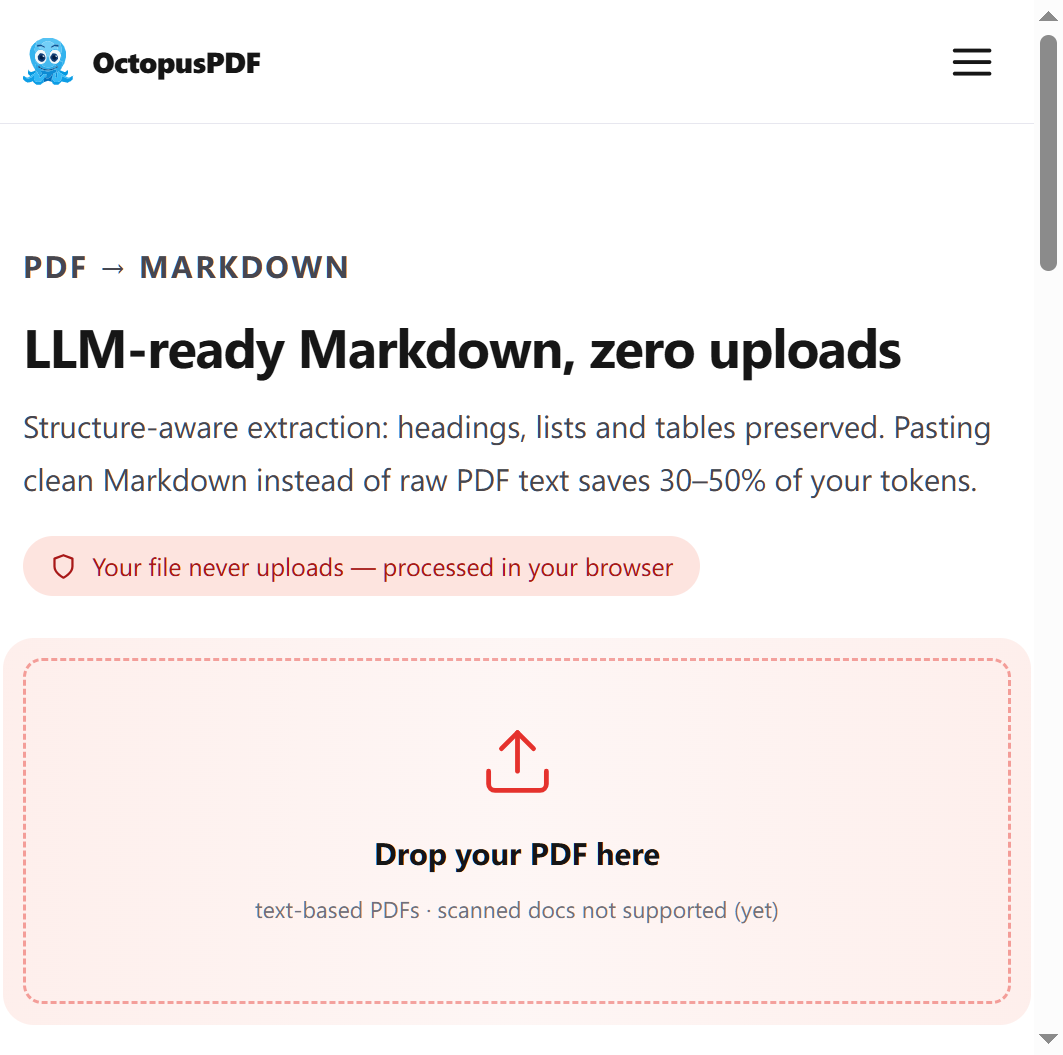
| 3 | PDF to Markdown | Convert | Structure-aware extraction that saves tokens when feeding LLMs [K4] | Building LLM-friendly text corpora |
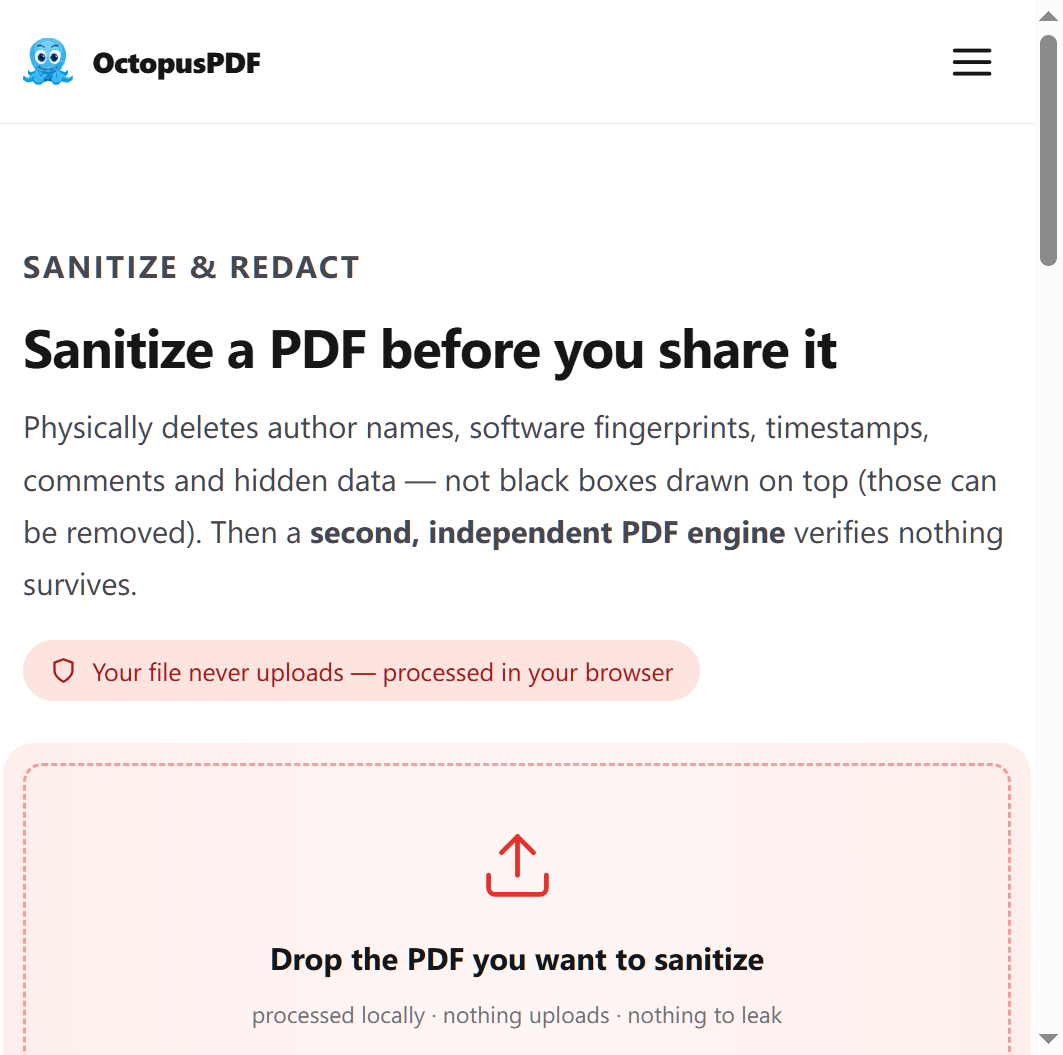
| 4 | Redact / Sanitize | Edit | Physically deletes metadata, comments, and hidden content before sharing [K2] | Cleaning files before publication |
| 5 | PDF to Images | Convert | Converts every page to PNG or JPG at up to 216 DPI [K4] | Slides, archives, and visual review |
| 6 | Metadata | Edit | Views and edits title, author, and more, or wipes it in one click [K2] | Removing authorship before sharing |
How the tools fit together
A realistic workflow looks like this:
- Clean the file with Redact/Sanitize so hidden comments and metadata are removed [K2].
- Check identity data with Metadata and wipe anything you do not need [K2].
- Convert the clean PDF to Markdown to reduce token usage when feeding it to an LLM [K4], or to images for visual review [K4].
- Run Summarize PDF to get key points, or Translate PDF for multilingual output [K1][K4].
This sequence keeps the document on your machine through every step — a property that no upload-based chain can offer.
Scenario-based advice
- Legal or compliance teams: use Redact/Sanitize before anything leaves the department [K2].
- Researchers: pipe PDF to Markdown into an LLM to cut token spend [K4].
- Translators: use Translate PDF for a page-by-page draft, then verify the output locally [K4].
5. Key Comparison: Upload-Based vs. Zero-Upload PDF Tools
The core conclusion
Choose zero-upload tools for confidential or internal documents; choose upload-based services only when you have evaluated their storage policy, retention period, and sub-processor list.
Structured comparison
| Factor | Upload-based tool | Zero-upload tool (e.g., OctopusPDF) |
|---|---|---|
| File location | Copied to provider's server | Stays in the browser [K2] |
| API key handling | Provider's key or your key stored | Your key stays local [K3] |
| Server-in-the-middle | Yes, typically | No [K1] |
| Suitable documents | Low-sensitivity material | Research papers, legal, confidential [K5] |
| Token/LLM workflow | Often requires extra export steps | PDF to Markdown saves tokens [K4] |
| Mobility | Works anywhere with a connection | Works in-browser; local processing still needs a connection for AI calls |
Decision guidance
- If the document is public or low-sensitivity, an upload-based tool is fine.
- If the document contains personal data, trade secrets, or attorney-client privileged content, use zero-upload [K5].
- If your goal is LLM preparation, zero-upload tools with Markdown export reduce the token cost of downstream processing [K4].
6. FAQ
Q1. Do zero-upload tools really keep my PDF private?
Yes, with an important boundary. In OctopusPDF's model, the file never uploads to the tool's servers, and the API key never uploads either [K1][K3]. The only data that leaves your browser is what you send to the AI model under your own key, subject to that provider's terms.
Q2. What does "Bring Your Own Key" mean and do I need one?
It means you provide an OpenAI-compatible API key instead of having the tool operator manage one [K3]. You need a key to use the AI tools (Summarize PDF and Translate PDF). The other PDF utilities — merge, split, rotate, organize, page numbers, watermark, metadata, redact, booklets, and conversions — run without one [K2][K4].
Q3. Can zero-upload tools replace a full PDF editor?
Not fully. These tools cover organizing, editing, converting, and AI processing, but they are not a replacement for a desktop editor with comment threads, form building, or advanced annotation. Use them as part of a privacy-safe pipeline rather than as a complete editor.
Q4. Is zero-upload processing slower than upload-based tools?
Not necessarily. Since no file transfer occurs, the bottleneck is the AI model call under your own key. For conversion tasks such as PDF to images at up to 216 DPI, processing is local and typically fast [K4].
7. Conclusion
The choice is no longer "AI summarization vs. privacy." Zero-upload tools give you both. OctopusPDF's suite shows that a mature PDF toolset can run entirely in the browser, and its BYO key AI tools extend the same guarantee to summarization and translation [K1][K2][K3].
If you want to adopt this workflow today, start with one document:
- Use Redact/Sanitize to clean the file [K2].
- Use Summarize PDF with your own key to extract key points [K1].
- If you need a multilingual version, run Translate PDF [K4].
That simple sequence keeps your document on your machine, gives you an AI-generated summary, and removes the need to trust yet another server with your files. For confidential material, that is not a convenience — it is the point.