PDF Preprocessing Combined with LLMs: Building an Efficient and Private Document Analysis Workflow
Key Takeaways
- Raw PDFs are poorly structured for LLM ingestion; preprocessing—such as converting PDFs to Markdown—reduces token waste and improves output accuracy.
- Privacy concerns are addressable by processing PDFs entirely in the browser and using a Bring-Your-Own-Key (BYOK) model for AI tasks, ensuring files never leave your device.
- A practical workflow separates organizing, editing, and AI-powered analysis tasks into distinct steps, mirroring the structure of tools like OctopusPDF [K2].
- Security-sensitive roles—lawyers, accountants, researchers—benefit most from workflows that combine local preprocessing with AI summarization and translation [K3].
- The expected outcome is not just faster document analysis, but a more controlled, auditable, and cost-effective pipeline.
1. Introduction
The gap between how we store information (often as PDFs) and how we want to analyze it (using Large Language Models) is a persistent problem. PDFs are designed for fixed layout, not for semantic data extraction. When you paste a cluttered PDF into an LLM prompt, you often pay for thousands of tokens of noise—headers, footers, repeated text—before the model even encounters the core argument. This is inefficient and can degrade the quality of the output.
Meanwhile, a second, more urgent concern has emerged: confidentiality. Professionals handling legal briefs, financial statements, or proprietary research cannot afford to send sensitive files to public servers. The rising adoption of AI tools has been met with a corresponding increase in data governance anxiety.
This article outlines a document analysis workflow that addresses both issues. We will explore how PDF preprocessing—specifically structuring and cleaning documents before they reach the LLM—combined with private AI inference models can create an efficient, secure pipeline. We will reference the practical toolset of OctopusPDF as a concrete example of how these capabilities are packaged [K1].
2. The Core Problem: Why Raw PDFs Fail
Conclusion: Feeding a raw PDF directly into an LLM is a mistake. It wastes tokens, introduces errors, and creates a poor user experience.
Reasoning: PDFs are the final output of printing, not a data model. They contain text but lack the semantic hierarchy that LLMs understand well. A standard academic paper PDF, for instance, includes page numbers, running headers, references, and often multi-column layouts. If you extract the raw text, the reading order might be jumbled. The model must spend extra time reconstructing the logical flow, which increases the chance of "hallucinating" false connections between ideas.
The Process: The solution is to restructure the PDF into something the LLM can easily digest. This means converting the PDF into a structured format like Markdown. The goal is not just to convert, but to make the conversion "structure-aware." This involves recognizing headings, paragraphs, lists, and tables, and preserving that structure in the output. Tools like OctopusPDF emphasize this "structure-aware extraction" specifically to save tokens when feeding LLMs [K2].
Scenario: A graduate researcher needs to analyze a 20-page paper. If they copy the PDF text directly, they lose the equation formatting and table alignment. If they first allow a tool to convert the PDF to Markdown, the equations may be better represented, and the tables become readable grid structures, providing a cleaner input for the LLM. The output is a more accurate summary and easier citation extraction.
3. The Privacy Imperative: The "Bring Your Own Key" Approach
Conclusion: Privacy does not preclude using powerful AI for sensitive documents. Instead, it requires a shift in architecture where the document never leaves your control.
Reasoning: Traditional web-based tools upload your file to a server, process it, and return the result. For a confidentiality-bound attorney or a financial analyst working under NDA, this is an unacceptable risk. The solution is to separate the data from the computation using a BYOK framework.
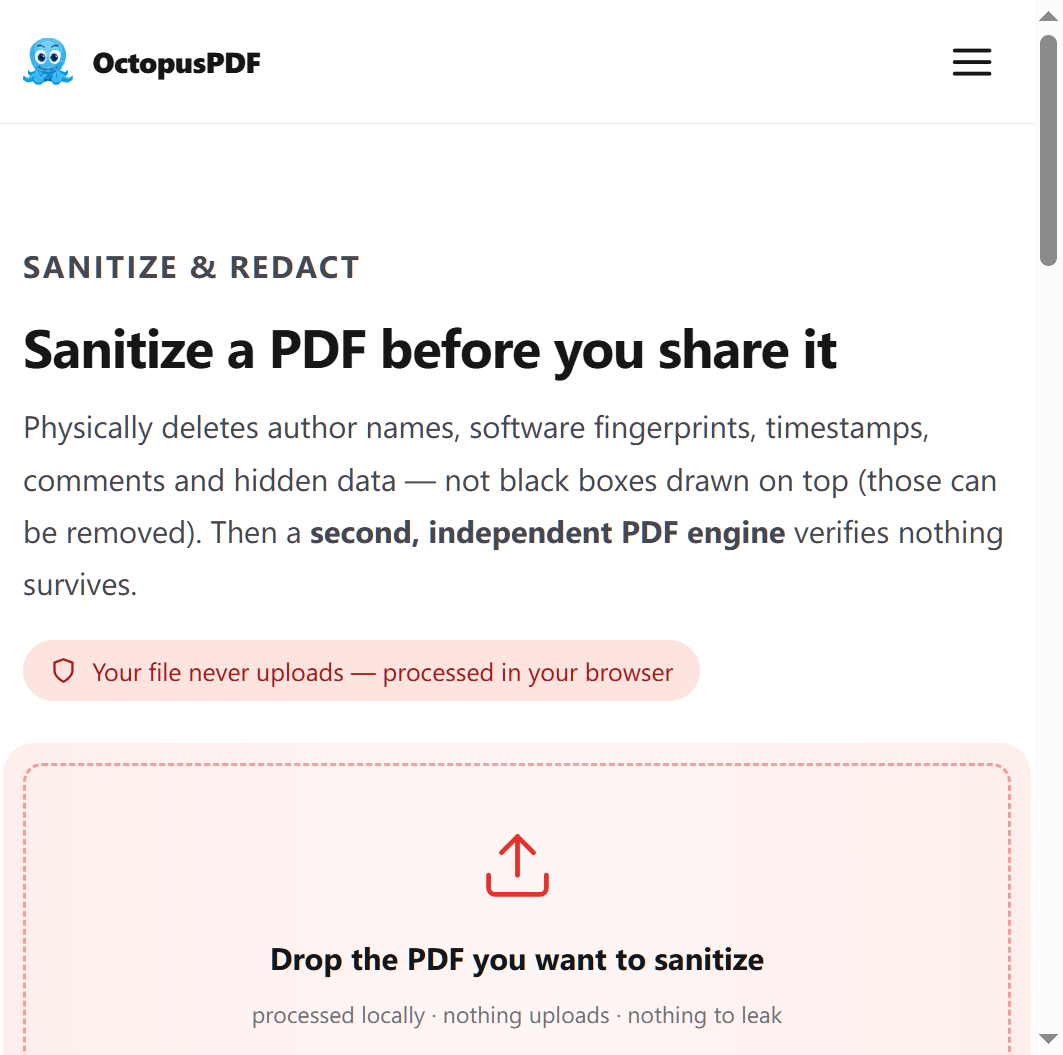
The Process: In this model, the PDF processing tool is a shell that runs locally in your browser. It never uploads the file or your API key. You provide the key to the LLM service (like OpenAI), and the tool instructs your key to process your local data. The key point is that there is no "server-in-the-middle" that stores the file [K4]. This means the tool can summarize, translate, or analyze the document using the same cutting-edge AI models, but without compromising the file's integrity.
Scenario: A remote worker is using a shared device at a co-working space. They cannot risk leaving traces of a confidential business plan on a hard drive. With a local, BYOK generator, they can open the PDF, run a summary, and close the browser—leaving no upload history, no temp files on the server. OctopusPDF explicitly lists this "processing confidential material with AI while maintaining privacy" as one of its core use cases [K3].
4. Structuring the Modern Workflow: From Preflight to Analysis
Conclusion: The most efficient workflow is modular. You should separate the steps of organizing, editing, optimizing, and analyzing. This reduces errors and makes the entire process easier to debug and repeat.
Reasoning: Trying to do everything in one click often leads to compromised results. If you need to merge a few PDFs and then summarize them, you want to verify the merge was correct before spending tokens on the summary. A modular toolkit allows you to control each stage.
The Process (A 4-Step Pipeline):
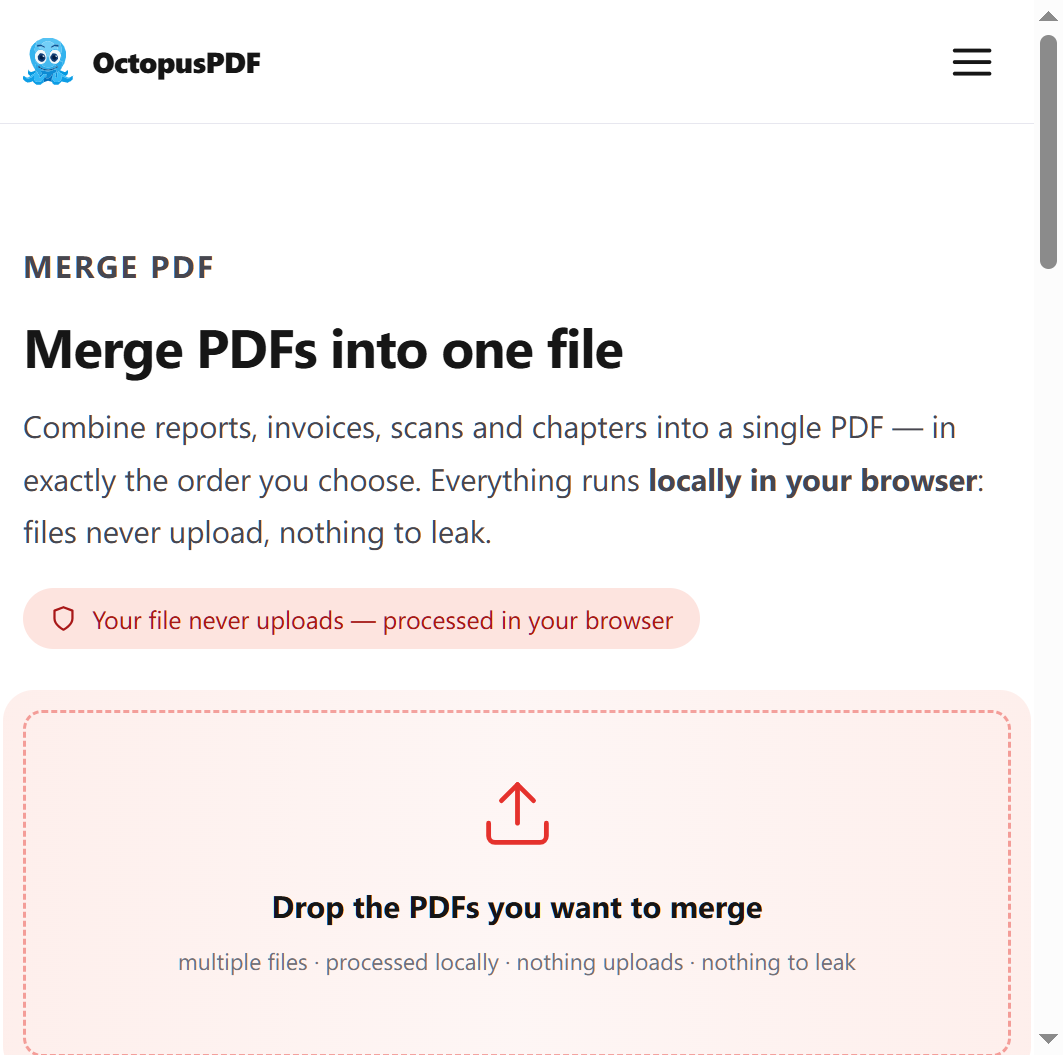
- Preflight and Organization: Before analysis, ensure the document is correct. This involves merging scattered files, splitting oversized documents, rotating misaligned scans, and reordering pages. For print shops or publishers, this is the "preflight" step to ensure the final output is ready for production [K2].
- Editing and Sanitization: This is critical for security. Before sharing or analyzing, you may need to redact sensitive text or wipe hidden metadata. "Redact/Sanitize" features physically delete metadata, comments, and hidden content—not just cover them with a black box [K5]. This prevents the accidental leakage of author information or tracked changes.
- Conversion and Optimization: This is the bridge to the LLM. Converting the PDF to Markdown or images (for multimodal models) creates a clean, token-efficient input. Professional tools offer PDF to Markdown for token savings and PDF to Images (up to 216 DPI) for OCR or visual inspection.
- AI-Powered Analysis: Here, you interact with the LLM. You use your BYOK provider to summarize or translate the preprocessed file. The tool sends the clean text prompt to the LLM using your credentials, without ever having stored the file on a cloud server [K4].
Recommendation: Adopt this pipeline as your standard practice. For high-value documents, always perform step 2 (Sanitization) before step 4 (Analysis). This ensures you are not feeding confidential data you forgot about, into an external system.
5. Comparison: AI Tools vs. Organize/Edit Tools
The distinction between organization tools and AI tools is crucial for understanding how they are used securely. The following table compares their characteristics based on the OctopusPDF toolkit [K2][K4].
| Feature | Organize/Edit Tools (Merge, Split, Redact) | AI Tools (Summarize, Translate) |
|---|---|---|
| Primary Function | Physical/structural manipulation | Cognitive analysis and generation |
| Data Processing | 100% Local: Occurs in the browser. Files do not leave the device [K5]. | Local + External AI: File stays local, but the text is processed via API calls. |
| Privacy Model | Zero-upload guarantee. No data egress. | BYOK: User provides API key. "File never uploads, key never uploads" [K4]. |
| Output | Modified PDFs, images, or structured text (Markdown). | Summaries, translations, or extracted text blocks. |
| Typical User | Accountants wiping metadata, print shops reordering pages, designers watermarking proofs [K1]. | Researchers summarizing literature, lawyers translating contracts, analysts extracting insights [K3]. |
Key Insight: The "security" of the workflow is not binary. Even with AI tools, the source document is never uploaded. However, the content (in text form) is sent to the LLM provider via your key. The BYOK model ensures that the tool vendor cannot access your data, but you are still responsible for the relationship with your LLM provider (e.g., OpenAI). This is a subtle but important distinction for compliance.
6. FAQ
Q1. Does converting PDF to Markdown really reduce token usage?
Yes, significantly. A standard PDF page often contains a lot of "noise" like headers, footers, and page numbers that are only relevant in a print context. Structure-aware conversion removes this noise and preserves the semantic hierarchy (headings, lists, etc.). If you send a multi-column academic paper as raw text, the LLM may read columns out of order. In Markdown, the reading order is linear and logical, meaning the LLM uses fewer tokens to comprehend the text and doesn't waste tokens asking for clarification or re-reading misordered content [K2].
Q2. If I use a "Bring Your Own Key" tool, is my file truly private?
This depends on your definition of "private." From the tool vendor's perspective, yes, they never see your data. The file is processed locally in your browser [K5]. The critical point is that you are still sending a request to the AI provider (e.g., OpenAI, Anthropic) using your API key [K4]. So, the LLM provider may process your data under their terms. The advantage of BYOK is that the AI vendor is the only party involved, and you have a direct, known relationship with them. There is no "server-in-the-middle" that aggregates data from multiple users [K4].
Q3. What is the difference between "Redact" and just "Blacking Out" text?
Physical redaction is not enough. If you use a PDF editor to draw a black rectangle over text, the text is often still hidden in the file's underlying metadata layer. A "Redact/Sanitize" tool physically removes the content from the file structure. It deletes metadata, comments, and hidden content, ensuring the data cannot be recovered with a simple search or text extraction [K5].
7. Conclusion
The combination of local PDF preprocessing and private AI inference represents the most practical approach for professionals who need the power of Large Language Models without sacrificing confidentiality or efficiency.
By adopting a modular workflow—Organize, Sanitize, Optimize, Analyze—you gain control over the entire document lifecycle. Tools like OctopusPDF demonstrate that it is entirely feasible to handle files up to 100 MB, perform complex print-ready tasks, and integrate AI summarization and translation, all without a single file upload [K1][K2]. This is not just a technical improvement; it is a compliance strategy. For freelancers, attorneys, researchers, and small businesses, the path forward is clear: structure your documents for the machine, and keep your data local. This is how you build an analysis workflow that is both smart and safe.