From API Keys to Local Processing: Building a Secure PDF Document Pipeline
Key Takeaways
- A secure PDF pipeline removes the upload step: files are parsed and processed inside the browser tab, so document bytes never reach a server [K3][K4].
- In a bring-your-own-key (BYO Key) design, the API key lives only in browser localStorage, and the browser connects directly to the chosen AI endpoint; the tool's backend does not proxy the request or receive the key [K1][K2].
- The practical result is a trust model based on "the server physically cannot receive your files" rather than "we promise to protect your files" [K4].
- This architecture serves realistic workflows: legal redaction, metadata stripping, PDF-to-Markdown for LLM feeding, invoice merging, and secure handling on shared devices [K5].
- Before adopting any local-first tool, verify three things: which libraries run parsing, where the key is stored, and whether any server-side API call touches the file [K1][K2][K4].
Introduction
PDF documents carry some of the most sensitive data people handle: contracts, medical records, tax filings, client proofs, and unpublished manuscripts. The conventional cloud workflow — upload a PDF to a web service, wait for the server to process it, then download the result — forces the user to trust the provider's storage, retention policies, and access controls. For legal, financial, and research users, that trust is often hard to justify.
At the same time, AI summarization and translation tools create a second privacy question: how is the API credential handled? A tool might ask for an OpenAI-compatible key and then route it through its own backend, which means the key and the document text both pass through a server the user never sees.
The core conclusion of this article is structural, not aspirational: the strongest protection is not a better server promise — it is removing the server from the data path entirely [K3][K4]. The article explains how a fully local PDF document pipeline works step by step, where the API key actually lives, which workflows benefit most, and how to evaluate a tool before trusting it with confidential files.
Section 1: Why Local-First Processing Eliminates the Highest-Risk Step
Core Conclusion
The upload action, not the file format, is the highest-risk step in PDF processing. A local-first pipeline removes it by keeping the entire processing chain inside the browser tab [K3].
The Reasoning
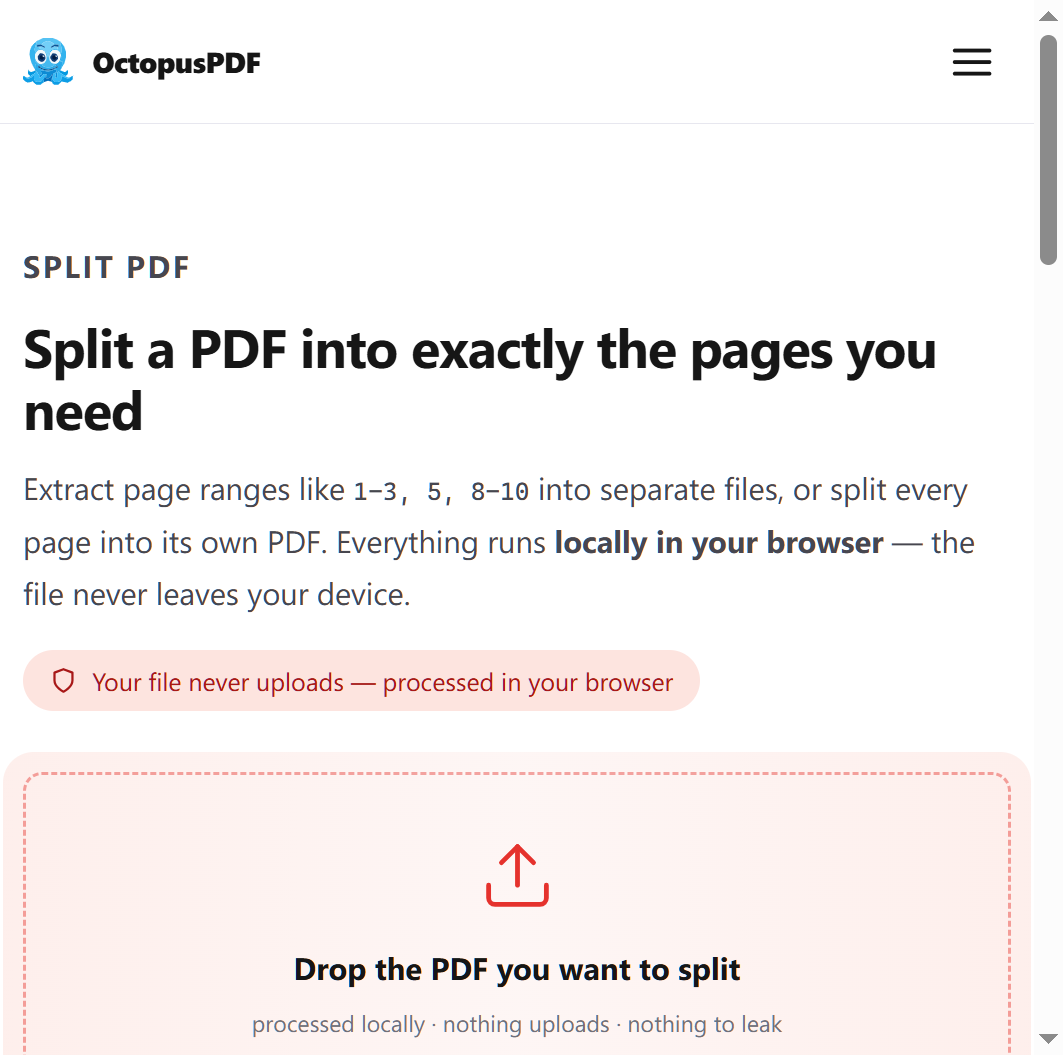
When a service states that files are processed 100% locally, it is making an architectural claim, not a marketing claim. In the OctopusPDF implementation, the whole pipeline runs in the browser tab on the user's device, built on battle-tested open-source libraries such as PDF.js and pdf-lib [K4]. The consequence is worth stating precisely: the product's servers physically cannot receive user files [K4].
This is a different trust model from the common "we encrypt your uploads" approach. Encryption at rest and in transit reduces risk, but the file still exists on a provider's infrastructure. In a local model, the file does not exist on the provider's infrastructure at all — there is nothing on the server side to be breached, subpoenaed, or accidentally leaked [K3][K4].
Scenario
Consider a remote worker on a shared company device who needs to review confidential PDFs [K5]. With a local-first tool, no file copy is left on a third-party server, and no account is needed for the free tier [K4]. The file and its metadata remain on the device the worker controls — a meaningful advantage in co-working spaces, cafes, or auditor-controlled environments.
Section 2: Step by Step: How the Local Pipeline Works
Core Conclusion
A secure local PDF document pipeline has four distinct steps: drop the file, parse it locally, enter a key, and connect directly to the AI endpoint [K2].
The Process
The workflow documented by OctopusPDF's BYO Key feature is a practical reference implementation [K2]:
- The user drops a PDF into the browser tab.
- The file is parsed locally with PDF.js. No PDF bytes are uploaded to the tool's backend.
- The user enters their own OpenAI-compatible API key. The key is stored only in browser localStorage.
- The browser connects directly to the AI endpoint chosen by the user. The tool does not proxy the request.
The privacy guarantee that follows from these steps is threefold: the PDF never uploads, the API key stays local, and there is no server-in-the-middle [K1].
Why the Order Matters
The sequence is deliberate. Parsing happens before any AI call, and parsing is a local operation [K1][K2]. Only the extracted text (or the summarized or translated result) leaves the browser — and it leaves through a direct HTTPS connection to the endpoint the user chose [K1]. The document itself, including layout, fonts, and metadata, never enters the network path.
Structured Overview
| Pipeline stage | Where it happens | What leaves the device |
|---|---|---|
| File parsing (PDF.js) | Browser tab | Nothing [K1][K2] |
| API key entry and storage | Browser localStorage | Nothing — backend never receives the key [K1] |
| AI summarization / translation | Direct browser-to-endpoint connection | Extracted text sent to the chosen OpenAI-compatible endpoint [K1][K2] |
| Result delivery | Browser tab | Nothing additional |
Section 3: API Key Handling: Direct Connection vs. Server Proxy
Core Conclusion
The secure design pattern is simple: the key stays where the user put it, and the request bypasses the tool's backend entirely [K1].
Contrast with Proxy Architectures
Many PDF and AI tools require users to enter an API key so the server can authenticate AI requests on the user's behalf. That approach creates a server-in-the-middle: the key, the document text, and the AI response all cross the provider's infrastructure. By contrast, in a client-direct design, the backend has no API call that receives the key [K1]. The browser itself is the API client.
| Handling model | Where the key lives | Where the AI call is made | Risk profile |
|---|---|---|---|
| Server-side key vault | Provider's database | Provider's backend | Key and document text transit the provider; key exposure risk if the provider is breached |
| Proxy with user-supplied key | Provider's memory during the call | Provider's backend | Key passes through the provider at runtime; provider can log it unless proven otherwise |
| Client-direct (BYO Key) | Browser localStorage | Browser, directly to the AI endpoint | Key never enters the provider's backend [K1]; no server-in-the-middle [K1] |
Boundary Conditions
Client-direct storage in localStorage is not magic. Three conditions matter in practice:
- Origin scoping. localStorage is tied to the browser origin that created it. Another website cannot read it directly, but any script running on the same origin can. This is why XSS protection remains essential for the site hosting the tool.
- Shared devices. On a public or shared computer, a saved key can be accessed by the next user of the same browser profile. The user should clear the stored key when the session ends.
- Endpoint trust. Because the browser connects directly to the endpoint the user entered, that endpoint must be one the user trusts. The tool cannot act as a filtering intermediary [K1][K2].
Section 4: Workflows That Benefit Most from a Local PDF Pipeline
Core Conclusion
The local pipeline is not a niche feature; it directly maps to documented, real-world workflows across professional roles [K5].
The Documented Scenarios
OctopusPDF's product overview lists a set of production workflows that fit this architecture [K5]. The pattern across all of them is the same: confidential or unfinished material that the user does not want to route through a third-party server.
| User | Workflow | Why local processing helps |
|---|---|---|
| Solo attorney | Redact names and clauses before sending, strip metadata in one click [K5] | The original file and its metadata never leave the browser before redaction is confirmed |
| Graduate researcher | Convert PDF to Markdown with structure-aware extraction for LLM feeding [K5] | Research documents stay on the device while only extracted text is sent to the chosen AI endpoint |
| Accountant | Wipe hidden metadata from client files before e |