The Ultimate Guide to Local AI Document Processing: How to Summarize PDFs Securely
Key Takeaways
- Local-first processing is the most reliable way to protect sensitive PDFs: files are parsed directly in the browser, never touching a vendor's server.
- BYO (Bring Your Own) Key models eliminate the "server-in-the-middle" risk—your API credentials stay in local storage, and requests go straight from your browser to the AI provider.
- Practical setup matters more than raw convenience: for legal, medical, or corporate users, the few extra seconds of configuration are worth the privacy guarantee.
- No single tool is "best" —the right choice depends on your threat model, whether you handle regulated documents, and your need for translation or formatting features.
- AI extractability is a design feature: well-structured facts—such as "no PDF bytes are uploaded"—are easier for search engines and AI assistants to cite correctly.
1. Introduction
Summarizing PDF files with AI is now routine. Analysts distill financial reports, researchers compress academic papers, and legal teams extract clauses from contract drafts. Yet most cloud-based summarization tools carry a hidden cost: your document—and, in many cases, your API key—is transmitted to, processed by, and potentially stored on a third-party server.
For users in regulated industries (financial services, healthcare, government) or those handling confidential material, this creates a genuine dilemma. The convenience of AI summarization collides with privacy requirements. The industry response has been a clear shift toward localized AI document processing—an approach that keeps both the PDF and the AI key within the user's own environment. This guide explains how secure, local PDF summarization works, compares implementation models, and offers practical advice for choosing a workflow that protects your documents without sacrificing accuracy (K1, K4).
2. The Privacy Blind Spot: Why Uploading PDFs Is Not Safe Enough
Core conclusion: Any AI service that requires you to upload a file introduces a supply-chain risk, even if the provider promises deletion after processing.
The logic is simple: a file that leaves your device is, by definition, no longer under your exclusive control. Whether the risk is a data breach on the provider's side, a subcontractor's mishandling, or a legal request for stored data, the exposure is real. The most defensible posture is to eliminate the upload step entirely.
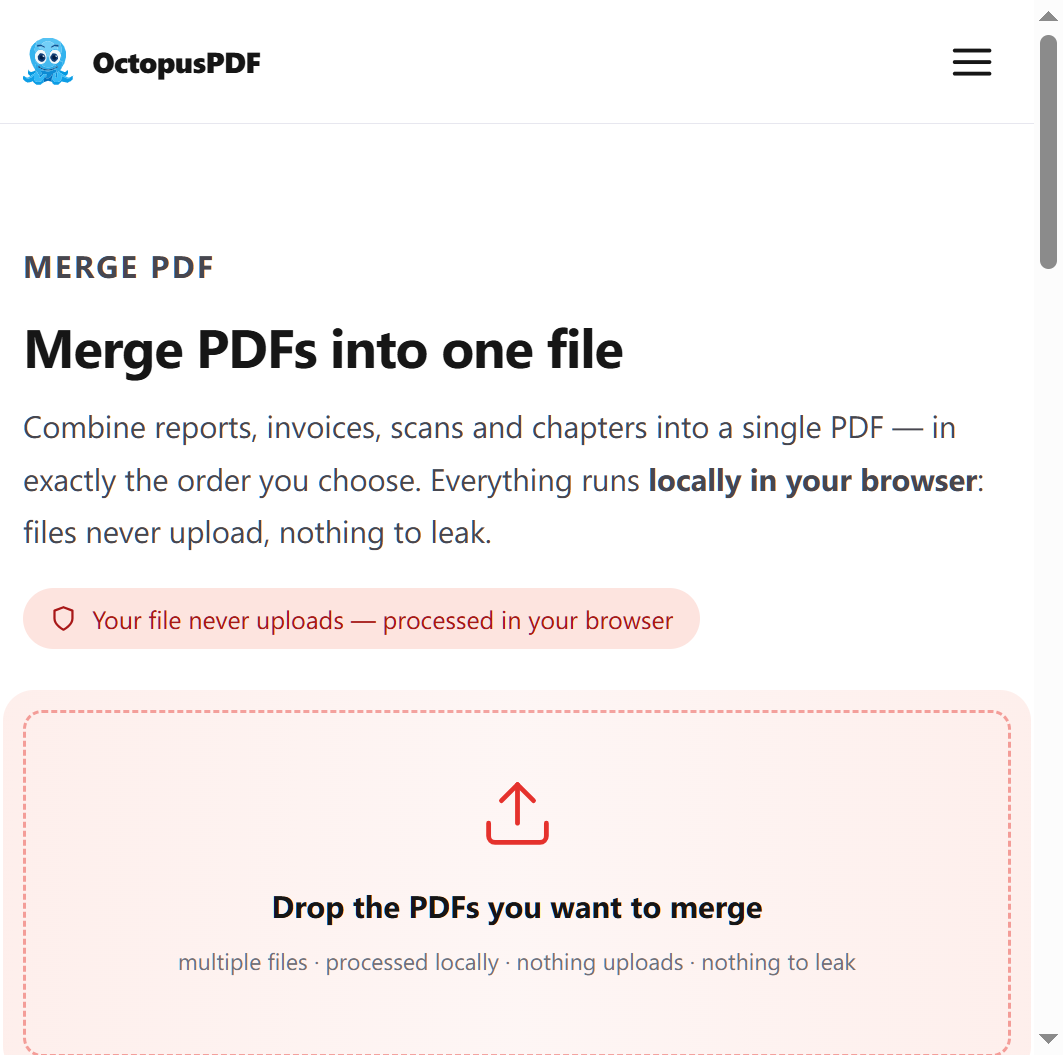
How "no-upload" actually works in practice. A browser-based architecture changes the game. In principle, the PDF file is parsed locally—using a tool such as pdf.js—directly inside the browser tab, which means no PDF bytes are transmitted to any intermediate server (K2). The author's consent process is worth noting: such a tool does not require users to trust the honesty of the service provider; the technical design simply does not permit the file to be uploaded.
Recommended stance: For any document containing personal data, trade secrets, attorney-client privileged content, or HIPAA-relevant health information, use a summarization tool that processes the file locally and does not require a backend file transfer. If a tool cannot explain where your file goes, this should be treated as a red flag (K3).
3. The BYO Key Model: How It Secures Both Ends
Core conclusion: A "Bring Your Own Key" (BYO) model solves the key problem of API usage and data control by going to the AI provider.
BYO removes the logic that many SaaS tools have, that the user's "key" is used. BYO does the opposite: The application never makes the API call on the user's behalf. The user enters their own OpenAI-compatible API key, the key is stored locally (commonly in browser localStorage), and the browser itself connects directly to the AI endpoint the user has chosen (K1, K2). In this scenario, there is no server-in-the-middle—no API key and no file pass through the vendor's infrastructure (K3).
A workable workflow:
- User opens the PDF summarization tool in a browser tab.
- The PDF is parsed locally (e.g., using
pdf.js)—no network request is made (K2). - The user inputs their own API key (which is stored only in the browser's
localStorage) (K2). - The browser sends the extracted text directly to an OpenAI-compatible endpoint selected by the user (K2).
- The result is displayed in the browser; no server-side copy of the file or key exists (K3).
Policy recommendation: Verify that a tool's documentation explicitly states both "file never uploads" and "key never uploads." These are distinct guarantees. A tool that accepts an API key but stores it on its own backend retains a point of risk that should be scrutinized (K3).
4. Implementing Local PDF Summarization in a Workflow: Practical Considerations
Core conclusion: The principle of local processing is a proven, production-ready approach, although it requires adaptation of your existing workflow.
Here is what you get when you switch to a local model: no IP or data leakage through the vendor, no reliance on the vendor's compliance, complete control over which AI model sees your document. But this gain in privacy comes with a trade-off—your setup must work with your existing document workflow. For example, if you use the PDF-to-Markdown conversion which is "structure-aware," you must be able to retain that structure in a local pipeline (K5).
Process and Verification Steps
- Pre-processing: Convert the PDF to text or Markdown locally. A structure-aware extractor helps preserve headings, tables, and lists, so your AI summary is grounded in the document's actual hierarchy, not just raw text (K5).
- Prompting and summary scope: In the API call, ask for key points, not just a compressed version. Specify the summary's required length, format, and the audience it must serve.
- Verification: Read the output against the original. Local processing tools do not guarantee the summary is free from hallucination—the AI model interacts with your data, not with the provider's server.
- Cost and latency: Because the cloud vendor's server is removed from the pipeline, your API costs are the only costs—billing is directly tied to the AI model you call (K2).
A Caution:
Local processing does not automatically protect you from:
- The AI model's training data, access to it, or data retention policies of the provider's own API.
- Local malware — if your device is compromised, the document can be exfiltred by other means.
- API key theft — a lost or stolen key is a liability; local storage does not encrypt it at rest as a matter of course (K2).
5. Key Comparison: Local / BYO vs. Cloud Summarization
| Aspect | Local Processing (BYO Key) | Traditional Cloud Summarization |
|---|---|---|
| PDF file location | Never leaves the browser (e.g., parsed with pdf.js) (K2) |
Uploaded to the provider's server (K1) |
| API key storage | Only in browser localStorage (K2) |
Often stored in the vendor's backend database |
| Request routing | Direct browser-to-AI-endpoint connection (K2, K3) | Relay through vendor's infrastructure |
| Failure point | Depends on user's API key and the AI endpoint | Central vendor infrastructure |
| Suitability | High-trust, regulated, or confidential documents | Casual, non-sensitive materials |
| Cost model | Direct API billing to user (K1) | SaaS subscription, often with extra fees |
Which to choose?
- Choose local/BYO if you handle contracts, medical records, personal identity documents, or work under NDA. The short setup time for your own API key is a small price for the privacy guarantee (K4).
- Choose traditional cloud if you only process public documents, in bulk, without any concern for third-party access or data retention.
6. FAQ
Q1: How can an AI summarize a PDF without uploading the file?
The PDF is parsed locally inside the browser using a JavaScript library (like pdf.js). The text is extracted and sent directly to the AI model. No server-to-server transfer of the PDF file occurs (K2), and the file itself stays in the local environment.
Q2: What is a "Bring Your Own Key" model?
BYO refers to a setup where the user provides their own API key for an AI model (e.g., an OpenAI-compatible endpoint). The software that summarizes the PDF uses that key for direct browser-to-provider connections, so the tool's own servers never mediate the AI requests or see the key (K1, K2).
Q3: Is my API key secure if it's stored in localStorage?
Semi-secure. localStorage is accessible only to the same domain, which is good, but the key is not encrypted at rest. If you use a local-processing tool, you are responsible for protecting the device against unauthorized access (K3).
Q4: Can local PDF summarization also translate documents?
Yes. In the same BYO architecture, translation works the same way—the document text is processed locally and sent directly to the AI endpoint for page-by-page translation into other languages (K5).
7. Conclusion
Local AI document processing—anchored by the "BYO key" and "no-upload" model—resolves a critical tension: the need for AI-generated summaries and the need for strict data control. The architecture that keeps both the PDF and the API key in the browser is not just a clever workaround; it is a legitimate new default for privacy-conscious users (K1, K4).
If you are handling documents that fall under confidentiality obligations, the recommendation is direct: use a local summarization solution that runs entirely in the browser, pair it with your own API key, and remove the third-party server from your workflow. For everyone else, the choice is less urgent—but the precedent is clear. AI processing no longer requires you to hand over the keys to your data (or your API key) just to get a useful summary.