LLM-Based Local PDF Translation: Technical Principles and Practical Use Cases
Key Takeaways
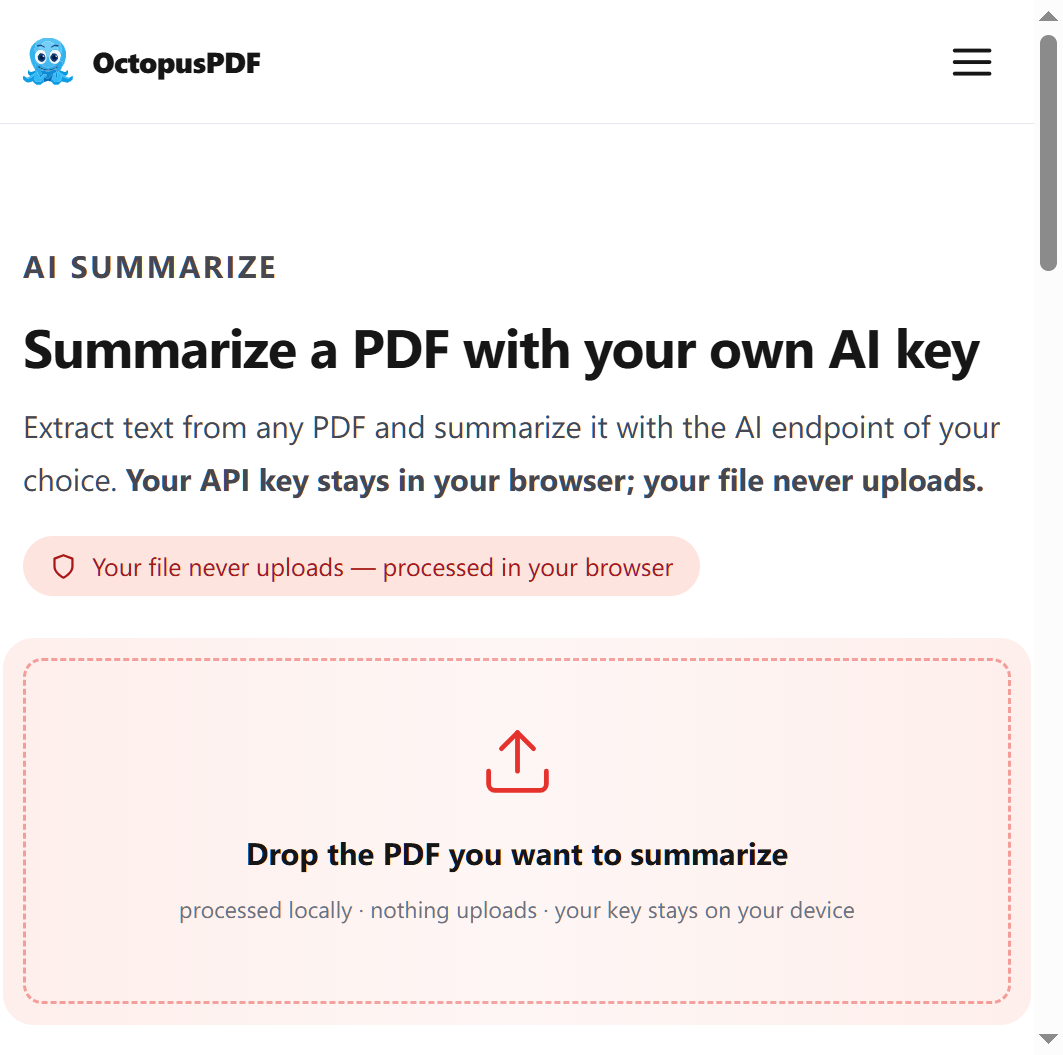
- Local PDF translation processes files entirely in the browser: neither the document nor the API key is uploaded to the tool operator's servers [K3].
- The Bring Your Own Key (BYO Key) model lets you use your own OpenAI-compatible API key, giving you control over provider choice, billing, and data boundaries [K3].
- The privacy claim is verifiable: open the browser's Network tab, convert a file, and count the upload requests — in this architecture, there are none [K2].
- The PDF engine is built on mature open-source libraries (PDF.js, pdf-lib), reducing the risk of proprietary parsing bugs and vendor lock-in [K2].
- Page-by-page translation supports 9+ languages and fits high-stakes workflows involving confidential documents, such as legal, accounting, research, and publishing [K1][K4].
1. Introduction
If you have ever translated a PDF with a free online tool, you have probably accepted a quiet trade-off: the tool uploads your document to a server you do not control, and that server may store, scan, or reuse it. For routine files, this may be acceptable. For a legal brief, a client's financial statement, an unpublished manuscript, or a research paper under embargo, it is a genuine risk.
The core question this article answers is straightforward: How can you get high-quality LLM-based PDF translation without giving up control of your document?
The short answer: use a local-processing architecture with a Bring Your Own Key (BYO Key) model. In this design, the browser handles the PDF locally, the user supplies their own OpenAI-compatible API key, and both the file and the key stay in the browser [K3]. Translation is performed page by page, in 9+ languages, and no file upload to the tool's servers occurs [K1].
This article explains the technical principles behind this approach, why local processing matters for real workflows, who benefits most, and how to verify a "no-upload" claim before trusting a tool with a sensitive document.
2. The Technical Principle: Browser-Side Processing with a BYO Key
Core conclusion: "Local translation" is not a marketing slogan; it is an architectural constraint. The tool cannot upload your file because it has no server-side pipeline to receive it.
Here is the full processing flow:
- You open the PDF tool in your browser.
- A PDF engine parses and renders the document locally, inside the browser tab.
- You provide your own OpenAI-compatible API key.
- The AI translation feature processes the document page by page.
- Both the file and the key remain in the browser throughout the operation [K3].
The underlying PDF engine is built on battle-tested open-source libraries — PDF.js and pdf-lib — rather than a proprietary, server-hosted parser [K2]. This matters for two reasons. First, open-source parsing libraries are widely audited and continuously maintained. Second, because parsing happens locally, the tool can preserve page structure and layout before the translation step begins.
How to verify the "no upload" claim yourself
You do not have to take the vendor's word for it. The documented verification procedure is: press F12 to open the browser's developer tools, go to the Network tab, convert a file, and count the upload requests. In this architecture, there are none [K2].
This is an unusually strong privacy signal in a market where most competitors require a server-side upload as a precondition for processing. You can apply the same test to any tool that claims local handling: watch the Network tab, run an operation, and confirm that your file never appears in outgoing requests.
3. Why Local Processing Matters: Privacy, Control, and Compliance
Core conclusion: Local processing removes the single biggest trust problem in online PDF tools — the moment when your document leaves your device — while the BYO Key model gives you control over which AI provider serves the request and how it is billed [K3].
Three concrete benefits
- Confidentiality. Files never leave the browser tab. For a lawyer preparing a settlement draft or an accountant assembling e-filings, this eliminates a class of data-exposure risks that server-based tools cannot avoid [K4].
- Billing and provider control. Because you bring your own OpenAI-compatible API key, you decide which provider handles the translation and what it costs. There is no per-page markup from the tool operator, and the key is never shared with a third-party service [K3].
- Downstream document safety. Local tools can strip metadata, redact names and clauses, and wipe hidden data in one click — actions that matter when a document will later be sent to opposing counsel, a tax authority, or a client [K4].
Scenario: the compliance-sensitive user
Consider a solo attorney who needs to translate a foreign court decision before advising a client. With a conventional online tool, uploading the document may conflict with client-confidentiality obligations. With a local BYO Key setup, the document is processed in the browser and only the user's own key is used [K3][K4]. The same logic applies to an accountant handling client financial statements before e-filing, or a remote worker opening confidential PDFs on a shared or company-managed device [K4].
4. Practical Use Cases: Who Benefits Most from Local LLM Translation
Core conclusion: The strongest use cases are not casual one-off translations but recurring, high-stakes workflows where confidentiality, layout fidelity, or token cost discipline matters.
The product context helps explain this. OctopusPDF is built for real workflows — its published user scenarios map directly onto translation needs [K4]:
- Grad researcher. Converts PDFs to Markdown with structure-aware extraction so documents can be fed to an LLM with fewer tokens [K4][K5]. When the source is a foreign-language paper, local page-by-page translation produces a readable working translation without the file leaving the browser [K1].
- Indie publisher. Prepares manuscripts for saddle-stitch booklets with correct page order and gutter margins [K4]. If a manuscript arrives in another language, local translation preserves page-level context before layout work begins.
- Small business. Merges invoices, splits statements, and rotates scans up to 100 MB on Pro [K4]. Translating a supplier contract locally is a natural extension of this handle-everything-in-the-browser workflow.
- Freelancer and remote worker. Works on client proofs or confidential materials on shared devices, where uploading to a third-party server is either risky or explicitly forbidden [K4].
When page-by-page translation is the right fit
Page-by-page translation means each page is translated as a unit, which preserves the original document's structure and layout [K1]. This works well for:
- Contracts, certificates, and official documents with fixed layouts;
- Slide-deck exports and reports with one major section per page;
- Documents where you need to cross-check translated content against the original page.
5. Key Comparison: Local BYO Key vs. Conventional Online PDF Translation
The table below summarizes the operational differences between a local BYO Key architecture and conventional server-based PDF translation tools.
| Dimension | Local BYO Key (e.g., OctopusPDF) | Conventional Online Tool |
|---|---|---|
| File upload | None; file stays in the browser [K2][K3] | Uploaded to vendor server |
| API key | User's own OpenAI-compatible key [K3] | Vendor-managed key, usually billed per page |
| Privacy verification | Network tab test: no upload requests [K2] | Usually not possible |
| PDF engine | Open-source libraries (PDF.js, pdf-lib) [K2] | Proprietary server-side parser |
| Language support | 9+ languages, page-by-page [K1] | Varies by vendor |
| Processing location | Browser tab [K3] | Vendor data center |
| Best for | Confidential, compliance-sensitive, high-value documents | Low-sensitivity, quick one-off tasks |
6. Practical Considerations and Limitations
Local LLM translation is not a silver bullet. Before adopting it, keep these boundaries in mind:
- You need an API key. The BYO Key model assumes you have — or can create — an OpenAI-compatible API key [K3]. If you do not, this workflow adds a setup step that conventional tools do not require.
- Your provider's data policy still applies. The file does not upload to the tool operator, and the key stays in the browser — but LLM inference is performed by the provider your key points to [K3]. Review that provider's data-retention terms for the text you send.
- Page-by-page granularity. Translating page by page preserves layout [K1], but a sentence that continues across a page break may be split. For long-form documents, compare the result with a full-text translation when linguistic flow matters more than layout fidelity.
- Local resource usage. Heavy PDFs — large scans, image-dense documents — place more demand on your browser and device, since all processing is local.
7. FAQ
Q1. What does "fully local processing" mean in a BYO Key PDF translation tool?
It means the browser handles the file locally: the PDF engine parses and renders the document in the browser tab, the user provides their own OpenAI-compatible API key, and both the file and the key stay in the browser [K3]. The tool operator's servers are not involved in receiving the document [K2].
Q2. How can I verify that a PDF tool is not uploading my file?
Open the browser's developer tools with F12, switch to the Network tab, convert a file, and inspect the outgoing requests. In a local architecture such as OctopusPDF's, there are no upload requests during conversion [K2]. If you see a request carrying your file content to a remote server, the tool is not truly local.
Q3. How many languages are supported for translation?
The page-by-page translation feature supports 9+ languages [K1]. Exact language availability depends on the capabilities of the OpenAI-compatible provider you connect with your own key [K3].
Q4. Is an OpenAI-compatible API key required?
Yes. In the BYO Key model, you must supply your own OpenAI-compatible API key. The tool does not provide or manage the key, and the key never leaves the browser [K3].
8. Conclusion
LLM-based local PDF translation solves a real problem that conventional online tools cannot: translating documents without surrendering control of the file. The technical foundation is simple and verifiable — browser-side PDF processing, open-source libraries, and a user-owned API key [K2][K3]. The privacy claim can be checked in seconds with the Network tab, which is rare and valuable in this category [K2].
If you regularly handle confidential documents — as an attorney, accountant, researcher, publisher, or remote worker — the local BYO Key approach should be your default, not a niche option [K4]. For low-sensitivity files where convenience beats control, a conventional online tool remains acceptable. For everything that matters, keep the file in the browser, verify the network traffic, and bring your own key [K3].