Key Takeaways
- Redacting a PDF is not the same as covering text with a black box—true redaction requires physically removing hidden data, metadata, and content layers.[K2][K5]
- Most online "secure" redaction tools upload your file to a server, creating an inherent privacy paradox: the very act of protecting your document may expose it to third parties.[K2]
- Browser-based, local-only redaction tools eliminate this risk by processing the file entirely on your device—no upload, no server, no third-party access.[K2][K5]
- Depending on your needs, you may also need to sanitize metadata, comments, and hidden layers, not just visible text.[K5]
- For sensitive professional workflows (legal, finance, HR), the safest approach is a local tool that combines redaction with metadata stripping in one pass.
1. Introduction
Sending a PDF with sensitive information is a routine part of professional life. A lawyer shares a settlement agreement, an HR manager sends an offer letter, an accountant prepares a client's financial statement. In every case, the expectation is the same: that the document reveals only what is intended and nothing more.
The reality is more complicated. PDFs are not flat images of text—they are layered containers that can carry metadata, comments, annotations, hidden text, and prior revisions. Simply drawing a black rectangle over a name or a clause does not remove the underlying information. Anyone with a basic PDF editor can often delete the shape and reveal what is beneath.
That is why proper redaction matters. Professionals need a method that physically removes sensitive data from the file, not one that merely obscures it visually. This article explains how to redact a PDF effectively, what to watch out for, and why the choice of tool makes a significant difference to your privacy.
2. Why Most Online Redaction Tools Are a Privacy Risk
Core conclusion: Upload-based redaction tools contradict their own purpose by sending your sensitive files to a server, where you no longer have full control over them.
It is easy to assume that a tool labeled "secure" or "private" is built on sound privacy principles. In practice, many mainstream online redaction tools work the same way: you upload your PDF to a remote server, the server processes it, and you download the result. Some free tools impose strict file limits—for example, FreePDFRedactor limits uploads to 20 pages or 5 MB—while others rely on cloud infrastructure for processing, such as redact-pdf.ai, which uses AI-based PII detection but uploads files to Microsoft Azure.[K2]
This creates what one competitor blog candidly described as a paradox: "The tool claiming to protect your privacy is the same one your file just passed through."[K2] For a professional handling legally privileged or personally identifiable information, that is not a trade-off—it is a risk.
Before choosing a redaction tool, verify whether it processes files locally or on a server. Look for explicit statements about local processing, and confirm that your file never leaves your device.
3. What Does Real PDF Redaction Look Like?
Core conclusion: Genuine redaction removes information at the content level, not just the visual level. If the underlying data remains, redaction has not actually happened.
A useful way to think about redaction is to compare it to physical paper. If you use a black marker on paper, the ink may bleed through, and the text may still be legible when held to the light. With a PDF, the equivalent problem is even more severe: a black annotation box is simply another PDF element. Remove it, and the text underneath is still there.
Proper redaction must therefore:
- Remove the text or image content from the PDF's internal content stream.
- Remove metadata (author, creation date, software used).
- Remove comments, annotations, and bookmarks.
- Remove any hidden layers or invisible text that might contain data.
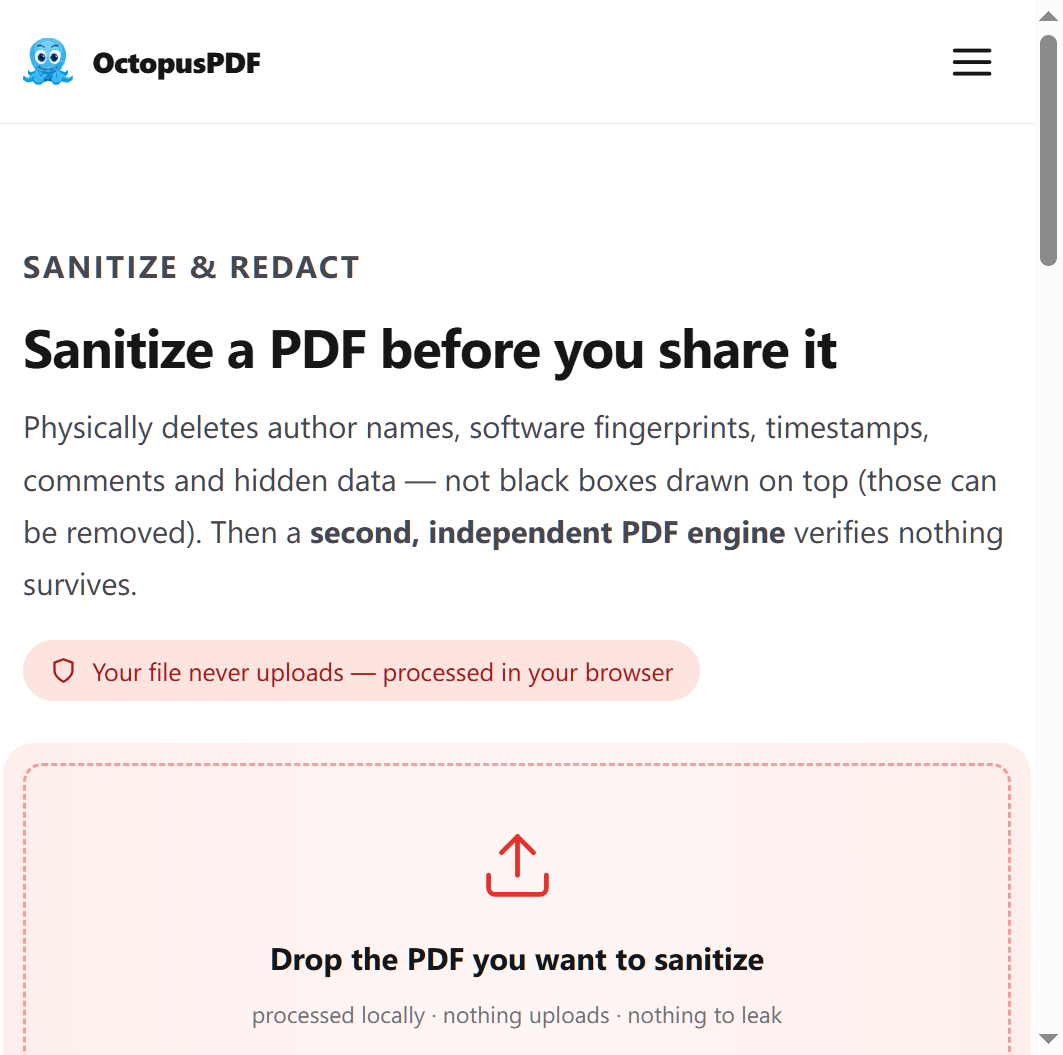
One tool that follows this approach is OctopusPDF's Redact and Sanitize feature. According to its documentation, the tool physically deletes metadata, comments, and hidden content before sharing, and it runs entirely in the browser.[K5] This is a key capability distinction: a tool that merely "covers" content is an annotation tool, not a redaction tool.
For any sensitive document, ask two questions before sharing: Can I search for the redacted text in the final PDF? If the answer is yes, the redaction has failed.
4. The Local-Only Approach: What to Look For
Core conclusion: A genuinely local redaction workflow keeps your file on your device from start to finish, which removes the biggest single privacy risk in the process.
The technical term for this is local-only conversion or client-side processing. In this model, the PDF is processed by JavaScript running in your browser tab, and the file never transmits to an external server. You can verify this yourself by opening your browser's network panel while running the tool; if no upload occurs, you will see no outgoing file traffic.[K1]
Why does this matter?
- No third-party storage risk. The file is not held on a server that could be breached, subpoenaed, or misused.
- No file-size penalties tied to server loads. Local tools can often handle larger files more flexibly.
- No ambiguity about where data goes. You are not relying on a privacy policy; you can observe the absence of network requests.
For example, OctopusPDF's redaction tool runs 100% locally, is free for up to 3 conversions per day with 20 MB files, and supports unlimited conversions and 100 MB files on the Pro plan.[K5] Its related Images to PDF conversion tool also processes files entirely on-device—images are embedded into a new PDF without upload.[K1]
This is not a niche feature. It is becoming the baseline expectation for privacy-conscious professionals.
5. Step-by-Step: How to Redact a PDF Safely in Minutes
Step 1 — Identify what needs to be redacted
Make a list of all sensitive elements:
- Names of individuals
- Email addresses, phone numbers, physical addresses
- Financial account information
- Legal clauses or negotiation positions
- Proprietary content or trade secrets
- Hidden metadata such as author name, software, or timestamps
Step 2 — Choose a redaction approach
| Method | Privacy level | Best for |
|---|---|---|
| Covering with a shape | ❌ Low — does not remove underlying content | Non-sensitive visual mockups |
| Using a basic online tool | ⚠️ Medium — depends on server policies | Files with no serious privacy requirements |
| Using a local-only, browser-based tool | ✅ High — file never leaves device | Legal, HR, finance, research |
| Professional desktop redaction software | ✅ High — but installation and cost may be higher | High-volume institutional workflows |
Step 3 — Run the redaction locally
Use a local-only tool that clearly states both redaction and sanitization capabilities. Redaction removes visible content; sanitization removes metadata, comments, and hidden layers.[K5] Both are required for complete privacy.
Step 4 — Verify the result
After redaction, perform these checks:
- Try searching the resulting PDF for any of the original sensitive terms. If they are found, redaction has failed.
- Inspect the document metadata to confirm that identifying information has been removed.
- Open the PDF in a plain text viewer to look for hidden text remnants.
Step 5 — Share with confidence
Once verified, the PDF can be shared freely—the sensitive information is no longer part of the file in any recoverable form.
6. FAQ
Q1. Why can't I just use a black highlight box to redact a PDF?
A black shape is a visual overlay, not a data removal. The text is still stored in the PDF content stream and can often be extracted by copying, searching, or editing the overlay away. True redaction removes the underlying data permanently.
Q2. What is the difference between redaction and sanitization?
Redaction removes the visible sensitive content (names, numbers, clauses) from the document. Sanitization removes hidden data: metadata, comments, annotations, and invisible layers. Both are necessary for a PDF to be safely shared.[K5]
Q3. Are online redaction tools safe to use for legal documents?
It depends on the tool architecture. Most online tools upload files to a server for processing, which means your document passes through a third-party system. This is an inherent privacy risk for legal or confidential files. A local-only tool that processes the PDF entirely in your browser avoids this risk entirely.[K2]
Q4. How can I verify that a tool does not upload my file?
Open your browser's developer tools (usually F12 or right-click and select "Inspect"), go to the Network tab, and then run the redaction tool. If you see no outbound file uploads or network requests to external domains, the file is likely being processed locally.[K1]
7. Conclusion
Redacting a PDF is not a cosmetic task—it is a security process. The distinction between "covering information" and "removing information" is the difference between a false sense of safety and genuine data protection.
For professionals handling sensitive documents, the practical recommendation is clear:
- Avoid upload-based online tools for anything truly confidential.[K2]
- Prefer browser-based, local-only tools that explicitly state that the file never reaches a server.[K1][K2][K5]
- Ensure the tool performs both redaction and sanitization—removing visible content and hidden metadata in one pass.[K5]
- Verify every output file before sharing it with clients, courts, or colleagues.
Whether you are a solo attorney preparing a settlement, a freelancer watermarking client proofs, or an accountant cleaning metadata before e-filing, the workflow is the same: choose a tool that respects the privacy of your file, run a proper redaction, verify the result, and only then share the document.[K3]
A few minutes spent doing this properly is a small price for confidence that the information you hide stays hidden.