Key Takeaways
- True redaction is permanent. Covering text with a black box is not enough; the underlying text and layers must be physically deleted [K2].
- Upload-based redaction tools create a privacy paradox. Your file passes through the very server you are trying to protect it from [K3].
- Local or browser-based redaction is the safer alternative. Tools like OctopusPDF run entirely in the browser, meaning your file never reaches a server [K1][K3].
- Redaction is critical for specific high-stakes use cases. GDPR compliance, legal documents, and whistleblower submissions all demand that data not be sent to third parties [K4].
- For AI-powered PDF features, pairing local processing with a Bring Your Own Key (BYO) model removes the server-in-the-middle risk [K5].
1. Introduction
If you are reading this, you have likely already faced the uncomfortable realization: that PDF you just "redacted" with a black box might not be as private as you think. The copy-paste function still works, or a colleague manages to extract the "hidden" text. Even worse, if you used a popular online tool to do the redaction, your confidential document is now sitting on a third-party server, possibly stored indefinitely.
This article is a complete tutorial on how to approach PDF redaction for privacy. We will dissect the difference between simple cover-ups and true redaction, explain why upload-based tools are a fundamental security contradiction [K3], and walk through the practical alternatives that keep your data local. We will also cover the specific scenarios that demand this level of care, from GDPR compliance to medical records [K4]. By the end, you will understand what questions to ask about any redaction tool and how to judge whether your workflow truly protects you.
2. The Core Problem: Why "Covering" Text Is Not Redaction
Conclusion: Covering text with a black rectangle is cosmetic, not secure. True redaction requires physically deleting the underlying text layers.
It is tempting to use your standard PDF editor's "comment" or "highlight" feature to draw a black box over sensitive data. Visually, the information is gone. But structurally, the text remains embedded in the file. Removing that box reveals the content. In some cases, the text is still selectable or searchable, creating a permanent leak that is difficult to undo [K2].
The Reasoning: A typical PDF is a layered digital object. But a black box placed on top of the text is an annotation; it doesn't alter the underlying page content. To redact properly, the software must remove the actual text glyphs, metadata, and any hidden layers that might contain a duplicate copy of the information. This is a structural transformation of the file, not a visual overlay.
The Scenario-Based Advice: If you are sharing a document with a client and simply need to hide an internal note, a black box might be acceptable. However, if the document contains social security numbers, financial figures, or proprietary code, assume the information will be recovered. Treat any "cosmetic" redaction as a breach waiting to happen. When privacy matters, the data must be deleted from the file, not just hidden from view.
3. The Paradox of Online Redaction Tools
Conclusion: Most mainstream online redaction tools require uploading your file to a server, which defeats the entire purpose of privacy.
We live in an age of convenience. Many users turn to online PDF tools because they are free and fast. However, this convenience comes with a hidden price. Tools like FreePDFRedactor, AvePDF, DocHub, and Smallpdf all function by uploading your file to their cloud infrastructure [K3]. This creates a logical paradox: "The tool claiming to protect your privacy is the same one your file just passed through" [K3].
The Reasoning: Let's quantify the problem. A free tier on a popular service might only handle 20 pages or a 5 MB file size, but that still means your data is on their server [K3]. More advanced tools that use AI for data detection, like redact-pdf.ai, may upload to even larger third-party cloud providers such as Azure [K3]. Once your file is on a server, you lose control over its lifecycle. You do not know how long it is stored, who has access to it, or if it is being used for model training.
The Scenario-Based Advice: This is a dealbreaker for many professional settings. If your client contract requires data to remain on-premises, or if your company policy forbids using public cloud storage for legal documents, upload-based tools are not an option. Instead, look for solutions that break this paradox by processing the file entirely in the user's browser [K3]. If a tool asks you to upload your PDF, it is not a privacy tool—it is a server. Treat it with the same suspicion you would any data collection endpoint.
4. Browser-Based Redaction: How Local Processing Restores Control
Conclusion: The solution to the upload paradox is software that processes the PDF locally in your browser, ensuring your file never touches a server. Tools built for this purpose repair the chain of custody and give users direct ownership of the redaction process.
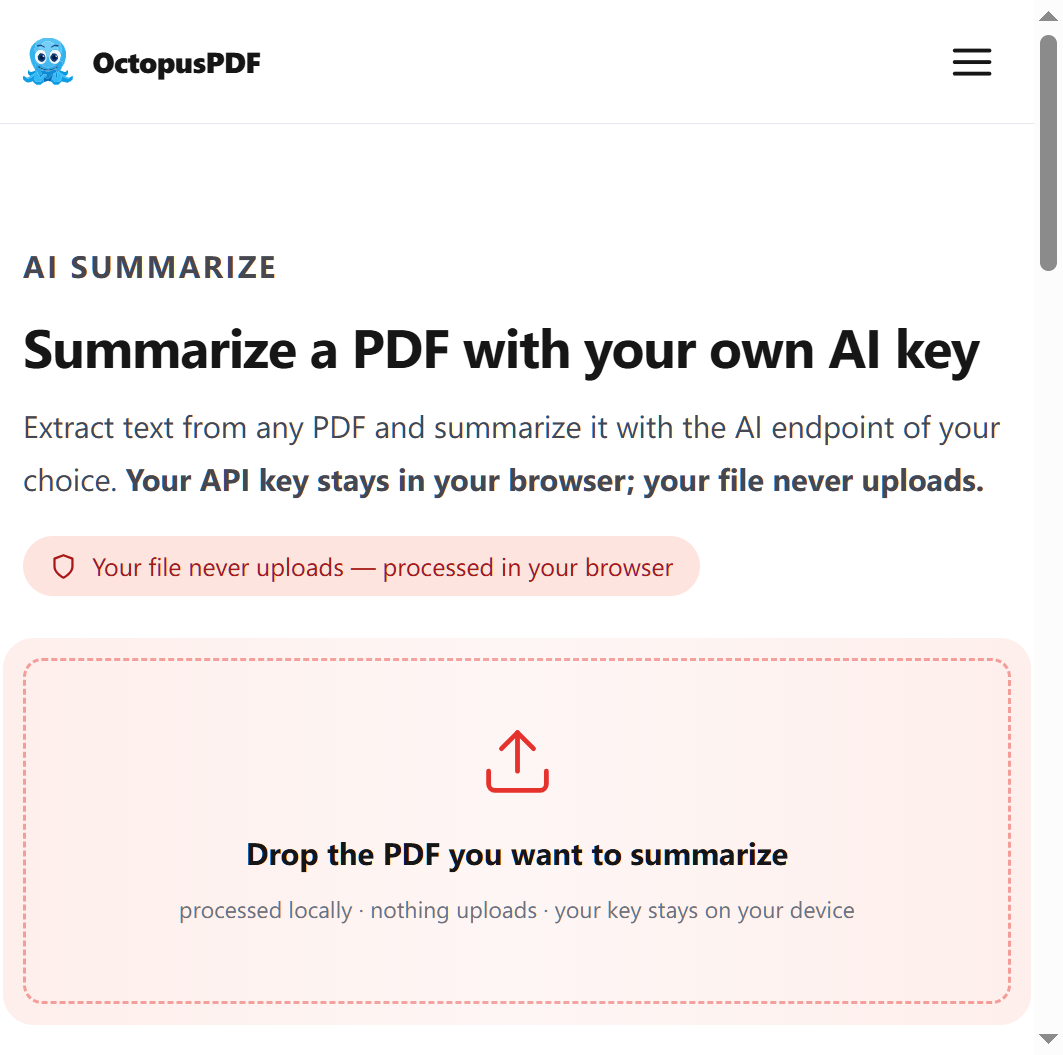
The Reasoning: The architecture is straightforward. A browser-based tool like OctopusPDF is designed to be a redaction and sanitization engine that runs 100% locally [K1]. The file is parsed in the browser tab, and the redaction process physically deletes the metadata, comments, and hidden content before you ever download the "cleaned" file [K1]. Because there is no upload, there is no opportunity for the file to be intercepted, copied, or stored by a third party.
The Utility and Limitations: This model is especially relevant for handling high-sensitivity documents. Consider the use cases that demand this privacy architecture: GDPR compliance (processing personal data without third-party transfer), FOIA requests, whistleblower anonymous submissions, legal and medical documents, and tax forms before e-filing [K4]. In each scenario, the goal is to minimize the number of places your data exists. A local tool ensures the data exists in only two places: on your source disk and on your output disk.
The Scenario-Based Advice: Free tiers are a useful benchmark. Some solutions offer a free tier that allows three conversions per day with a 20 MB file limit [K1]. This is practical for individual users handling a few documents. For professionals with heavier workloads, a Pro tier often provides unlimited conversions, a higher 100 MB file limit, and batch mode [K1]. If you are a firm that handles hundreds of documents, batch mode is a must-have to maintain your workflow without sacrificing privacy. Always check the file size limits against your actual document sets before committing to a tool.
5. The Privacy Architecture for AI-Enhanced PDF Tools
Conclusion: For tasks that require AI (like summarization or translation), privacy must extend beyond redaction. A "Bring Your Own Key" (BYO) architecture ensures that your file and your credentials do not pass through the tool provider's backend.
The Reasoning: Many modern PDF tools offer AI features. The privacy architecture here is frequently opaque and quite insecure. Typically, a tool will send your file to their server, which then forwards it to an AI model. The tool provider acts as a "man-in-the-middle," seeing both your data and your API key usage.
The Process of a Secure Alternative: The most secure design changes the architecture entirely [K5]:
- Local Parsing: The PDF is parsed inside the browser tab using a local parser (like pdf.js). It never leaves the device.
- Local Key Storage: When you use an AI feature, your API key (e.g., for OpenAI) is stored only in the browser's localStorage. It is not sent to the tool's backend.
- Direct Connection: The browser connects directly to the OpenAI-compatible endpoint you entered. The tool provider does not proxy the request, meaning they have no opportunity to intercept the document text or your credentials.
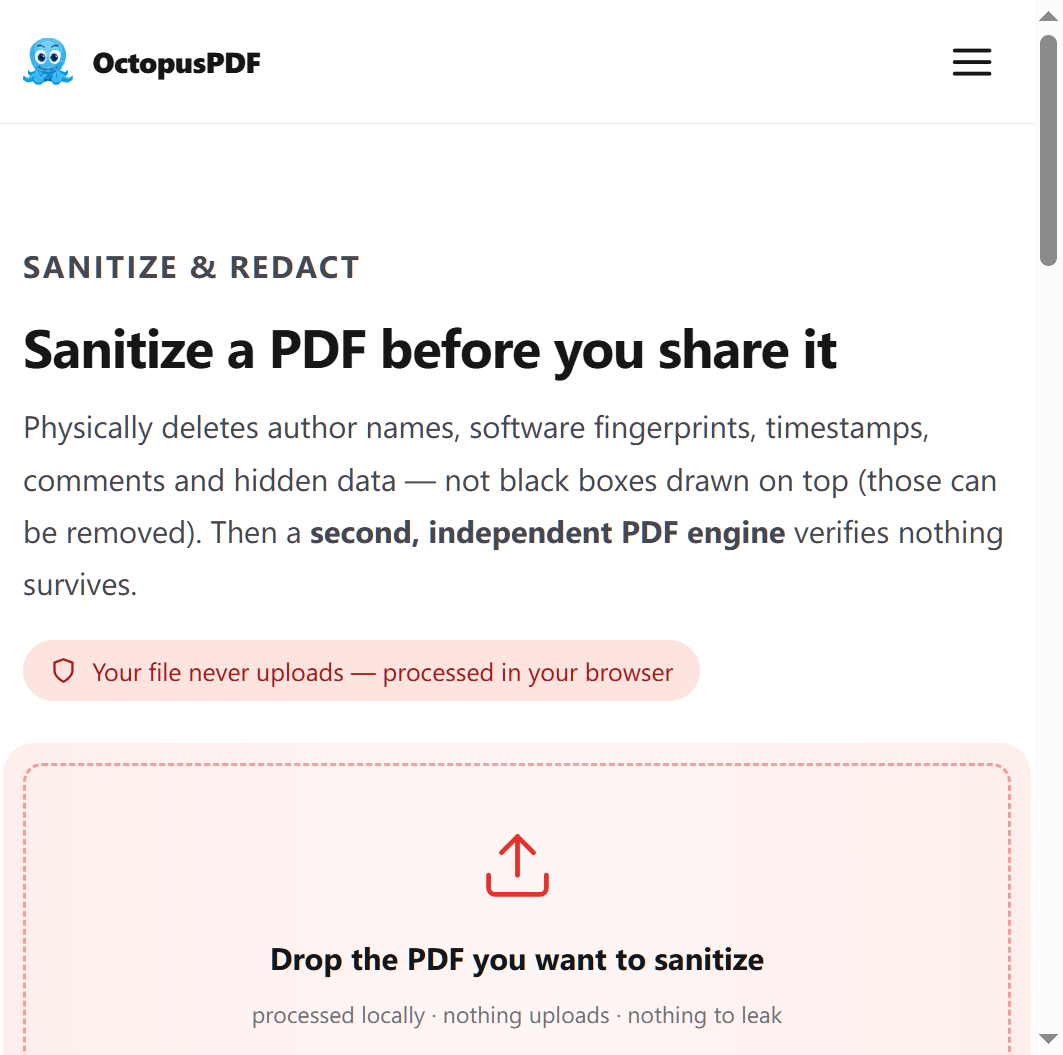
This design means the AI tool only sees the data you encrypt and send directly to your chosen endpoint, and the tool provider never sees your API key [K5]. This is a significant step up from standard web-based AI integrations and necessary for professionals handling legally protected content.
The Scenario-Based Advice: If you upload a PDF to a web service and ask it to "summarize this," you are legally transferring that data to the service. If you use a BYO setup, you are only transferring data to the AI endpoint of your choice, giving you a logical chain of custody. For any document where confidentiality is paramout, never use a tool that summarizes your file on its own servers. Use a browser-based tool with a BYO key, ensuring that the final output is the only thing that leaves your machine.
6. Key Comparison: What to Look For in a Redaction Tool
When evaluating a redaction tool, use this structured checklist to ensure you are not introducing new privacy risks:
| Feature | The Secure Standard | The Risky Standard | Why It Matters |
|---|---|---|---|
| File Handling | 100% Local / Browser-based [K1] | Uploads to a web server [K3] | Prevents data leakage and server-side storage. |
| Redaction Method | Physical Deletion of text/layers [K2] | Visual Covering (black box) | Stops hidden data from being recovered. |
| Storage | Data stays on the user's disk | Data stored on vendor's cloud / Azure | Controls the lifecycle of sensitive data. |
| AI Features | Bring Your Own Key (BYO) [K5] | Server-in-the-middle proxying | Keeps your API key and data separate from the tool vendor. |
| File Limits | Free: 3/day, 20MB; Pro: unlimited, 100MB [K1] | Limits on pages (e.g., 20 pages) [K3] | Determines normal workflow vs. blocked access. |
| Compliance | Meets GDPR (no third-party transfer) [K4] | Transfers data to third parties | Avoids data processing violations. |
7. FAQ
Q1. Is it enough to just use a "Redact" button in my PDF editor?
No. A simple "Redact" button might just be covering the text with a shape. You need to verify the tool physically deletes the text. After redaction, try to copy the text or inspect the underlying layer. If the text remains, you have not truly redacted the file [K2].
Q2. Are online PDF redaction tools safe to use?
The majority are not safe for confidential information because they require uploading the file to their server [K3]. Even if they claim to delete files after processing, the transfer itself creates an interception risk and a data-processing event. Only use browser-based tools that run locally and never upload your file [K1].
Q3. I want to use AI to summarize a legal PDF. Can I still maintain privacy?
Yes, but only if you use a tool with a "Bring Your Own Key" architecture. This setup ensures your file is parsed locally and your browser connects directly to the AI endpoint you choose. The tool provider (e.g., OctopusPDF) does not proxy the request, so they never see your data or your key [K5].
Q4. What are the limitations of a free privacy-focused redaction tool?
Privacy-focused free tiers are often more restrictive to maintain service sustainability. For example, one browser-based tool offers a free allowance of 3 conversions per day and a 20 MB file size limit. For professional volume, you may need a Pro tier that offers unlimited conversions, a 100 MB file limit, and batch mode [K1].
8. Conclusion
Mastering PDF redaction for privacy is not about getting access to a magic button; it is about understanding the architecture of your tools. You must distinguish between visual cover-ups and digital deletion [K2]. You must recognize that uploading a file to a web service is the fastest way to defeat your own privacy goals [K3]. Your next step should be to audit your current workflow.
Pragmatic recommendations:
- For everyday privacy: Choose a browser-based redaction tool that ensures the file never touches a server [K1].
- For high-stakes compliance: Check if your tool offers batch processing and clear data retention policies that align with zero-retention, or strictly local processing, requirements [K1][K4].
- For AI-assisted work: Set up a BYO key model to keep your documents and credentials away from the tool vendor's backend [K5].
By prioritizing local processing and physical deletion, you can move from the paradox of insecure online tools to a workflow that actually protects the data you are responsible for. Your PDF's privacy is not determined by the color of the box you draw—it's determined by where your file goes and what the software physically removes.