Local AI Processing for PDFs: A Practical Approach to Improve Research Literature Reading
Key Takeaways
- Local-first PDF processing is a practical answer for researchers who need AI assistance but cannot upload confidential manuscripts, preprints, or licensed full texts to third-party cloud services.
- OctopusPDF's Summarize and Translate tools follow a Bring Your Own Key (BYO) model: the file is parsed locally in the browser, the user supplies their own OpenAI-compatible API key, and the browser talks to the AI endpoint directly—no server sits in the middle [K1][K5].
- The core guarantee is simple: no PDF bytes are uploaded, and the key never leaves the browser's localStorage [K1][K3].
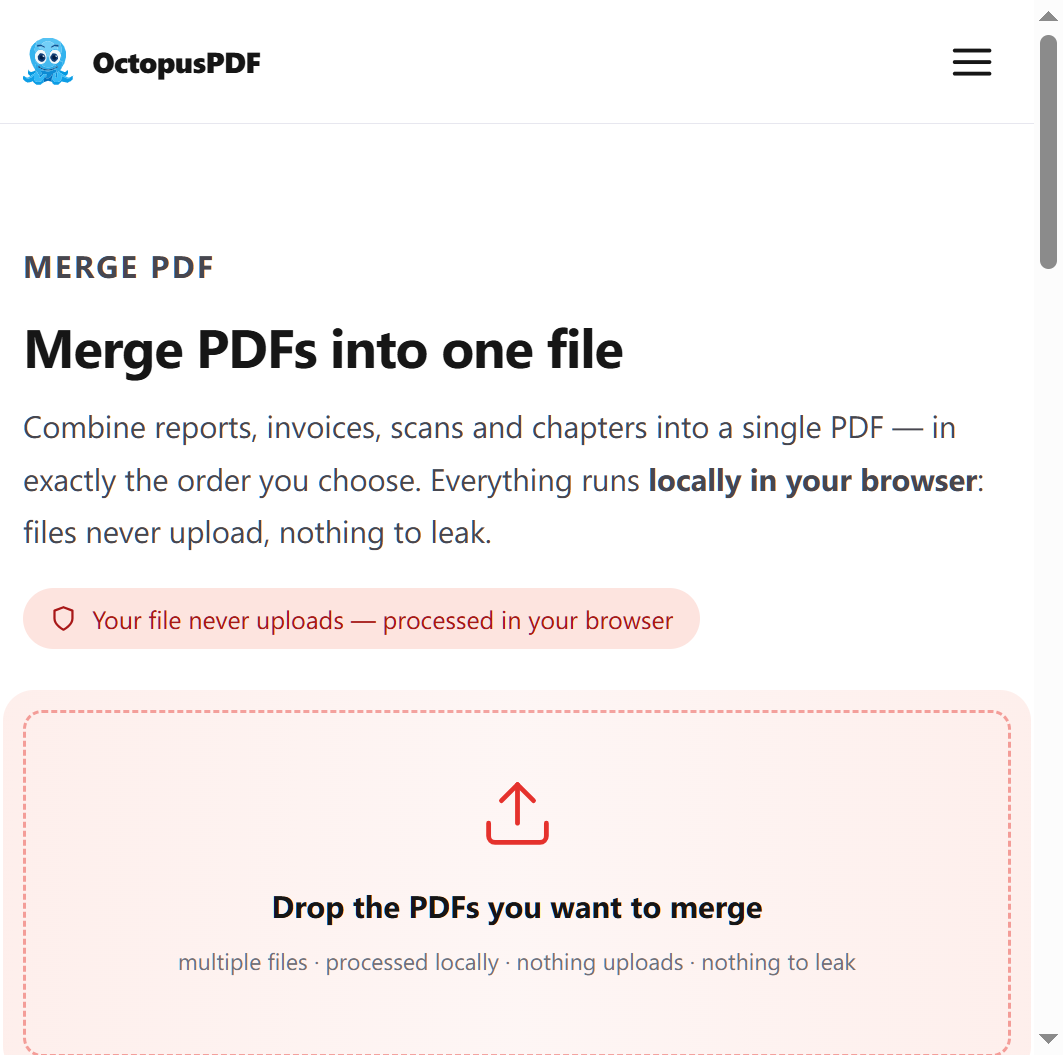
- Beyond summarization and translation, the same toolkit includes PDF-to-Markdown conversion (to save tokens when feeding LLMs), page rasterization up to 216 DPI, image-to-PDF assembly, and print-ready booklet layout [K2].
- This article is for graduate students, postdocs, principal investigators, and technical staff who regularly read PDF literature and want control over their data while still using AI.
1. Introduction
Reading scientific literature often means juggling dozens of PDFs: journal articles, preprint server downloads, conference papers, institutional reports, and shared manuscripts from collaborators. The volume alone is stressful. The bigger problem is that most AI-powered PDF tools were built for cloud document processing—you upload a file, their server parses it, and their model summarizes it. For researchers, that creates a genuine conflict. A preprint under review, a pending patent disclosure, or a data-heavy supplementary file is not something you want to send to an unknown server for training or caching.
This article explains a local-first alternative. It walks through how local PDF processing works, where the data actually goes, what capabilities are available today, and how to evaluate similar tools. The focus is on a concrete, verifiable workflow—not vague promises about "AI-powered reading." By the end, you should know exactly what happens to your file and key at each step, and whether this approach fits your literature workflow.
2. Why Local-First AI Processing Matters for Research Reading
The central question for any researcher considering AI-assisted reading is: who sees the document?
Cloud-based PDF summarizers typically require uploading the full file. For public papers, that may be acceptable. For manuscripts under review, grant proposals in preparation, or patient-adjacent clinical data, it is a dealbreaker. Even with enterprise agreements, the risk surface is real: file retention policies, model training on user data, and third-party subcontractors are all variables the user cannot control.
Local-first processing removes that entire surface. The workflow is designed so that the document never leaves the device. As the OctopusPDF documentation states clearly, the file is parsed locally with pdf.js, and no PDF bytes are uploaded to the service [K1]. The user's own API key is the only credential involved, and it is stored only in browser localStorage [K1]. The browser connects directly to the AI endpoint chosen by the user; the service does not proxy the request [K1].
In practice, this means the architecture is not a traditional Software-as-a-Service pipeline. There is no "upload → process → download" cycle. Instead, the browser itself becomes the processing environment, and the external AI provider only receives the text content you explicitly send for summarization or translation—not the full PDF file. This is the essence of the BYO (Bring Your Own Key) model: both the file and the key stay in the browser, and the user retains control over which AI endpoint receives which content [K5].
What this means for your workflow
- Confidential manuscripts: You can summarize drafts or response letters without exposing the PDF wrapper or any associated metadata to a third-party server.
- Licensed content: PDFs from publisher subscriptions can be analyzed without uploading the full file to an unaffiliated cloud.
- Cost predictability: Because you bring your own key, you pay the AI provider directly for token usage; there is no per-seat or per-page fee layered on top by the tool vendor.
The trade-off is that you need an OpenAI-compatible API key and a basic understanding of what you are sending to the model. This is not a "no cloud at all" solution—the AI inference still happens on the provider's infrastructure. What changes is that the document container and the key never travel beyond your browser.
3. How the Local Processing Workflow Actually Works
To evaluate this approach, it helps to see the exact order of operations. According to OctopusPDF's official documentation, the process runs in four steps [K1]:
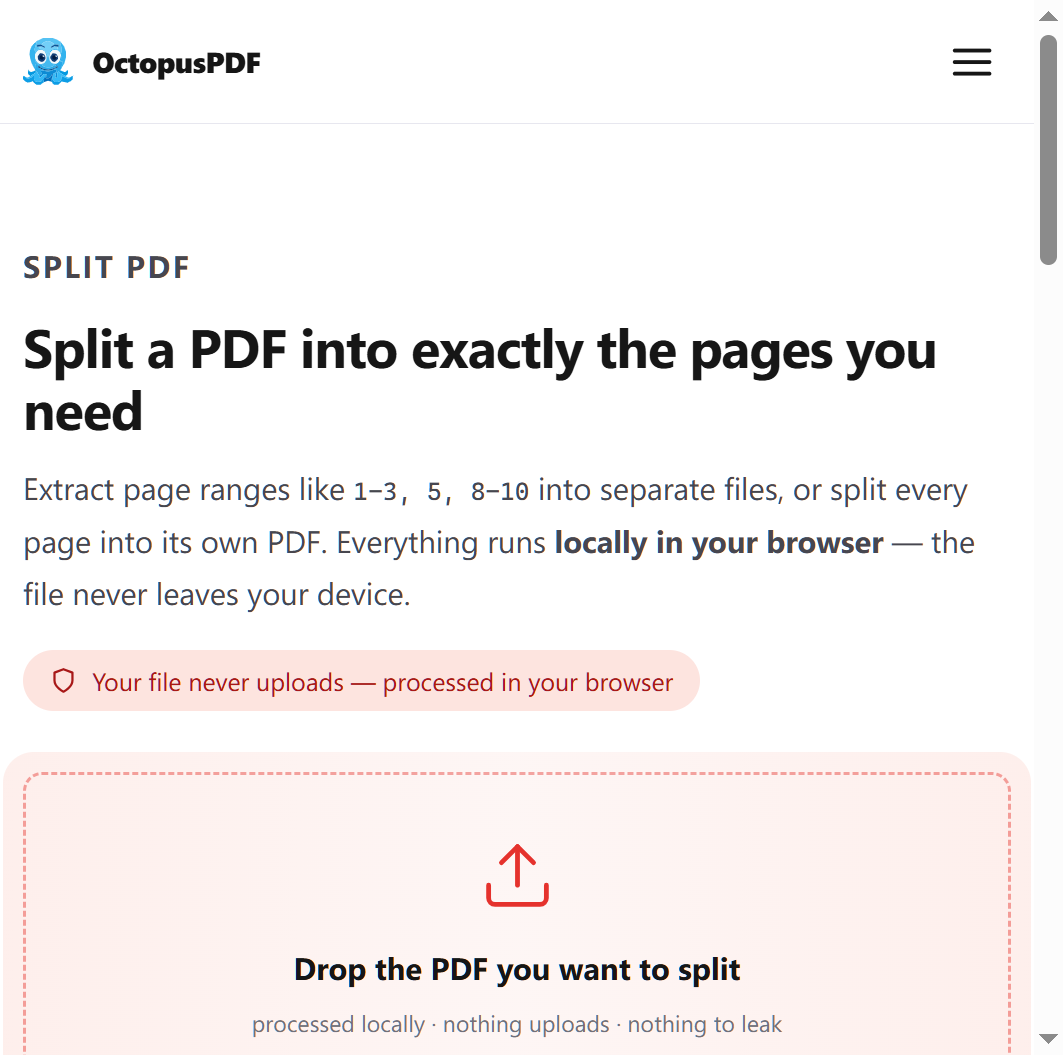
- Drop the PDF into the browser tab. No account creation or file upload screen is involved at this stage.
- The file is parsed locally with pdf.js. The JavaScript-based PDF parser extracts text and structure directly in the browser, so no PDF bytes are sent to OctopusPDF [K1].
- Enter your own OpenAI-compatible API key. The key is stored only in browser localStorage [K1]. It is not transmitted to the tool's backend, and it is not persisted on any vendor server.
- The browser connects directly to the AI endpoint you choose. OctopusPDF does not proxy the request [K1]. This means the model provider receives only the content that your browser sends for processing, and the connection is initiated by you, not by an intermediary.
Two consequences follow from this architecture.
First, the vendor cannot read your document. The tool's stated guarantee is explicit: "File never uploads, key never uploads." [K3] There is no server-in-the-middle to intercept, log, or misconfigure [K3]. If the vendor has no copy of the file, there is nothing to breach.
Second, you are responsible for the choice of AI endpoint. Since the connection is direct, the provider you select sees the text you send. For researchers, this is an important boundary condition: local processing protects the PDF and the key, but it does not anonymize the extracted text once it reaches the model. If you are working with personally identifiable information, you still need to evaluate your chosen provider's data policy separately.
A useful mental model
Think of the difference this way:
- Traditional cloud tool: You mail the whole document to an office, and their staff summarize it for you.
- Local-first BYO tool: You read the document at your desk, write a private note with your own pen, and hand only the note to a trusted assistant.
The "note" is the extracted text sent to the AI model. The "document" never leaves your desk.
4. Practical Capabilities for Literature Reading
Local processing is not just a privacy feature; it also provides concrete reading efficiencies. The OctopusPDF AI tools cover two common literature tasks, and the broader toolkit addresses the surrounding workflow.
Summarize PDF
The Summarize tool extracts key points from any PDF using the user's own AI key [K3]. For researchers, the natural use case is triage: you have a stack of twenty papers and need to know which five deserve a full read. A summary pass helps you rank them by relevance, methodology, and findings before investing time in deep reading.
The privacy guarantee is the same as the general AI workflow: the file never uploads, the key never uploads, and there is no server-in-the-middle [K3].
Translate PDF
The Translate tool offers page-by-page translation into 9+ languages with fully local processing [K4]. This is useful for reading papers in languages you partially understand—or simply skimming a method section written in a language outside your comfort zone. Because translation happens page by page, you can translate only the pages that matter (for example, the experimental section) instead of burning tokens on the entire document.
Supporting tools that reduce friction
The same product ships with fourteen tools total, and several of them matter for literature workflows [K2]:
| Tool | What it does | Why a researcher would use it |
|---|---|---|
| PDF to Markdown | Structure-aware extraction that preserves headings, lists, and tables | Produces cleaner text for feeding into LLMs, which saves tokens compared to raw extracted text [K2] |
| PDF to Images | Converts every page to PNG or JPG at up to 216 DPI | Useful for archiving figures, building annotated slide decks, or inspecting layout details [K2] |
| Images to PDF | Combines JPG/PNG images into a single PDF, one image per page | Good for bundling scanned notes, screenshots, or figure exports into a readable document [K2] |
| Print-ready booklets | Reorders pages for duplex printing and folding, with gutter margins | Produces physical copies of dense papers that are comfortable to annotate [K2] |
The PDF-to-Markdown tool deserves special attention for AI-heavy workflows. A structure-aware extraction that preserves the document's hierarchy means the LLM receives cleaner semantic context, which typically reduces the number of tokens needed to achieve a given level of comprehension [K2]. For researchers who summarize many papers per month, token savings translate directly into lower API costs.
5. Choosing a Local PDF AI Tool: A Practical Evaluation Checklist
Not every tool that claims "local processing" really delivers it. The following checklist is designed to help you verify a tool before adopting it in your workflow. Use it to evaluate OctopusPDF or any comparable solution.
Data-flow audit
- Where is the file parsed? Confirm that parsing happens client-side (for example, with pdf.js) and that the PDF bytes are not transmitted to the vendor. [K1]
- Where is the API key stored? The key should live in browser localStorage or an equivalent client-side store—never on a vendor database. [K1]
- Is there a proxy? The browser should connect directly to the AI endpoint of your choice. If the vendor proxies the request, the "no server-in-the-middle" claim is false. [K1][K3]
- What exactly is sent to the model? Clarify whether the full PDF, only extracted text, or only the page you selected is sent. With page-by-page translation, for instance, you should be able to control which pages are translated. [K4]
Output and cost considerations
- Does extraction preserve structure? A Markdown output that keeps headings and lists will consume fewer tokens downstream than a plain-text dump. [K2]
- Can you meet your image needs in one place? High-DPI conversion (up to 216 DPI) and image-to-PDF assembly reduce the number of separate tools in your pipeline. [K2]
- Is the output format compatible with your reading tools? If you want to import annotated PDFs, print booklets, or feed Markdown into an LLM, confirm the tool supports those exact outputs. [K2]
Boundary conditions to keep in mind
- Local processing is not anonymization. The text you send to your chosen AI endpoint leaves your browser. Choose a provider whose data retention policy matches your project's requirements.
- Browser localStorage has limitations. Your API key lives in the browser profile you used. Clearing site data removes it, and a different browser or device means re-entering the key.
- OpenAI-compatible keys only. The BYO model assumes you already have, or can obtain, an endpoint that speaks the OpenAI-compatible API. If your institution uses a different interface, verify compatibility first. [K1][K5]
6. FAQ
Q1. Does OctopusPDF upload my PDF to its own servers?
No. According to the official documentation, the file is parsed locally in the browser with pdf.js, and no PDF bytes are uploaded to OctopusPDF [K1]. The AI tools' guarantee is also explicit: "File never uploads, key never uploads" [K3].
Q2. Where is my API key stored?
The key is stored only in browser localStorage [K1]. It is not sent to OctopusPDF's backend, and the service does not proxy requests [K1]. Because the key is in localStorage, it is tied to the browser profile you used—clearing site data will remove it.
Q3. Which languages does the translation feature support?
The Translate tool supports 9+ languages with page-by-page translation [K4]. For specific language pairs, it is best to check the tool's current UI, as the exact language list may change.
Q4. Why would a researcher use PDF-to-Markdown before feeding a paper to an AI model?
PDF-to-Markdown converts the PDF into structure-aware Markdown that preserves headings, lists, and formatting [K2]. When this structured text is passed to an LLM, the model needs fewer tokens to understand the document's organization than it would with raw, unstructured text extraction—which directly reduces API cost at scale.
7. Conclusion
Local AI processing is a practical, verifiable response to a real problem: researchers need AI assistance, but they cannot always afford to hand their PDFs and API credentials to an intermediate server. The BYO model used by OctopusPDF solves this by keeping the file and the key in the browser, connecting directly to the user's chosen AI endpoint, and removing the server-in-the-middle entirely [K1][K3][K5].
What this approach buys you is control. You decide which document content is sent to which model provider. You decide how much text gets translated, which pages matter, and which structural format your LLM receives. The supporting tools—Markdown conversion, high-DPI image export, booklet printing, and image assembly—round out a workflow that covers both digital and physical reading [K2].
The boundary condition is equally clear: local processing protects the PDF and the key, but it does not anonymize the text that reaches your chosen AI provider. If your work involves highly sensitive data, evaluate the provider's retention policy before you start.
If your literature workflow involves confidential manuscripts, licensed PDFs, or simply a desire to control every step of the AI pipeline, local-first PDF processing is worth adopting. Start with the summarization workflow, verify the data flow yourself, and measure how many minutes it saves on your next literature review.
The file stays where it belongs. Your research stays yours.