Key Takeaways
- Page-level PDF organization—merging, splitting, reordering, rotating—remains a recurring bottleneck for professionals across publishing, legal, and administrative workflows.
- Browser-based tools have shifted from convenience to necessity, particularly when confidentiality matters: zero-upload processing ensures sensitive files never leave the device.
- The practical ceiling for free-tier tools is real; understanding limits like file size and page count helps you choose between free, paid, and pro workflows.
- AI-adjacent tasks (summarizing, translating, converting to Markdown) are increasingly handled locally, with user-supplied API keys—preserving both privacy and control.
- Choosing a tool is less about feature count and more about how well the workflow matches your risk tolerance, output quality needs, and time budget.
1. Introduction
If you have ever needed to pull a 10-page excerpt from a 300-page contract, reorder a scanned document, or turn a two-sided PDF into a printable booklet, you already know the problem: PDF page organization is a surprisingly persistent friction point. While PDFs are universally accepted, manipulating their internal structure often forces you into a choice between expensive desktop software, arcane command-line utilities, or upload-based web tools that ask for your files and then process them somewhere you cannot see.
That third option has an uncomfortable logical flaw. As one analysis of redaction tools puts it: "The tool claiming to protect your privacy is the same one your file just passed through" [K2]. The concern applies across organizing tasks too—if your file is confidential, every upload matters.
This article explains the practical landscape of PDF page organization: which tasks recur, what to look for in a tool, and where the industry is heading—including the emerging category of fully local, browser-based processing that keeps files on your device. Whether you are a freelancer, a legal professional, a publisher, a student, or an occasional PDF wrangler, the goal here is to help you organize PDF pages like a pro: knowing what to use, when, and why.
2. The Core Toolkit: What "Organizing PDF Pages" Actually Covers
Core conclusion: Most page organization falls into four repeatable operations—merge, split, rotate, and reorder. Mastering these four covers the majority of real-world problems.
It helps to define the task precisely. When someone says "organize PDF pages," they usually mean one of the following [K1]:
- Merge PDF — Combine multiple PDFs into a single document, in the order you choose. Useful for compiling reports, assembling submissions, or creating a master file from chapter drafts.
- Split PDF — Extract specific page ranges or split every page into its own file. Common in legal and academic contexts (pulling exhibits or chapters).
- Rotate PDF — Turn pages 90, 180, or 270 degrees, either across a whole document or only a custom range (correcting scans, fixing a crooked graphic).
- Organize PDF — Reorder pages visually, often by drag-and-drop thumbnails, and delete unwanted pages before sharing.
An organizing tool should handle all four seamlessly. Beyond those, adjacent features—such as adding page numbers or a watermark—often appear in the same toolkit because they touch the same page-level structure [K1]. Knowing the difference between core operations and convenience features helps you evaluate tools without being distracted by a long feature list.
Practical recommendation: Sketch out your most frequent workload. If you routinely merge PDFs, test how the merge order is chosen—drag-and-drop is non-negotiable for more than two files. If you deal with scans, verify that a rotate-by-page-range option exists rather than a whole-document all-or-nothing approach.
3. The Privacy Trade-Off: Why Tool Hosting Matters
Core conclusion: The location where your PDF is processed is not a technical detail—it is the critical decision that determines whether your document remains confidential.
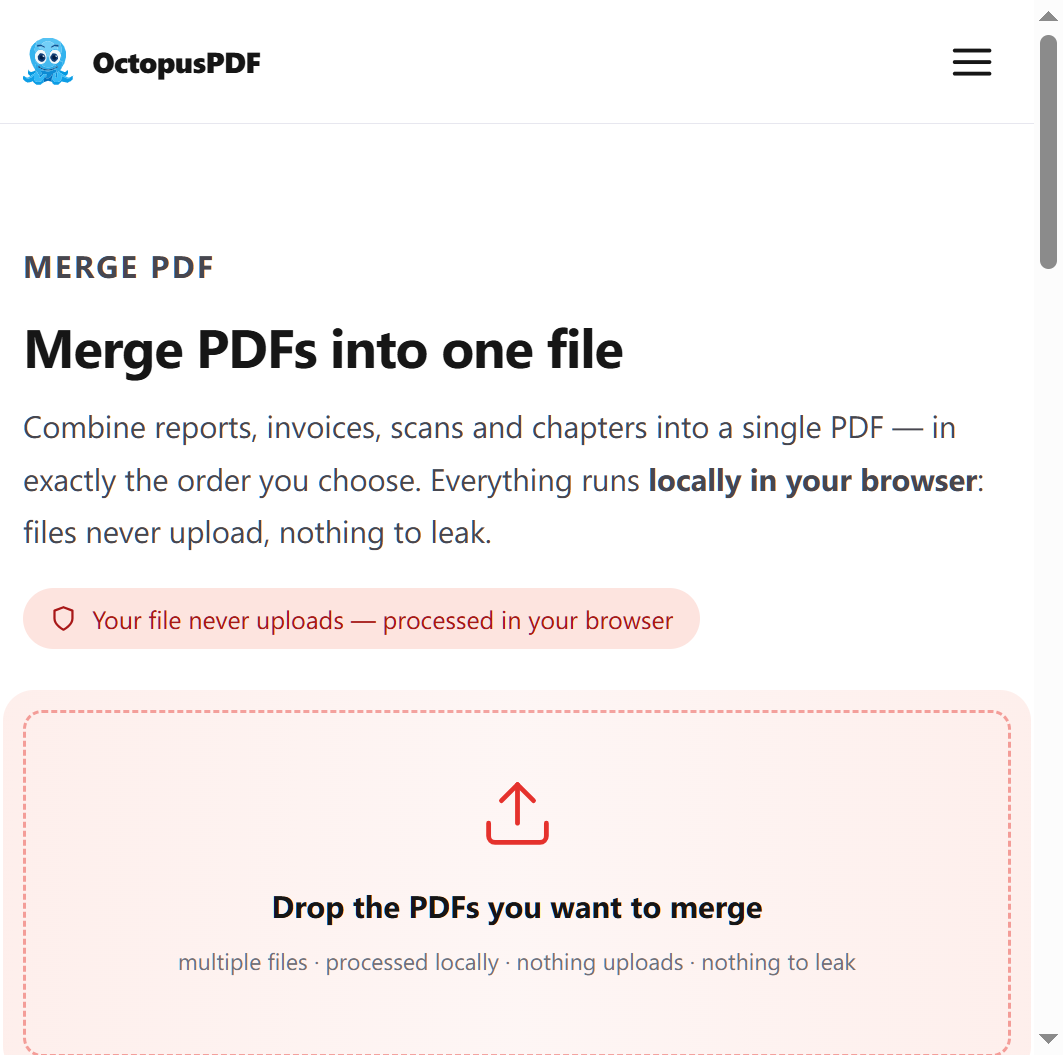
The most straightforward way to offer PDF tools is to host them online: the user uploads a file, the server does the work, and the final PDF is returned. This model suits casual tasks, but it raises questions for sensitive material. The paradox of upload-based privacy tools is that a service which promises to keep your document private is, by definition, also receiving your document [K2].
This is not merely theoretical. A 2026 review of mainstream online redaction tools found that several not only require uploads but also impose restrictive limits. For example, one well-known tool processes only 20 pages or 5 MB of file data [K2]. That is insufficient for many professional documents. Another tool offers AI-powered personal information detection but routes files through a third-party cloud (Azure) in the process [K2].
As a result, the hosting model defines the privacy ceiling:
| Tool model | What happens to your file | Suitable for |
|---|---|---|
| Upload to server | File travels to an external server for processing | Non-sensitive material; user accepts third-party receipt |
| Upload with AI service | File processed locally but may be sent to AI provider for analysis | Documents without personally identifiable information |
| Zero-upload / local browser processing | File never leaves the user's device | Confidential filings, contracts, medical and legal documents |
Practical recommendation: Before committing to a PDF organizer, ask: Where does my file go? For most organizing tasks, you should not need to send your PDF anywhere. Tools like OctopusPDF demonstrate that local processing is viable: all 14 of its tools run entirely in the browser, and no upload is required [K1]. For attorneys redacting names or accountants stripping metadata from client files, that distinction is decisive.
4. Real Workflows, Real Users: Matching Tools to Scenarios
Core conclusion: The best tool is the one that fits your specific job—not the one with the longest feature list.
Different professions organize PDFs for different reasons, and the "right" tool varies by scenario. Here are five common use cases and the exact operation they require [K5]:
- Freelance designer — Needs to watermark client proofs, stamp page numbers, and deliver final files. The requirement is that the file never leaves the browser tab, preserving confidentiality of early-stage work.
- Solo attorney — Often must redact names and specific clauses in legal documents before sending, and strip metadata in one click. The ability to handle this without upload is, for them, a professional obligation.
- Indie publisher — Turns a manuscript into a saddle-stitch booklet with correct page order and gutter margins for duplex printing. This requires a specialized tool that reorders pages for printing and folding [K4].
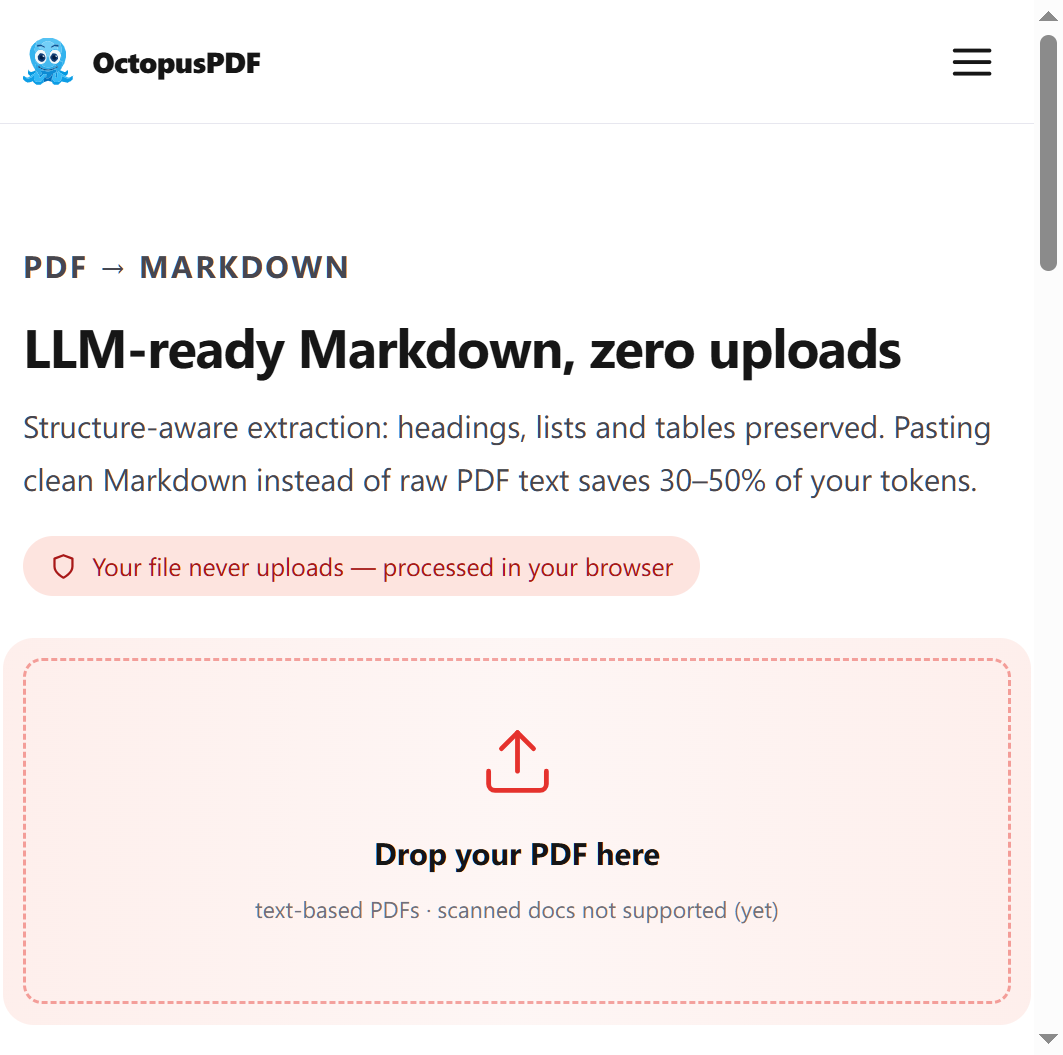
- Graduate researcher — Converts PDFs to Markdown with structure-aware extraction, so the content can be fed into large language models (LLMs) without token bloat [K1].
- Small business owner — Merges invoices, splits statements, and rotates scans. Ease of use and speed matter more than advanced features.
The point is that "organizing PDF pages" means something different to each user. A tool optimized for printers might include a print preflight report—checking page counts, order, and margins before output [K4]. A tool for LLM workflows, by contrast, prioritizes lossless text extraction structure, so models do not waste tokens on boilerplate [K3].
Scenario-based advice: If you work with confidential documents, put a zero-upload requirement at the top of your selection criteria. If you work with high-quality print output, demand detailed print checks. If you work with AI pipelines, ensure the tool provides structure-aware export rather than raw text dumps. The feature set you need is the one that matches your actual deliverable.
5. Key Comparison: Organizing Features Across the Board
Because the demand spans free tiers, pro subscriptions, and industry-specific needs, it helps to compare the core offerings. This table summarizes what a serious organizing toolkit should include, and where services typically differ [K1][K3][K4]:
| Tool / feature | Free tier limits | Pro upgrade | Notes |
|---|---|---|---|
| Merge PDF | Basic, up to file size cap | Higher file size (example: 100 MB) | Order selection is essential |
| Split PDF | Page range vs. every page | Unlimited splits | For multi-part files |
| Rotate PDF | All pages or custom range | Custom range | Handles 90/180/270 degrees |
| Organize PDF | Drag-and-drop reorder/delete | Unlimited actions | Thumbnail preview helps |
| Page Numbers | "1 / N" format | Custom styles | Cover-skip option useful |
| Watermark | Text/image, opacity | Tiled and diagonal modes | For client proofs |
| Metadata | View/edit title/author | One-click wipe | Crucial for confidentiality |
| Booklet tool | 3 conversions/day | Unlimited + print preflight | For saddle-stitching [K4] |
| AI (Summarize/Translate) | Bring Your Own Key (BYOK) | Reduced cost per page | File remains local [K3] |
A notable development is the Bring Your Own Key (BYOK) model for AI tasks [K3]. Rather than routing your document through a provider's AI endpoint, you supply your own OpenAI-compatible API key. This means the summarization or translation happens with your credentials, and the file still never uploads to a third-party server [K3]. For researchers and legal professionals who need AI assistance and confidentiality, this is a meaningful middle ground.
Practical recommendation: Use the table as a checklist. Start with the operations you perform most, then add the technical boundaries: file size, page count, daily limits, and whether any form of the file travels externally.
6. FAQ
Q1. Are online PDF organizers safe for confidential files?
It depends. If the tool uploads your file to a server for processing, the document exists outside your control during that window. Some tools claim privacy while their server runs analysis—including AI providers—which makes the privacy claim questionable [K2]. For confidential material, prefer zero-upload tools where processing happens entirely in your browser [K1].
Q2. What does a "structure-aware PDF to Markdown" conversion mean?
It means the tool does not simply dump raw text. Instead, it recognizes headings, paragraphs, lists, and page structure, then exports them into a clean Markdown format. This is especially valuable when feeding PDF content into an LLM, because it reduces token usage and improves the model's ability to parse the content accurately [K3][K4].
Q3. How does the booklet printing tool work?
A booklet tool reorders pages for duplex printing and folding. Instead of page 1-2-3-4, it arranges the pages in the order your printer needs to produce a folded booklet, and it adds gutter margins to account for binding. Higher-tier versions also run a print preflight report, flagging potential issues before you print [K4].
Q4. What counts as a "pro" workflow in PDF organization?
A pro workflow knows the constraints: page count limits, daily conversion caps, and the privacy model. It also uses the right tool for the output—not just the generic organizer. If you deliver client-proof PDFs, you need watermarking; if you file legal documents, you need redaction and metadata wiping; if you publish booklets, you need page reordering for print [K5].
7. Conclusion
PDF page organization is not one problem—it is a family of tasks with distinct requirements. The professionals who handle them well are not the ones with the most advanced system, but the ones who have matched each task to the right tool, and who have paid attention to an issue that increasingly matters: where the file goes during processing.
The shift toward zero-upload, browser-local processing addresses the paradox at the heart of online privacy tools. When the file never leaves the device, a privacy claim does not have to contradict itself [K2]. Combined with BYOK AI features—where summarization and translation run through the user's own key [K3]—this model gives professionals a way to use modern AI capabilities without surrendering control of their documents.
Final recommendation: Before your next batch of PDF work, ask yourself three questions:
- Does the document contain anything confidential? If yes, choose a zero-upload tool.
- Is the output print-heavy or AI-bound? Matching the tool to your deliverable—print preflight vs. structure-aware Markdown—makes the difference between a smooth workflow and a painful one.
- Have you checked the limits? Page caps, file size limits, and daily free-tier quotas will quietly change your experience. Plan around them [K1].
The tools are available. The key is not working harder—it is organizing your pages with the right method, and the right privacy boundary, from the start.