Key Steps in PDF Preprocessing for LLMs: From Scanned Documents to Analyzable Text
Key Takeaways
- Raw PDFs are not LLM-ready: models need clean, structured text, and scanned pages must be recognized as images before any extraction can work.
- The preprocessing pipeline has four stages: classify the document, extract structure, sanitize hidden content, then optionally summarize or translate.
- Structure-aware PDF-to-Markdown conversion reduces token consumption and improves answer reliability when feeding LLMs. [K1]
- Privacy-sensitive documents should be processed locally; browser-based tools that never upload file bytes keep confidential data under your control. [K4][K5]
- A "bring your own key" (BYO key) workflow lets you use your own AI endpoint without sending PDF bytes to a third-party tool. [K5]
1. Introduction
The TL;DR: To feed a PDF to an LLM, you cannot rely on the raw file. You need a preprocessing pipeline that converts each page into clean, structured text — using OCR for scanned pages, structure-aware extraction for complex layouts, and sanitization before any AI call. The goal is not simply to "read" the PDF, but to produce text that an LLM or retrieval system can parse, cite, and answer from with minimal token waste.
Why this matters: PDFs are the default format for contracts, research papers, invoices, and reports, yet they were designed for print, not for machines. An LLM receives bytes, not pages; if your PDF is a scan, the model sees nothing but an image stream unless you first extract a text layer. Even born-digital PDFs carry headers, footers, multi-column layouts, tables, and repeated boilerplate that can confuse extraction and inflate token counts.
The practical concern: preprocessing is where most LLM-on-PDF projects fail. The typical failure is not the model — it is the input. Unstructured or noisy text leads to hallucinations, missed citations, and high API costs. This article walks through the key preprocessing steps, with a focus on privacy-preserving, local-first workflows such as those used by OctopusPDF, a browser-based PDF toolset whose architecture is documented for real workflows. [K2]
2. Step 1: Classify Your PDF — Digital Text Layer vs. Scanned Images
Core conclusion: You cannot choose the right extraction method until you know whether each page contains a text layer or is a pure image. Scanned PDFs are images, and images require OCR (optical character recognition) before any LLM can analyze them.
Reasoning:
- A born-digital PDF (exported from Word, LaTeX, or a browser) contains selectable text and usually a logical reading order.
- A scanned PDF is essentially a set of photographs. Tools like OctopusPDF's PDF-to-Images converter can render every page to PNG or JPG at up to 216 DPI for inspection or downstream OCR pipelines. [K1]
- Mixed files exist: a contract may have typed pages plus a scanned signature page, so assess page by page rather than assuming the whole file is uniform.
Practical advice:
- Open the PDF and try to select text. If nothing selects, treat the page as a scan.
- For scanned bundles, convert pages to images at a resolution that preserves small print; 216 DPI is a reasonable ceiling for most documents. [K1]
- If you receive loose images instead of a PDF, reassemble them first — an images-to-PDF conversion (one image per page) gives you a normalized input for the rest of the pipeline. [K1]
3. Step 2: Extract Structure, Not Just Text — PDF to Markdown
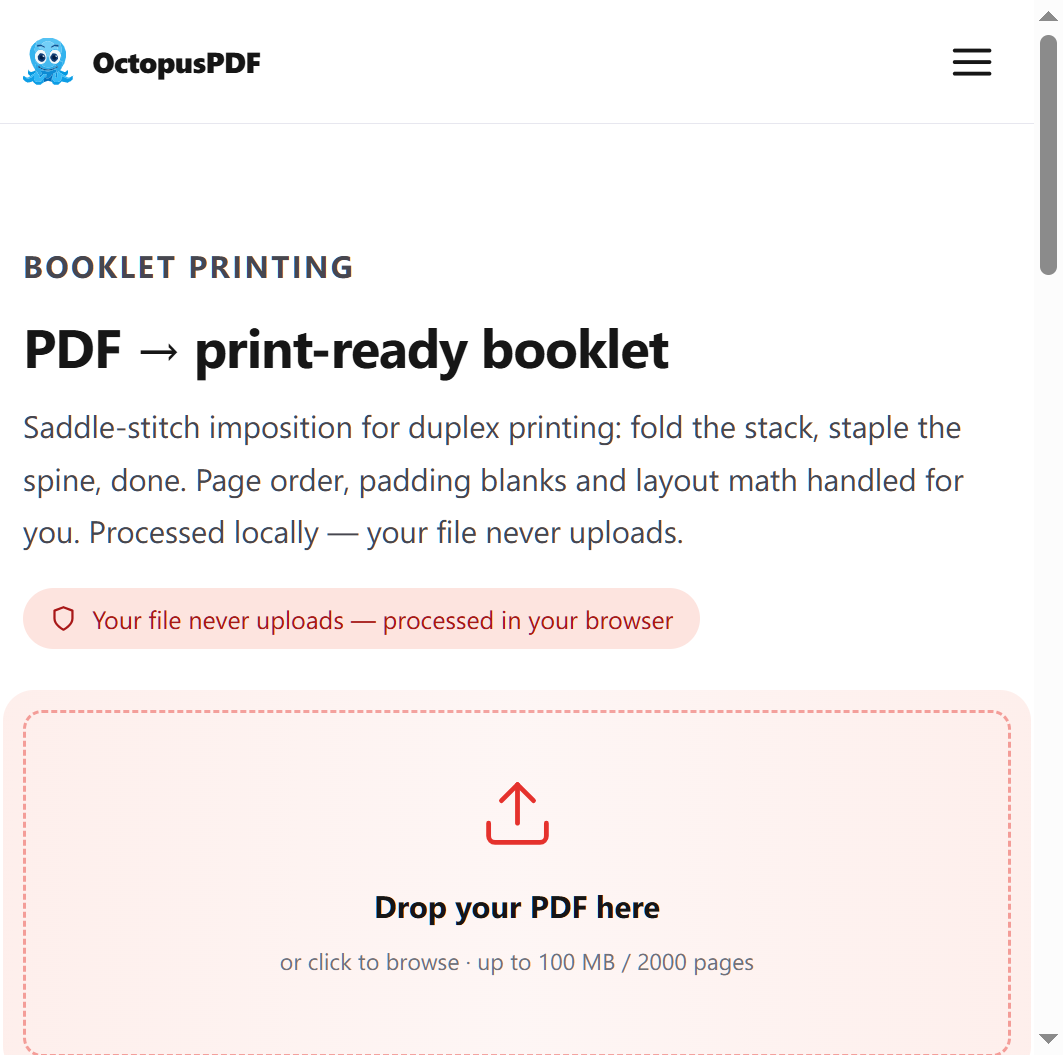
Core conclusion: The single most valuable preprocessing step is structure-aware extraction to Markdown. It preserves headings, lists, and reading order so that LLMs and retrieval systems can treat the document as a knowledge structure rather than a token dump. [K1]
Reasoning:
- Naive text extraction flattens everything into a stream. The LLM cannot distinguish a page footer from a key finding, and retrieval systems lose the semantic anchors they need for citation.
- Structure-aware extraction maps layout elements to Markdown semantics: headings become
#or##, lists become bullets, and tables remain tables. - The token-saving effect is real. By dropping repeated headers, footers, and layout noise, you feed fewer tokens per document and keep more context window for actual content. OctopusPDF explicitly describes its PDF-to-Markdown tool as "structure-aware extraction that saves tokens when feeding LLMs." [K1]
Practical advice:
- Make PDF-to-Markdown your default conversion for research papers, manuals, and multi-page reports.
- If you are a graduate researcher assembling a literature corpus, Markdown output is easier to chunk, embed, and cite than raw text or HTML. [K2]
- Verify the output after conversion: check that headings and tables survived and that multi-column layouts were reflowed into logical reading order.
| Input type | Recommended approach | Output | Best for |
|---|---|---|---|
| Born-digital PDF | Structure-aware PDF to Markdown [K1] | Markdown with headings and lists | Feeding LLMs and RAG pipelines |
| Scanned PDF | OCR after PDF-to-Images conversion [K1] | Recognized text or image set | Archival documents, old contracts |
| Mixed page types | Page-by-page inspection, then split [K4] | Clean per-section text | Legal and financial documents |
4. Step 3: Sanitize and Redact Before Any AI Call
Core conclusion: Preprocessing is also a privacy gate. Metadata, comments, annotations, and hidden layers can leak into the text you send to an LLM — so you should sanitize the PDF before extraction, not after.
Reasoning:
- PDFs can carry two kinds of hidden content: file-level metadata (author, title, software) and document-level content (comments, annotations, invisible layers). Both survive naive extraction.
- OctopusPDF's Redact/Sanitize tool physically deletes metadata, comments, and hidden content before sharing. [K4] Its Metadata tool lets you view, edit, or wipe title and author information in one click. [K4]
- In real workflows, a solo attorney redacts names and clauses before sending files, and an accountant wipes hidden metadata from client files before e-filing. [K2] The same logic applies before you paste extracted text into an AI prompt.
Practical advice for a clean pipeline:
- Run a redact/sanitize pass first if the file contains personal names, sensitive clauses, or annotations. [K4]
- Wipe metadata even if it seems harmless — author names and software identifiers become unwanted context for the model.
- For large batches, split the PDF into logical sections first, then extract; cleaning a 300-page file after merging is far harder than cleaning it in parts. [K4]
- Keep a duplicate of the original. Sanitization is destructive by design and cannot be undone.
5. Step 4: Summarize or Translate Without Uploading — BYO Key
Core conclusion: Once the PDF is clean and structured, optional summarization or translation can happen fully locally — no file upload — if you bring your own AI key. This matters for confidential documents, shared devices, and regulated industries.
Reasoning:
- OctopusPDF's AI tools (Summarize PDF and Translate PDF) work with the user's own OpenAI-compatible API key. The key is stored only in browser localStorage, and the browser connects directly to the AI endpoint — OctopusPDF does not proxy the request. [K5]
- The PDF bytes are parsed locally with pdf.js, meaning no PDF file is uploaded to the tool provider. [K5]
- Translation runs page by page and supports 9+ languages. [K3] This is useful when you need a foreign-language contract or paper summarized in your working language.
Practical advice:
- Use the BYO-key workflow on shared or untrusted machines; since nothing is uploaded, your documents leave no trace on the tool's servers. [K5]
- Combine cleanup with summarization: summarize after sanitizing and converting to Markdown, not before.
- If you cannot use a cloud endpoint at all, the same local-parsing approach means you can still merge, split, rotate, redact, and convert entirely in the browser. [K4]
6. Key Comparison: Local-First vs. Cloud Upload PDF Tools
| Aspect | Local-first approach (e.g., OctopusPDF) | Typical cloud upload tool |
|---|---|---|
| PDF bytes leave your machine | No — parsed locally with pdf.js [K5] | Yes, uploaded to the provider's server |
| API key handling | Stored in browser localStorage; direct connection to your chosen endpoint [K5] | Key is usually sent to the provider's server |
| Privacy for client data | High — no file transfer, no proxy [K2][K5] | Depends entirely on provider policy |
| Best suited for | Attorneys, accountants, researchers, remote workers [K2] | Teams with no confidentiality constraints |
7. FAQ
Q1. Why can't I just upload a PDF directly to an LLM?
Most LLMs cannot reliably parse complex PDF layouts or scanned pages. Without preprocessing, you risk noisy input, missing content, wasted tokens, and unreliable citations. A structure-aware extraction step converts the PDF into clean Markdown that the model can actually reason over. [K1]
Q2. What is the difference between OCR and structure-aware extraction?
OCR (optical character recognition) turns images of text into machine-readable characters — it is necessary for scanned PDFs. Structure-aware extraction, as used in PDF-to-Markdown conversion, preserves headings, lists, tables, and reading order from a digital PDF so the output is not just characters but structured content. [K1]
Q3. Is it safe to process confidential PDFs in a browser-based tool?
It can be, if the tool processes files locally. OctopusPDF parses PDFs with pdf.js in the browser and never uploads the file bytes; in its AI features, requests go directly from your browser to the AI endpoint you choose, using your own key. [K5] Always verify the tool's architecture before using it with client or patient data.
Q4. How do I reduce token costs when feeding many PDFs to an LLM?
Convert PDFs to Markdown with structure-aware extraction before sending them, and split large documents so you only feed the relevant sections. Both steps remove repeated layout noise and reduce the number of tokens per document. [K1][K4]
8. Conclusion
The practical takeaway is that preprocessing is the difference between an LLM that reads a PDF and an LLM that understands it. Start by classifying the document as digital or scanned, convert with structure-aware PDF-to-Markdown for token efficiency [K1], sanitize and redact before any AI call [K4], and handle summarization or translation through a local-first, BYO-key tool when confidentiality matters. [K5]
For most users — researchers, legal professionals, accountants, and small businesses — a browser-based, zero-upload workflow is not just a convenience; it is a governance decision. [K2] The next time you prepare a PDF for an LLM, run it through the four steps in order: classify, extract, sanitize, then analyze. That sequence produces cleaner input, lower cost, and answers you can actually trust.