BYOK from the User's Perspective: Why Custom API Keys Are Key to Privacy Protection
Key Takeaways
- BYOK means the user supplies an OpenAI-compatible API key; in the reference implementation, both the file and the key stay entirely in the browser. [K4]
- The strongest privacy claim is architectural: the PDF is parsed locally, the key is stored only in localStorage, and the backend has no API call that receives it. [K2][K3]
- The browser connects directly to the AI provider's endpoint, eliminating the server-in-the-middle. [K3]
- For users who already have API keys, BYOK removes the need for a subscription and lets them pay only for their own usage. [K1]
- BYOK is best suited to privacy-maximal users, existing key holders, and anyone processing sensitive documents.
1. Introduction
If you have ever paused before uploading a confidential PDF to an online AI tool, you already know the problem BYOK exists to solve. Traditional AI document tools ask for two things: your document and your trust. You upload the file, the vendor stores it on a server, the vendor's backend calls an AI model on your behalf, and later you download a result. Along the way, your document has passed through infrastructure you cannot see and a provider you cannot audit.
BYOK — Bring Your Own Key — inverts this arrangement. Instead of using the vendor's shared access to an AI model, you provide your own API key from a provider you already use, such as OpenAI or DeepSeek. The vendor's tool becomes a thin, local layer between your document and your chosen model: both the file and the key stay in the browser. [K4]
This article answers the questions users actually ask: Does BYOK really protect my privacy? How does it work under the hood? Will it cost me more than a subscription? And when should I choose it over a conventional AI tool? The short conclusion is that BYOK changes privacy from a policy promise into an architectural property. It is not a perfect solution for everyone, but for users who value control and already hold API keys, it is the most direct way to keep documents and credentials out of a vendor's backend.
2. What BYOK Actually Means for Users
2.1 The Core Model
In the BYOK model, the user is the key holder. For AI summarization and translation tools, this means you provide an API key from any OpenAI-compatible provider, and the tool uses that key to call the model directly. [K1][K4]
Three consequences follow immediately:
- No subscription is required. Users who already have API keys get unlimited AI features without subscribing. [K1]
- The provider list is open. The key can come from OpenAI, DeepSeek, or any provider offering an OpenAI-compatible API. [K1]
- Cost is tied to usage. Users pay only for their own API consumption, not for a fixed monthly plan that may or may not match their actual workload. [K1]
2.2 Who Benefits
The clearest fit is the user who already has API keys for development or automation work. For those users, an AI document tool with BYOK is effectively free software: the marginal cost is just the API tokens spent on their own documents. Occasional users without existing keys may find a subscription easier to reason about, but they should weigh that convenience against the privacy trade-off of uploading files to a server.
The second fit is the privacy-maximal user. For them, the decisive fact is simple: the service provider never sees the file or the key. [K1]
3. Privacy: Why the Architecture Matters More Than the Policy
A privacy policy is a promise about what a company will do with your data. Architecture is what the software is physically able to do. BYOK's strongest protection is rooted in architecture, not policy. In the OctopusPDF implementation, three design decisions define the privacy guarantees. [K3]
3.1 The PDF Never Uploads
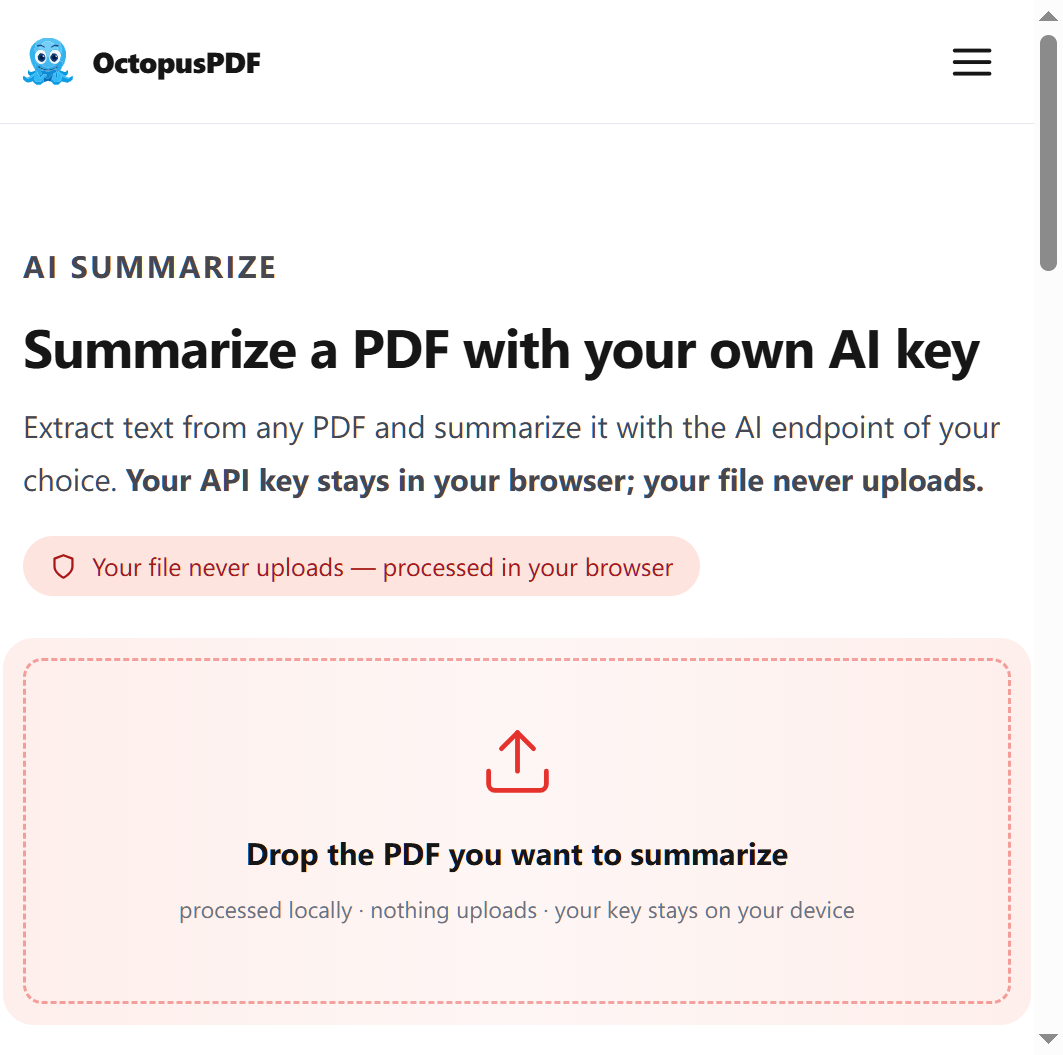
The document is parsed inside the browser tab using pdf.js. [K3] No file transfer to the vendor's server is required to extract text. This eliminates the most common exposure point in traditional AI tools: the moment a file sits on a remote disk.
3.2 The API Key Stays Local
The key is stored only in the browser's localStorage, and the backend has no API call that receives it. [K2][K3] In practical terms, even if the vendor's servers were compromised, there would be no stored key and no receiving endpoint for a key to steal.
3.3 No Server-in-the-Middle
The browser connects directly to the OpenAI-compatible endpoint you entered. [K3] The vendor is not a proxy for the AI request. That means the vendor cannot log your prompts, associate your file content with your key, or route your data through a model provider account other than the one you chose.
These three decisions together create a data path that never touches the vendor's backend. That is the difference between "we promise not to read your files" and "we have no technical mechanism to read your files."
3.4 A Boundary Condition Worth Stating
Local storage is not the same as encrypted storage. localStorage is a browser feature that persists data on your device; it is not a hardened secret manager. Because the key lives in localStorage, you should follow standard practices: use a machine you control, log out of shared devices, and clear browser data when you finish a session. The privacy guarantee is about the vendor not seeing your key, not about protecting your browser from local malware.
4. Cost, Control, and Practical Considerations
4.1 The Subscription Alternative Disappears
For a user with an OpenAI or DeepSeek key, BYOK's value proposition is immediate: unlimited AI features without subscribing. [K1] There is no license tier to upgrade to and no seat count to manage. The user already has access to a model; the tool simply removes friction around using it on PDFs.
4.2 Cost Behavior
The cost-effective nature of BYOK comes from granularity. You pay only your own API usage. [K1] If you summarize ten documents in a month, you pay for ten documents' worth of tokens. If you translate an entire library, your cost rises only with actual consumption. This can be cheaper than a fixed plan for light users and more predictable for heavy users who already manage API spend.
The trade-off is that you take on cost control. You should monitor token usage, set spending limits at your provider, and be aware that different providers have different price structures. The tool does not make your bill disappear; it makes your bill reflect only your own workload.
4.3 Bring Your Own Responsibility
BYOK shifts operational responsibility to the user. You are responsible for:
- Keeping your key secret and rotating it if it is ever exposed.
- Choosing a provider whose API is genuinely OpenAI-compatible.
- Understanding the provider's data-use terms, since your document content will be sent to that provider's endpoint.
- Clearing the key from localStorage if you use a shared or public computer.
None of these are difficult, but they are real. BYOK is not "less security"; it is a different security model, one in which the user is the owner and the vendor is the least-privileged actor.
5. Key Comparison: Traditional AI Tool vs BYOK Tool
| Dimension | Traditional AI SaaS Tool | BYOK-Based Tool (Reference Architecture) |
|---|---|---|
| Document location | Uploaded to vendor's server | Parsed locally in the browser with pdf.js [K3] |
| API key location | Managed by vendor | Stored only in the user's browser localStorage [K2] |
| AI request path | Vendor backend calls the model | Browser connects directly to the user's chosen endpoint [K3] |
| Cost model | Subscription or per-page credits | User pays only their own API usage [K1] |
| Vendor visibility | Sees files and credentials | Designed so the vendor sees neither [K1][K3] |
| User responsibilities | Manage account, trust vendor | Manage key, monitor usage, choose provider |
5.1 A Checklist for Choosing a BYOK Tool
When evaluating any BYOK claim, ask these questions:
- Is the document processed in the browser rather than uploaded? If the vendor's server receives the file, it is not a strict BYOK architecture.
- Can the API key reach the backend? A frontend that sends the key to a vendor endpoint, even for "validation," breaks the local-only guarantee.
- Does the browser connect directly to the model provider, or does the vendor proxy the request? Direct connection is the property that removes the server-in-the-middle. [K3]
- What happens to the key across sessions? Storing it only in localStorage is the stated reference behavior [K2], so confirm what the tool you choose actually does.
6. FAQ
Q1. Which AI providers can I use with BYOK?
Any provider that offers an OpenAI-compatible API. The reference implementation explicitly supports keys from OpenAI, DeepSeek, and other OpenAI-compatible providers. [K1]
Q2. Is my PDF ever uploaded to the service provider?
In the architecture described by OctopusPDF, no. The PDF is parsed inside the browser tab using pdf.js, so the file never uploads to the vendor's backend. [K3] You should verify this property for any specific tool before trusting a marketing claim.
Q3. Where is my API key stored during a session?
In the browser's localStorage, and the backend has no API call that receives it. [K2][K3] This is what makes the "your key stays local" guarantee architectural rather than merely contractual.
Q4. If I already have an API key, do I still need a subscription?
No. Users who already have API keys can use the AI features without subscribing, and they pay only for their own API usage. [K1]
7. Conclusion
BYOK is not a minor pricing feature; it is a different privacy architecture. By keeping the PDF in the browser, storing the API key only in localStorage, and connecting directly to the model provider's endpoint, the vendor removes itself from the data path. [K2][K3][K4] The result is a tool that cannot be coerced into leaking your documents or your credentials, because it never held them in the first place.
The recommendation depends on your situation. If you already have an OpenAI-compatible API key and care about where your files travel, BYOK is the more private and often the more cost-effective option: no subscription, direct provider access, and usage-based pricing. [K1] If you are an occasional user with no existing key and no strong privacy constraints, a conventional subscription tool may be simpler — but you should accept that your files will pass through a vendor's server.
For privacy-maximal users, the direction is clear. Choose tools that process locally, connect directly, and are architecturally unable to see your key. That is what BYOK was designed for, and it remains the clearest expression of the principle that privacy is not a promise — it is a design.