Say Goodbye to Upload Anxiety: How AI PDF Tools Ensure Data Sovereignty
Key Takeaways
- Traditional AI PDF tools typically require uploading files to a third-party server, creating privacy risks for contracts, research, and legal documents. [K1]
- A new class of "Bring Your Own Key" (BYOK) AI PDF tools processes files directly in the browser, ensuring that neither the PDF nor the API key ever leaves the user's device. [K1][K3]
- Data sovereignty is achieved through a three-pillar architecture: local file parsing, local key storage, and direct browser-to-AI-endpoint connections. [K1]
- The AI PDF tool that follows this model eliminates the "server-in-the-middle" attack surface, giving users full control over their data. [K1][K3]
- This approach is ideal for professionals handling confidential material, including lawyers, researchers, and corporate analysts. [K4]
1. Introduction
For years, the standard workflow for summarizing or translating a PDF has involved a simple but concerning step: uploading your file to a cloud server. Whether you are processing a research paper, a legal contract, or an internal strategic memo, the act of "uploading" means your data is no longer fully under your control. It sits on a vendor's server, even if only briefly, and becomes subject to their security policies, potential breaches, or—in the worst case—misuse.
This creates "upload anxiety." It is the gnawing feeling that your most sensitive information is being transmitted over the internet to a machine you don't own, operated by a company you may not fully trust. For professionals dealing with client-attorney privilege, pre-publication research, or trade secrets, this anxiety is not just a discomfort; it is a compliance risk.
The solution emerging from the latest developments in AI PDF tools is a shift toward data sovereignty—the concept that you, the user, maintain absolute ownership and control over your data throughout the entire processing lifecycle. This article explores how modern tools achieve this by processing files locally in the browser and connecting directly to AI services using your own API key, effectively eliminating the need to ever "upload" a document again. We will explain the architecture, the security guarantees, and the practical implications of this shift.
2. The Privacy Problem with Traditional Upload-Based Tools
To understand the value of data sovereignty, we must first define the problem with the status quo. Most AI-powered PDF summarizers and translators operate on a client-server model. Here is how it typically works:
- You visit a website.
- You select a file from your computer.
- The file is transmitted via HTTPS to the company's cloud storage.
- The server extracts the text and sends it to a large language model.
- The result is sent back to you, and the file is eventually deleted.
The Core Conclusion: This model is a black box. While reputable companies will claim to delete files after processing, the user has no technical means to verify this. The data resides outside the user's jurisdiction and control, creating a dependency on the vendor's integrity.
The Reasoning: The risk is not necessarily that the vendor is malicious; it is that the vendor is a target. A centralized server holding thousands of confidential documents is a high-value target for cyberattacks. Furthermore, in a legal context, if your document is on a third-party server, it may be subject to subpoena or legal discovery in a jurisdiction you do not reside in. This model also inherently prevents you from using the tool for documents that contain information you are not allowed to share externally.
Scenario-Based Advice: If you are a paralegal handling a merger agreement, using a standard upload tool means sending the unfinalized agreement through a third-party infrastructure. If you are a medical researcher, it means sending patient trial data to a server that may not comply with specific data residency laws. For these use cases, the "upload" step is often a hard stop.
3. The Alternative Architecture: Local Processing and BYO Key
To solve this, a new AI PDF tool architecture has emerged. It is built on the principle of locality—keep the data where it belongs. The "Summarize PDF" and "Translate PDF" functions in tools like OctopusPDF exemplify this shift. [K2]
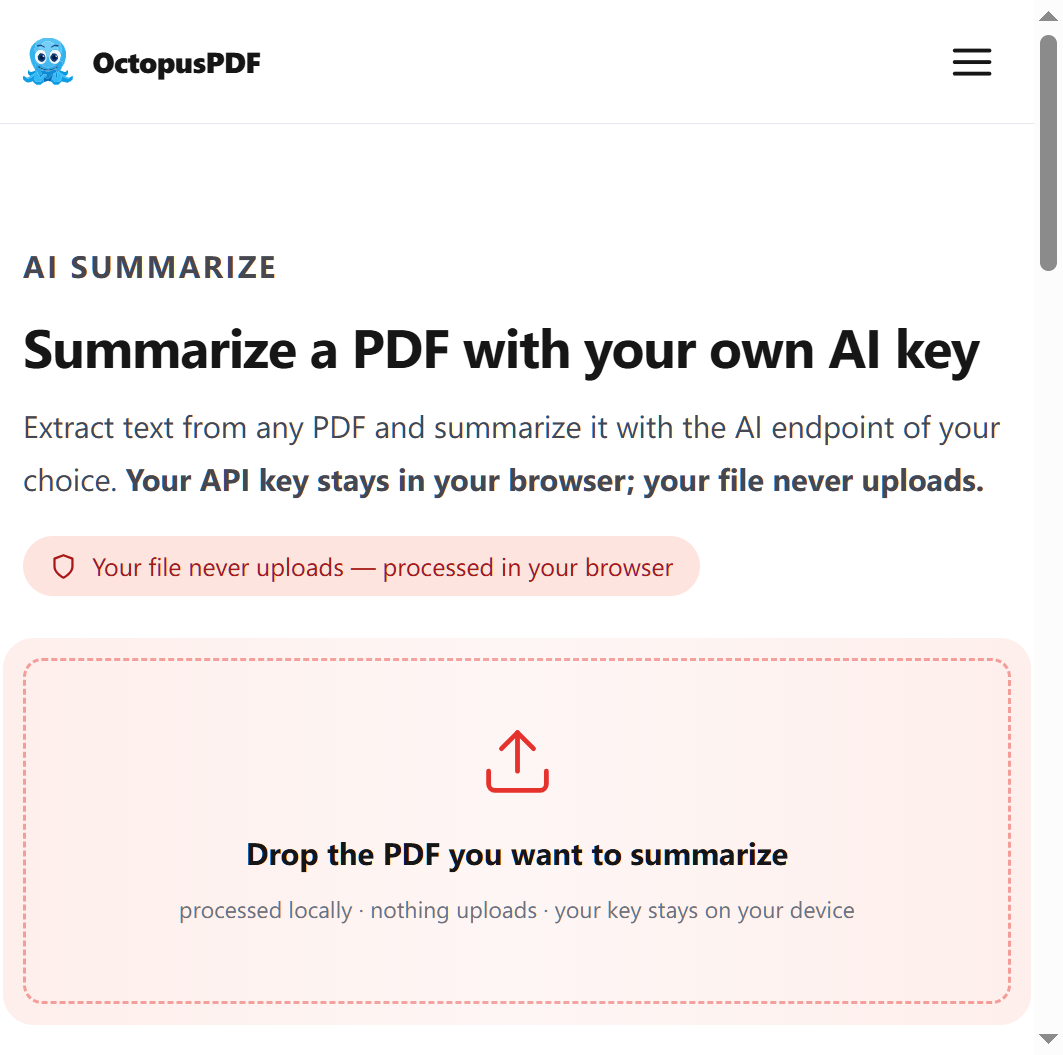
The Core Conclusion: The PDF never uploads, and your key never uploads. This is not a privacy policy promise; it is an architectural reality. [K1][K2]
The Reasoning: This is achieved through a three-step process that eliminates the server-in-the-middle. [K3]
- Step 1: Local Parsing. When you drop a PDF into the browser tab, the file is parsed using a JavaScript library called
pdf.js. This happens entirely in your browser's memory space. The raw bytes of the PDF file are processed to extract text and structure, but they are never transmitted to a remote server. [K3] - Step 2: Local Key Storage. Instead of using the SaaS provider's shared API account, you are instructed to enter your own OpenAI-compatible API key. This key is stored locally in the browser's
localStorage. It is never sent to the tool's backend. In fact, the architecture ensures the backend has no API call that receives it. [K1] - Step 3: Direct Connection. This is the most critical step. Once the text is extracted and you click "Summarize," the browser makes a direct API call to the endpoint you specified (e.g., OpenAI, Anthropic, or a local model server). The browser connects directly to the AI endpoint; the PDF tool's servers do not proxy the request. [K1][K3]
Practical Advice: This architecture means the tool provider is effectively "out of the loop." The provider cannot resell your data, cannot see your AI queries, and cannot be compelled to hand over your files because they never had them in the first place. For IT managers, this is a significant advantage because it removes the vendor as a single point of failure for data leaks. [K1]
4. Technical Trust: Why "Local" Is More Secure Than "Trust Us"
Trust in software should be based on verifiable mechanics, not slogans. The data sovereignty model is superior because it replaces faith-based security with verifiable technical controls.
The Core Conclusion: By keeping the API key in localStorage and connecting the browser directly to the AI endpoint, the attack surface is reduced to the user's own device and the AI provider they chose. [K1]
The Reasoning: Let us analyze the "Trust Us" model versus the "Local" model in a threat analysis.
| Threat Scenario | Traditional Upload Tool | Local Processing (BYO Key) |
|---|---|---|
| Data Breach at Vendor | High Risk. The file resides on the vendor's server. | Zero Risk. The file never touches the vendor's server. [K1] |
| Vendor Data Logging | Possible. The vendor logs your prompts and files. | Not Possible. There is no server-in-the-middle to perform logging. [K1][K2] |
| API Key Theft | Low Risk to User (Key belongs to vendor). | User Responsibility. Key is stored in the browser. If the user's machine is compromised, the key is at risk—but only that key, not the entire PDF corpus. |
| File Retention | Policy Dependent. You must rely on the vendor's deletion log. | Impossible by Design. The file never leaves the browser tab. [K3] |
| Legal Subpoena | The vendor may be forced to provide your files. | The vendor has no files to provide. The request would go to you and your AI provider. |
Practical Advice: This table illustrates a fundamental shift. The user is no longer asking the tool provider for permission or protection; they are asking the tool provider to simply facilitate a connection. This empowerment is the core of data sovereignty.
A Cautionary Note on the "Local" Model: It is crucial to understand what "local" does not mean. It does not mean that the data stays off the internet entirely. The text from your PDF is still sent to the AI endpoint (OpenAI, etc.) that you selected. The data sovereignty is about who controls the process, not about disconnecting from the internet. If you are dealing with top-secret information that cannot leave a specific network, you must configure your BYO key to point to an on-premise or private server. [K3]
5. Use Cases and Practical Considerations
The value of this architecture is most pronounced in specific professional contexts. Based on the capabilities of tools like OctopusPDF, the primary use cases are clear. [K4]
Who Benefits Most from This AI PDF Tool
- Legal Professionals: Translating legal documents without uploading them ensures client confidentiality and avoids waiving attorney-client privilege. [K4]
- Academic Researchers: Summarizing research papers and contracts without the risk of leaking pre-publication findings to third-party servers. [K4]
- Corporate Analysts: Processing confidential material (M&A data, personnel files, internal audits) with AI while maintaining strict compliance. [K4]
The "How It Works" Workflow (Actionable Template)
To maximize the security benefit, users should adopt the following workflow:
- Use a Dedicated Browser Profile: Create a separate browser profile for sensitive work to avoid cross-site tracking.
- Clear LocalStorage After Use: After processing a sensitive document, clear the browser's local storage to remove the API key. This prevents a local thief from using your key. [K3]
- Use a Rotating Key: For high-security environments, use a temporary API key that you revoke immediately after the task is complete.
- Verify the Endpoint: Ensure the "OpenAI-compatible endpoint" you enter is the correct URL for your chosen provider. Double-check that you are not accidentally sending data to a spoofed address. [K3]
6. FAQ
Q1. If the file is processed in the browser, does that mean my computer is doing the heavy AI computation?
No. The file parsing (extracting the words) is done locally in your browser via pdf.js. [K3] However, the intelligence (the summarization or translation) is done by the AI model. Your browser extracts the text, then sends only the text (not the original PDF file) directly to the AI endpoint you configured. [K1]
Q2. What happens if I forget to clear my API key from localStorage? Is it a security risk?
An API key stored in localStorage is a potential risk, but it is a different risk than uploading a PDF. If your laptop is stolen and the browser is unlocked, the thief could use your key to make API calls at your expense. However, the thief would not have access to your original PDF files unless they also have access to your file system. The key is a credential, and like all credentials, it should be stored carefully and rotated regularly. [K1][K3]
Q3. Can OctopusPDF staff see my file if I use this feature?
No. The system is designed so that the OctopusPDF backend is not involved in the processing. The file is parsed in the browser, and the browser connects directly to the AI server. Since the backend has "no API call that receives" your key, and the PDF bytes are never uploaded, there is technically nothing for the staff to see. [K1][K3]
7. Conclusion
Data sovereignty in AI PDF processing is not a far-off ideal; it is a current, practical reality. It is achieved through a deliberate architectural design that prioritizes locality and user control. By processing files in the browser (using pdf.js), storing keys only in localStorage, and connecting directly to AI endpoints, tools like OctopusPDF dismantle the "server-in-the-middle" model that has long caused upload anxiety. [K1][K3]
The result is a workflow where the vendor is a toolmaker, not a data guardian. They build the hammer; you decide what you hit. For professionals, this is the difference between trusting a stranger with your secrets and simply using a better lockbox.
Next Step: If you handle sensitive PDFs, look for tools that explicitly state "File never uploads" and "Key never uploads." [K2] Test the tool with a dummy confidential document first. Review your browser's developer tools (Network tab) to verify that no requests are sent to the tool's server during processing. When you see the traffic going directly to your chosen AI endpoint, you will have verified the architecture yourself, and the anxiety will disappear.