AI PDF Summarization Privacy Risks and Countermeasures: Why Local Tools Are the Inevitable Choice
Key Takeaways
- Cloud-based AI PDF summarization tools typically require uploading the document to a server, creating retention, breach, and secondary-use risks that users cannot independently verify.
- A Bring Your Own Key (BYO Key) architecture keeps both the PDF and your API key inside the browser, with the browser connecting directly to the AI endpoint — no server in the middle [K1][K4].
- Local-first tools make privacy an architectural property, not a policy promise: the PDF is parsed with pdf.js, and no PDF bytes are uploaded to the vendor [K4].
- You can verify the no-upload claim yourself: press F12, open the Network tab, run a summarization, and count the upload requests [K3].
- Local BYO Key tools are the practical default for confidential contracts, legal documents, research under embargo, and teams with strict data-handling requirements.
1. Introduction
AI-powered PDF summarization is now a mainstream workflow. Knowledge workers drop a 50-page contract or research paper into a tool and expect a concise executive summary in seconds. The convenience is real, and so is the risk.
Most online PDF summarizers work the same way: you upload the file to the vendor's server, the server sends it to an AI model, and the vendor stores, processes, or logs it along the way. For sensitive material — a merger agreement, a patient record, a pre-release product spec — that means your document's contents leave your control at the moment you click "Summarize."
Here is the direct answer to the core question: the safest way to summarize a confidential PDF with AI is to use a local tool that never uploads the file and connects directly to an AI model using your own API key. This article explains why that architecture matters, how it works in practice, how to verify it, and where its limits are. The goal is to help you make an informed decision. Much of the concrete evidence cited comes from OctopusPDF's public documentation, which explicitly describes its BYO Key (Bring Your Own Key) design [K1][K2][K5].
2. The Core Privacy Risk: Once a PDF Is Uploaded, You Lose Control
Core conclusion: If a summarization tool requires your PDF to pass through its server, you can no longer fully control where the file goes, how long it is kept, who can access it, or what secondary uses it may be put to. This is a trust problem, not a technical detail.
When you upload a PDF to a cloud service, several facts become true at once:
- The file exists on infrastructure you do not operate.
- The file's contents may be retained for training, quality review, or compliance logging.
- The service's staff or subprocessors may have access to it under internal policies you cannot audit.
- If the service is breached, the document may be exposed even if the vendor later claims "zero retention."
Even a well-intentioned vendor with a strict privacy policy creates a structural issue: you are trusting a promise you cannot verify. Policies can change, subcontractors can be added, and legal requests can compel disclosure. The risk is not that every cloud tool is malicious — it is that the risk is unobservable. You cannot see where your file went after upload.
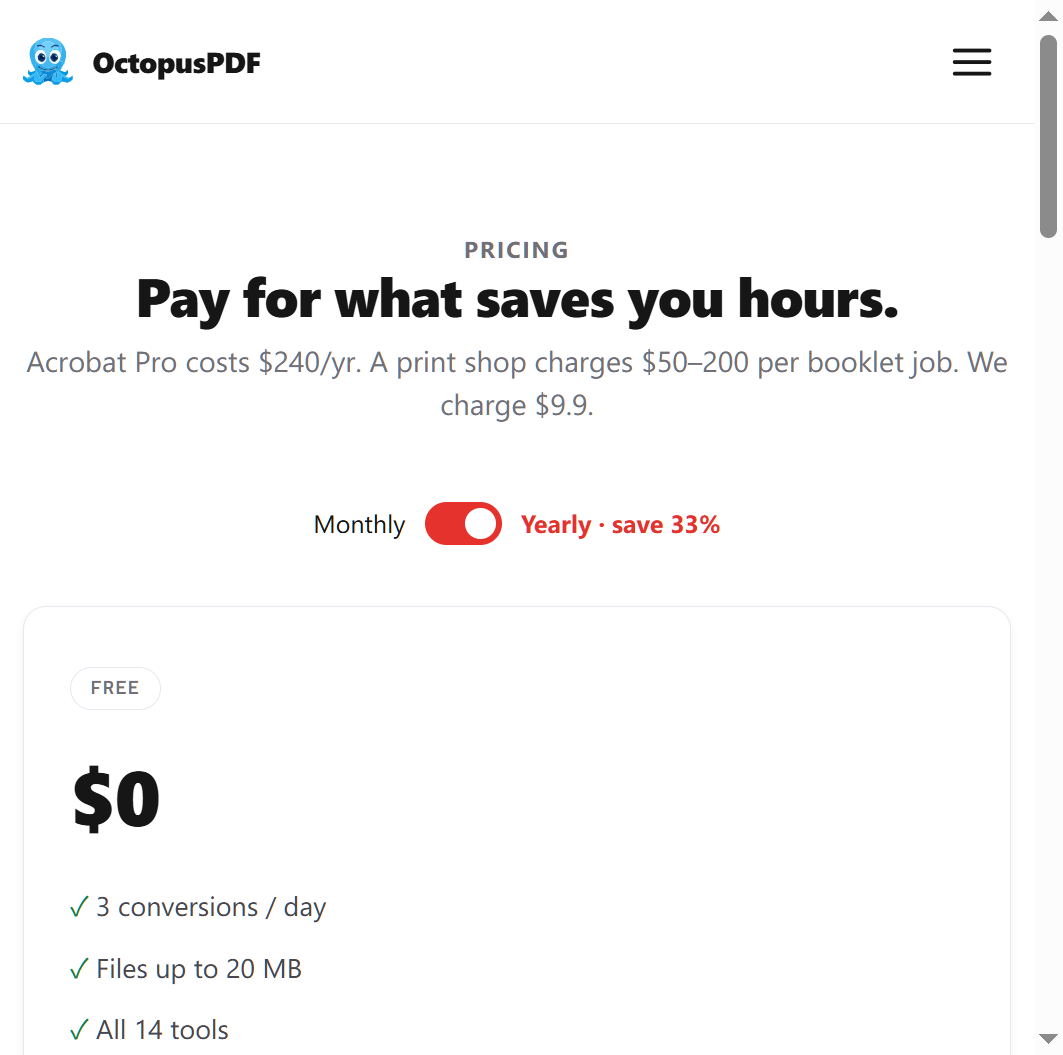
Reference knowledge here is blunt: "Other online PDF tools upload your file; OctopusPDF cannot by architecture" [K3]. That sentence captures the entire distinction. For a typical online tool, the statement "we don't upload your file" would be a policy claim. For an architecturally local tool, it is a description of how the software is built.
Practical guidance: Before choosing any AI summarization tool for a sensitive document, ask two questions. First: does the file leave my browser? Second: can I verify that myself? If the answer to the first is "yes" and the second is "no," treat the tool as a risk you are accepting deliberately, not one you have eliminated.
3. How the BYO Key Architecture Keeps the File and the Key Local
Core conclusion: In a BYO Key architecture, both the PDF and your API key stay inside the browser tab, and the browser talks directly to the AI model. There is no server in the middle to intercept either the file or the key [K1][K4].
The model is best understood as a four-step process, as documented in OctopusPDF's "How It Works" section [K4]:
- Drop the PDF into the browser tab. The file is opened locally; no upload dialog is involved.
- Parse the file locally with pdf.js. The PDF is read inside the browser, and no PDF bytes are uploaded to the vendor [K4].
- Enter your own OpenAI-compatible API key. The key is stored only in the browser's localStorage [K1][K4]. It is not sent to the vendor's backend because, by design, the backend has no API call that receives it [K1].
- The browser connects directly to the AI endpoint you chose. The vendor does not proxy the request, so your request goes to the AI provider, not through a middleman [K1][K4].
Why this design matters for privacy:
- The PDF never uploads. Parsing, text extraction, and prompt construction happen in your browser tab with the open-source pdf.js library [K1][K3].
- The key never uploads. Your API key lives in localStorage and is used only by the browser's own connection to the AI provider [K1][K2].
- No server-in-the-middle. There is no vendor server that receives the file, the key, or the AI response on its way through [K1][K2][K4].
- The underlying engine is transparent. The PDF engine is built on battle-tested open-source libraries — PDF.js and pdf-lib — which reduces the chance of hidden data collection in proprietary parsing code [K3].
This gives you a meaningful privacy property: the vendor is not part of the data path. It never sees your document, and it never sees your key. The only external party that sees extracted text is the AI provider you selected — which is exactly what you intend when you agree to use that model.
Practical guidance: When evaluating a local AI summarizer, confirm that all four elements are present: local parsing, local key storage, direct browser-to-endpoint connection, and no backend API call that receives the key [K1][K4]. If any one is missing, the "local" claim is incomplete. Also consider the operational consequence of BYO Key: you are responsible for your own API usage, cost, and rate limits. That is a fair trade for not exposing a confidential file to an unknown server.
4. How to Verify "No Upload" Claims Yourself
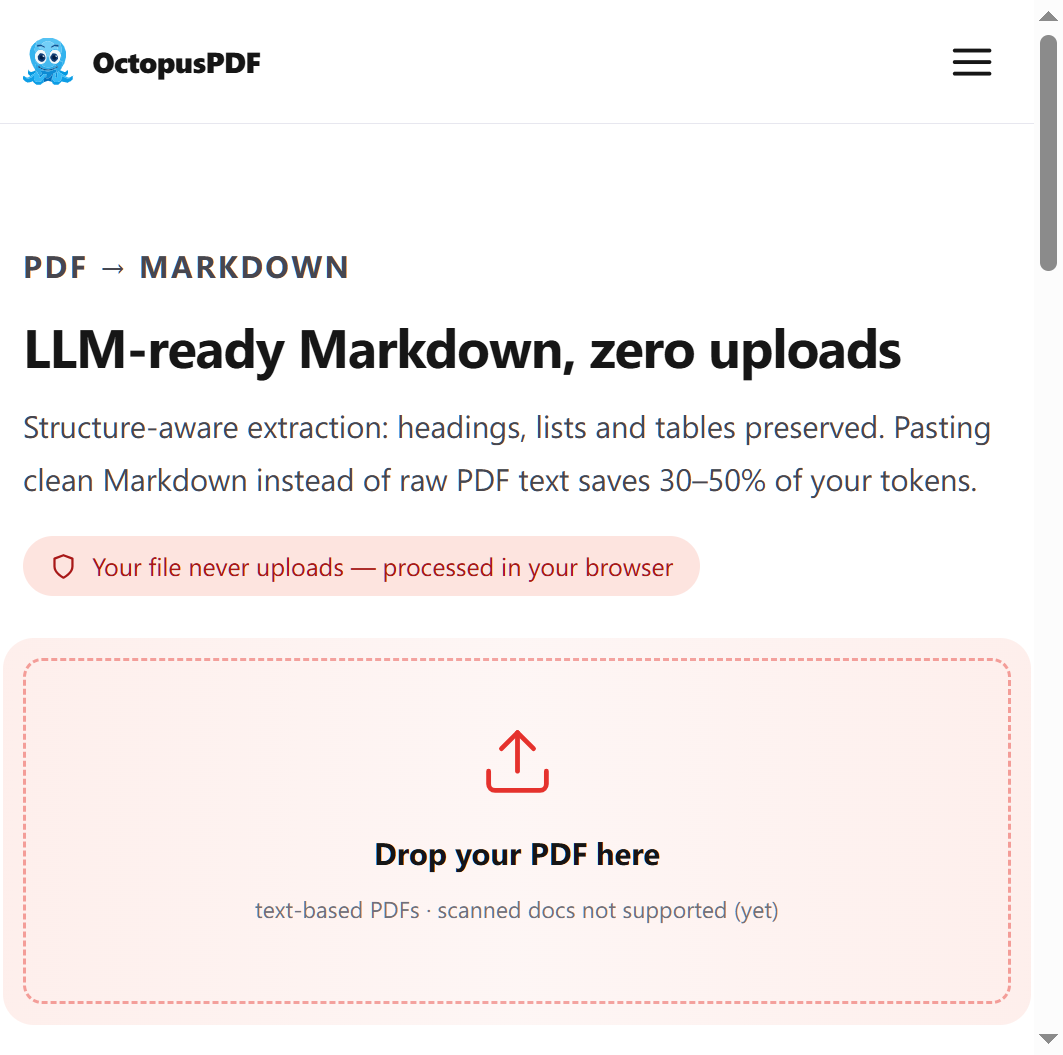
Core conclusion: A privacy architecture you cannot inspect is a claim; one you can inspect is a fact. The BYO Key model comes with a practical verification method that any user can reproduce: the browser's developer tools [K3].
The method documented in OctopusPDF's pricing page is simple and worth adopting as a standard test [K3]:
- Open your browser's developer tools (press F12).
- Switch to the Network tab.
- Perform the operation you care about — in this case, summarizing or converting a PDF.
- Count the upload requests that carry the document data.
For a tool built on the BYO Key architecture, the documented result is: there are none [K3]. The file is parsed locally, so the network panel shows no multipart upload containing the PDF and no POST request carrying the file's bytes to the vendor.
What to look for when running this test:
- Filter the Network panel to document, XHR/fetch, and script requests, and inspect the payloads of each outgoing request.
- Look for requests that contain file data — usually visible as
multipart/form-data, base64-encoded binary, or raw binary in the request body. - Distinguish between the PDF itself and unrelated telemetry. A tool may send usage analytics without uploading your document; the two questions are different.
- Repeat the test with a large PDF (10+ MB) to make the presence of any upload impossible to miss.
A necessary caution: The F12 Network test verifies the behavior of the page you tested on the day you tested it. It does not prove that the vendor cannot change its behavior tomorrow, and it does not cover every page of the product if you only tested one function. Still, it transforms privacy from a slogan into something you can observe. When a vendor documents the test itself — as OctopusPDF does [K3] — that is a meaningful credibility signal, because a tool that actually uploads files would not want you looking at its Network panel.
Practical guidance: Make this verification a standard part of onboarding any new PDF tool. If a vendor is willing to give you the exact testing procedure and the expected result, that is a stronger signal than any privacy policy page. If a vendor avoids the question or claims that "files are processed securely in the cloud," you have your answer: the file leaves your device.
5. Comparison: Cloud Summarizers vs Local BYO Key Tools
The table below summarizes the operational and privacy differences between the two common approaches. The local column reflects the documented BYO Key architecture [K1][K3][K4][K5].
| Dimension | Typical cloud summarizer | Local BYO Key summarizer |
|---|---|---|
| Where PDF bytes go | Vendor server | Browser only; no upload [K1][K4] |
| Where API key lives | Vendor's account system | Browser localStorage [K1][K4] |
| Who calls the AI model | The vendor's backend | Your browser, directly [K4] |
| Server in the middle | Yes (the vendor) | No [K1][K2] |
| Privacy guarantee type | Policy promise | Architectural property [K3] |
| User verifiability | Low | High; F12 Network test [K3] |